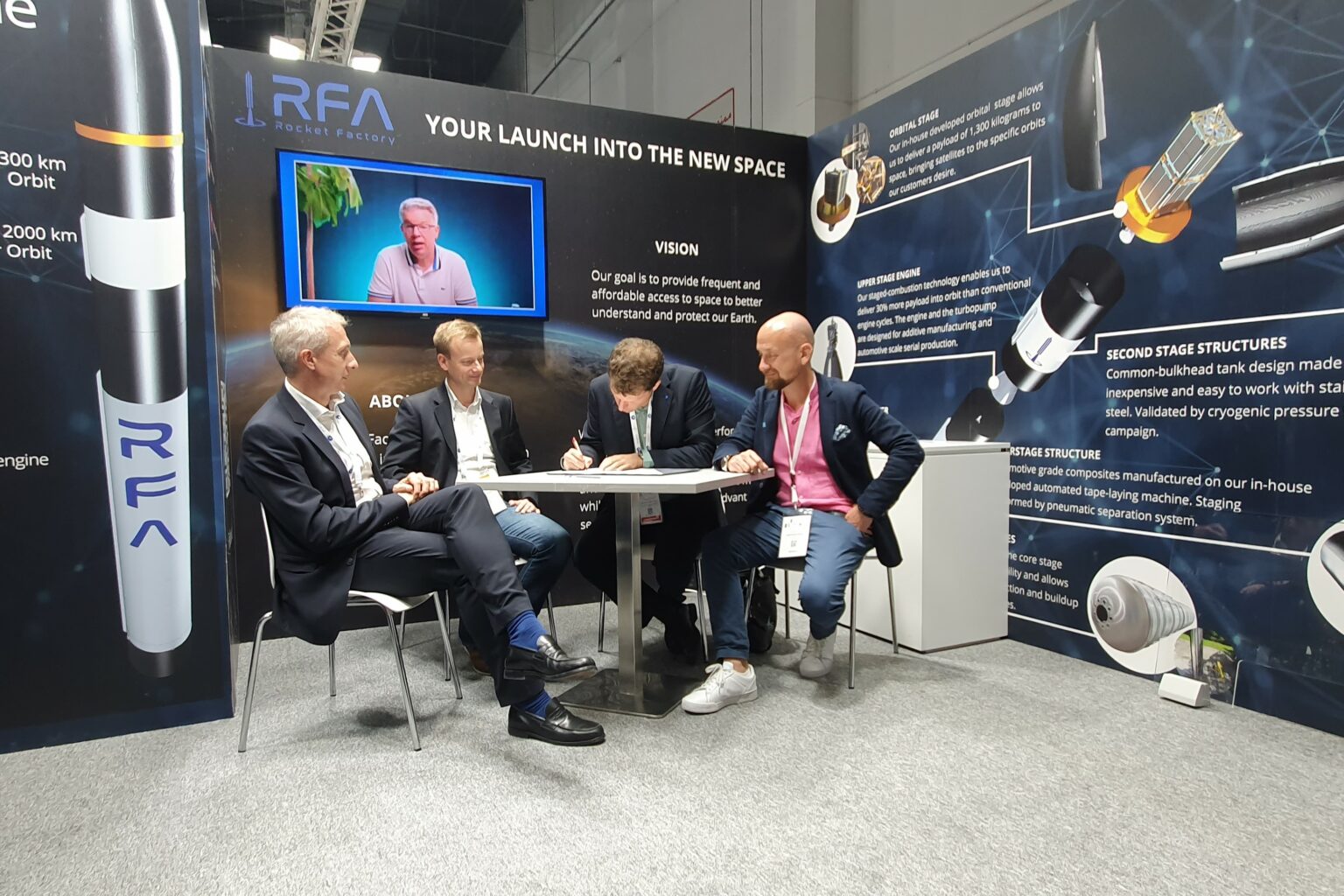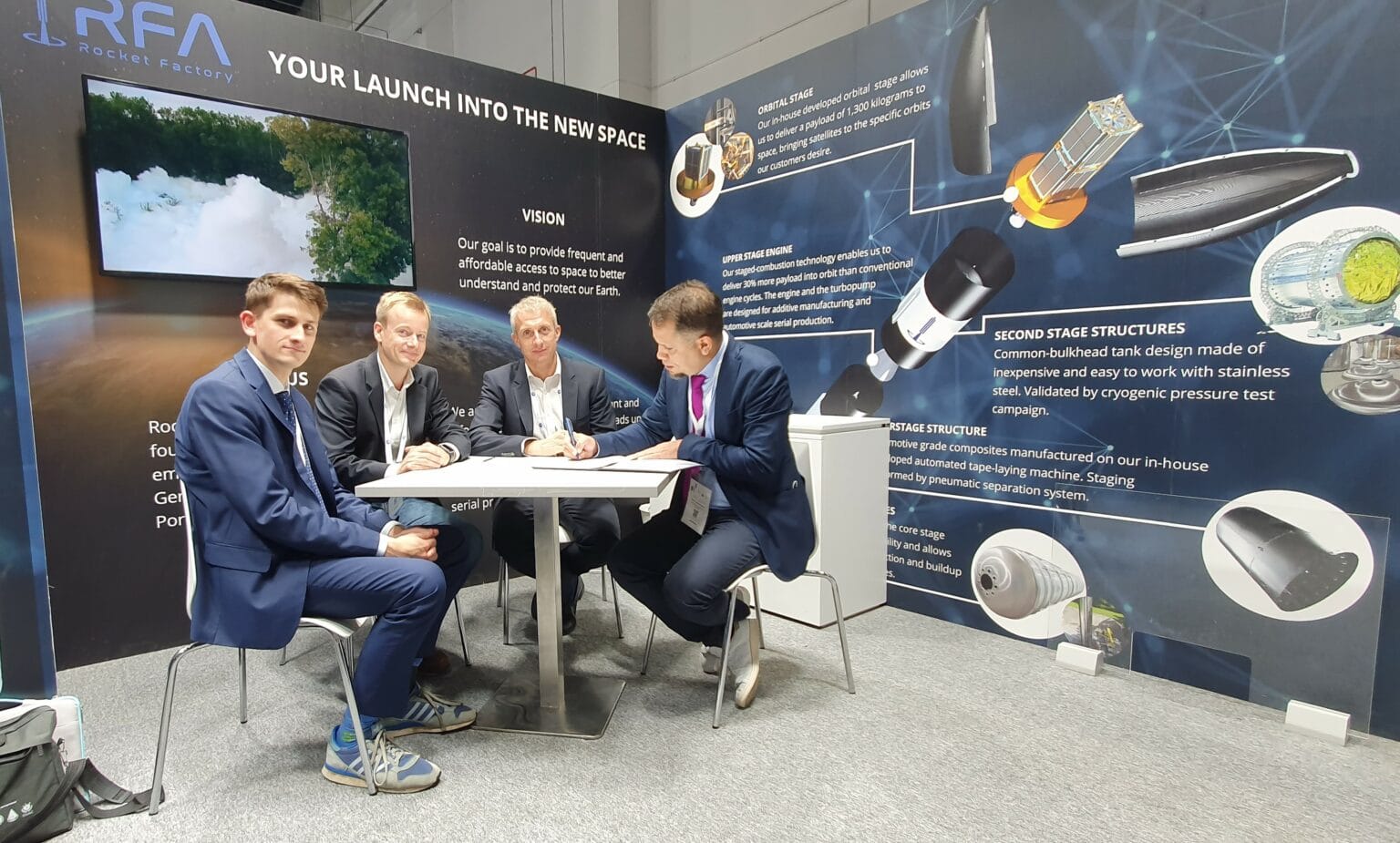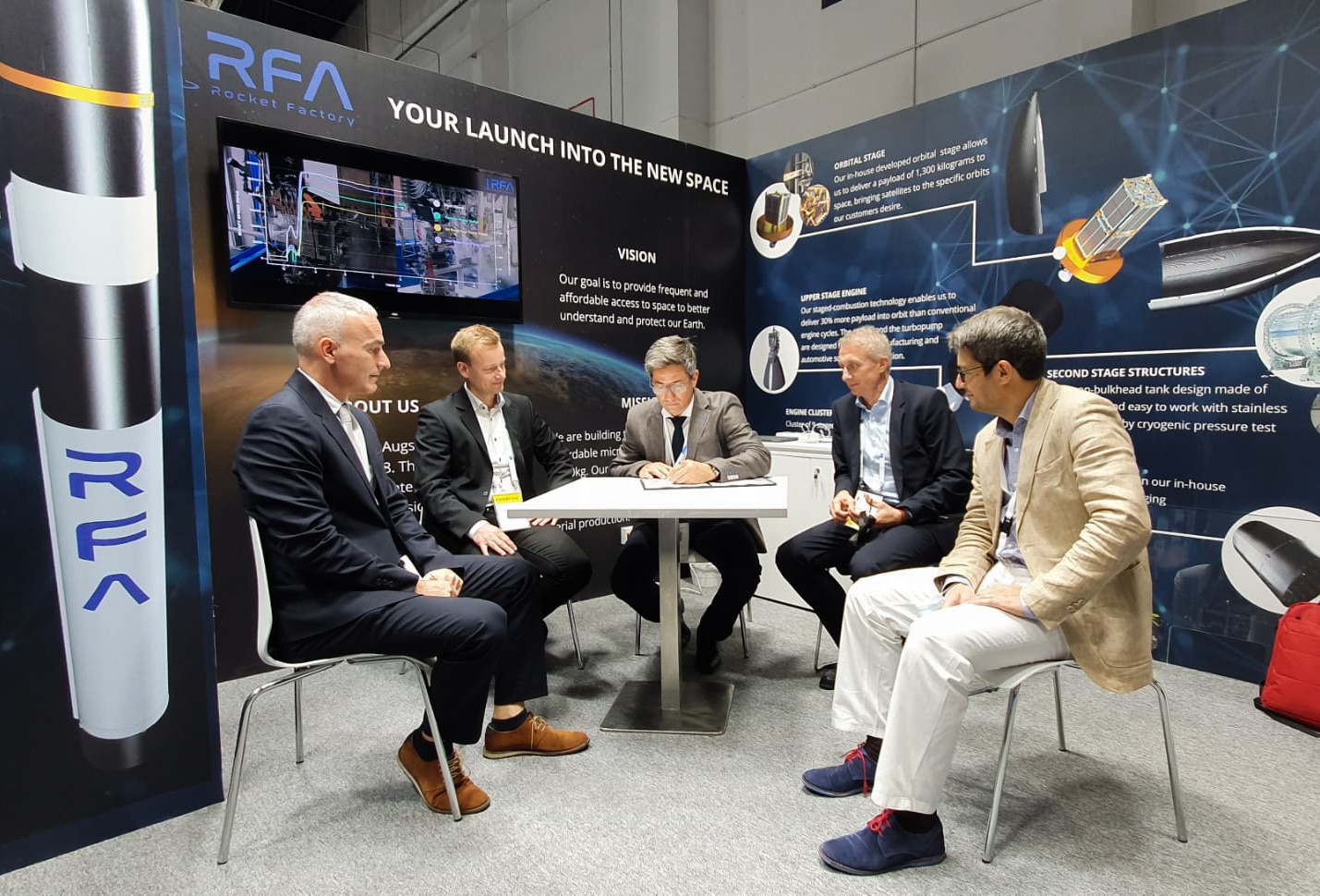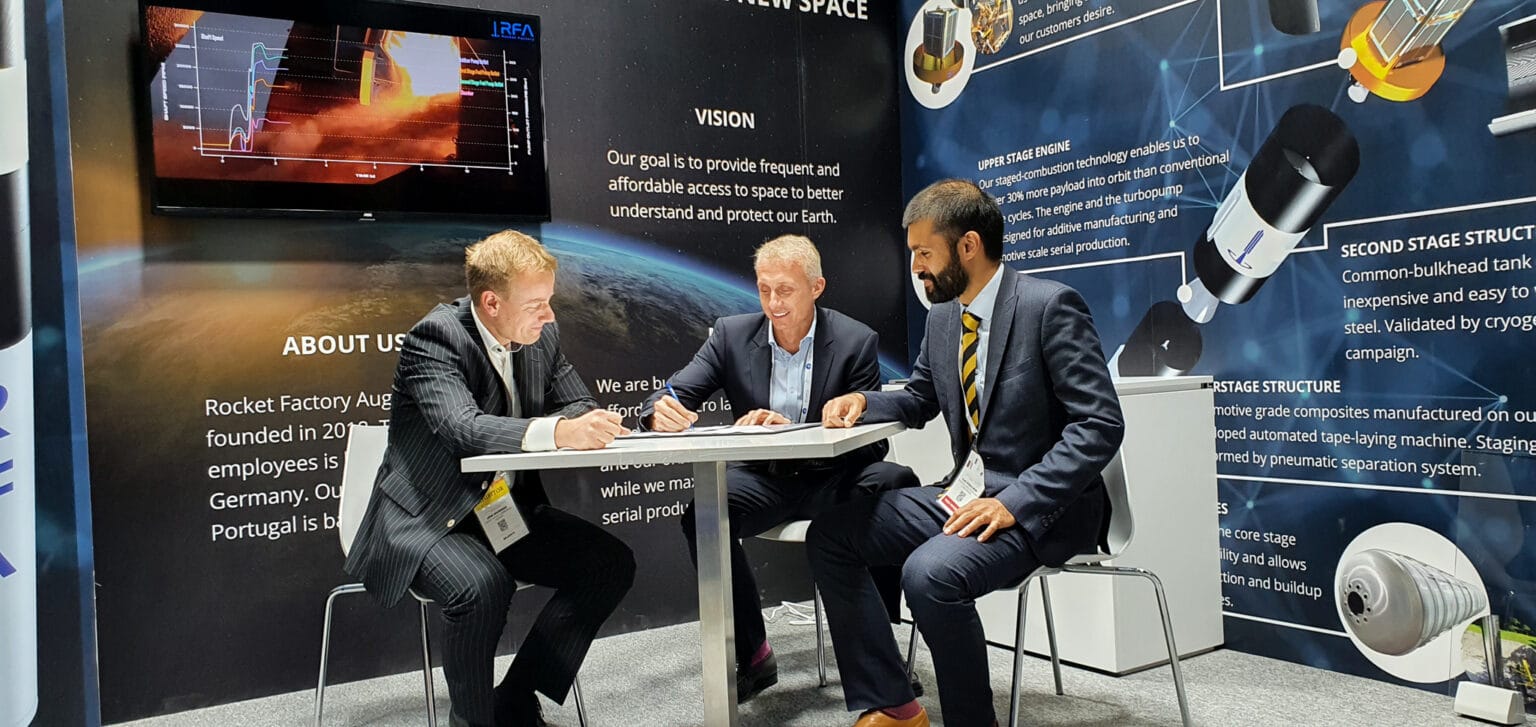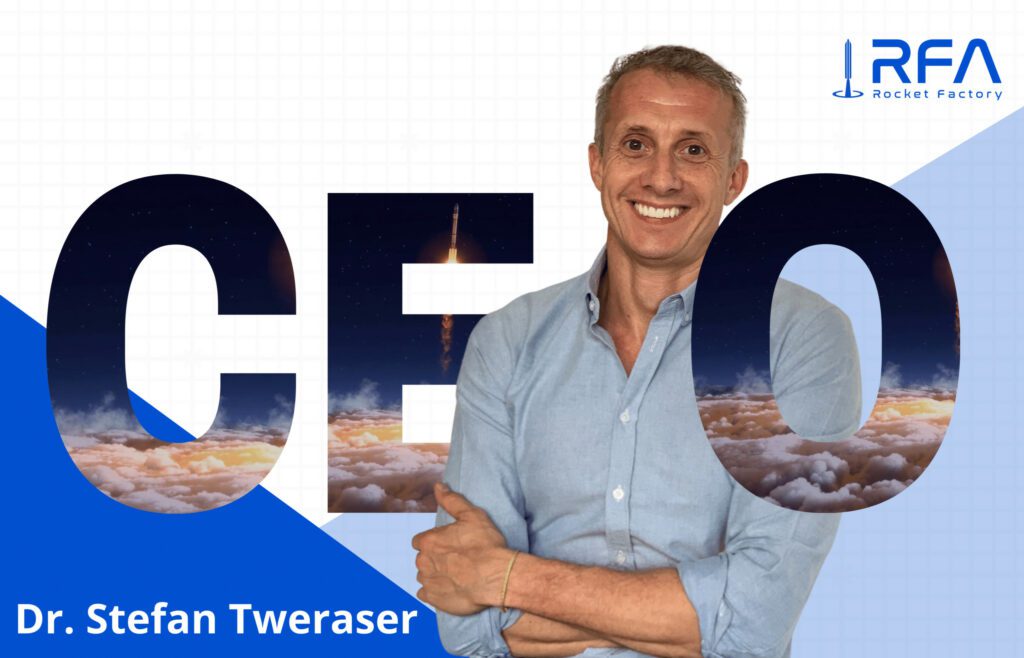























Indulis Kalnins becomes new CEO at RFA 

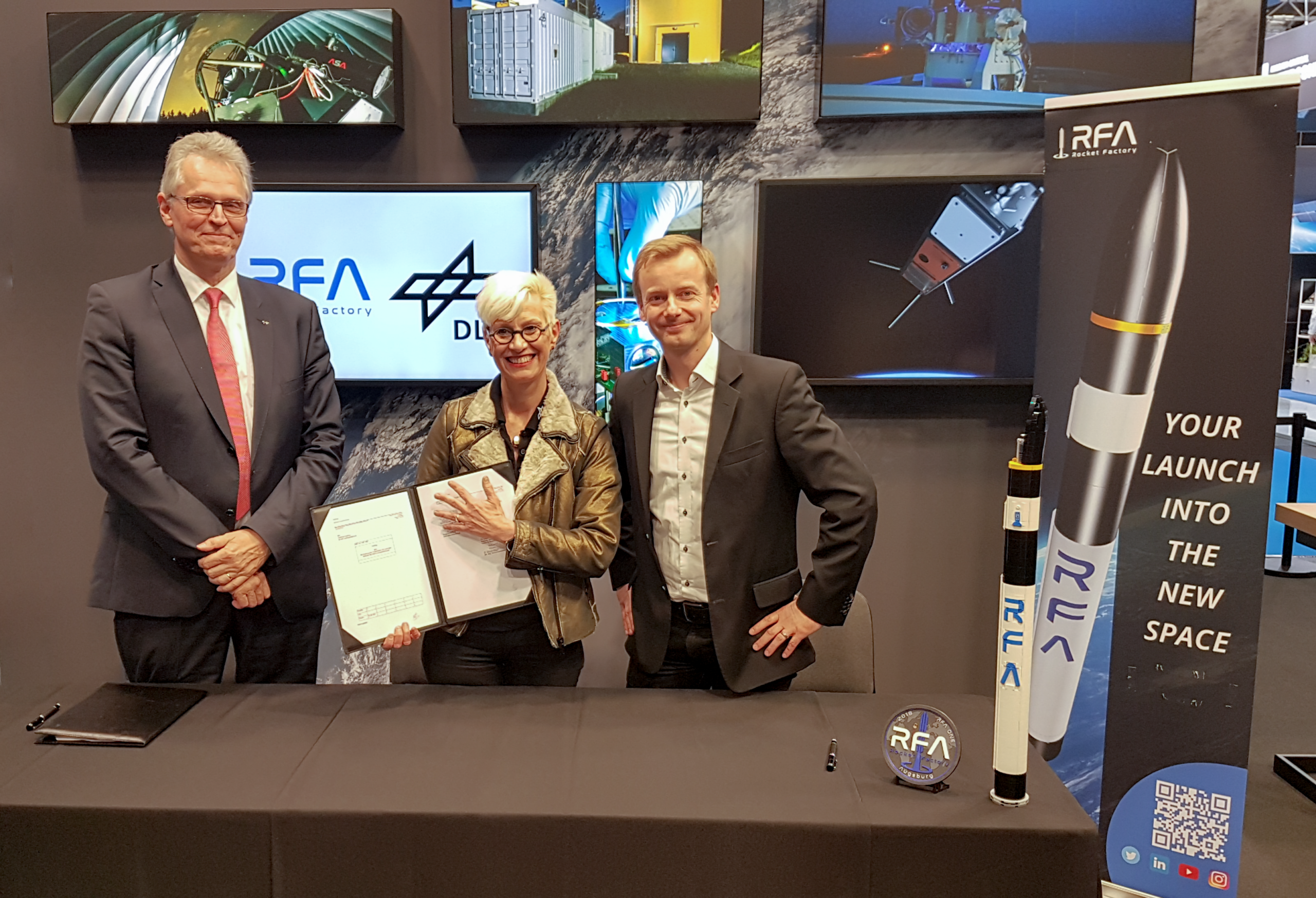
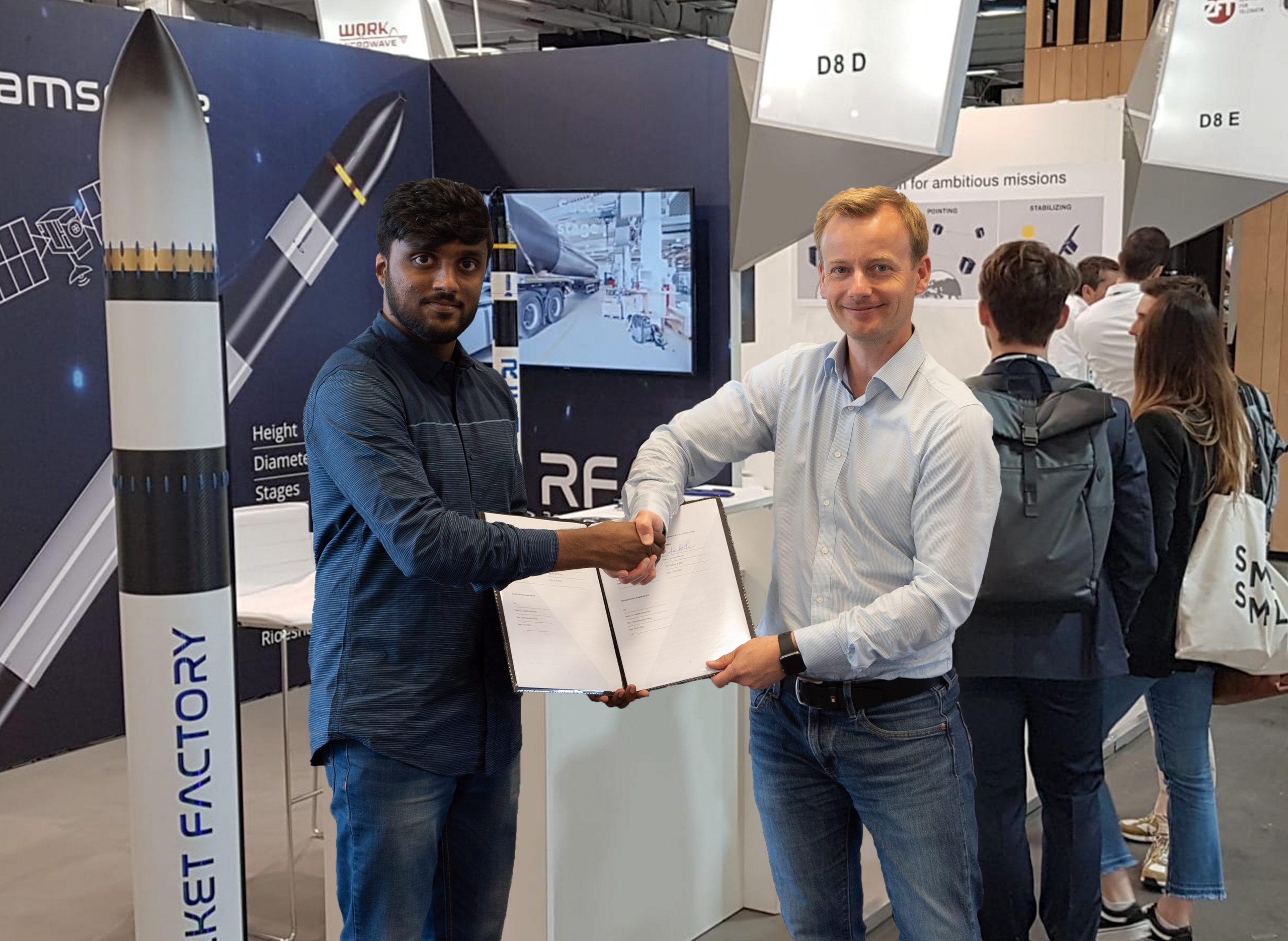
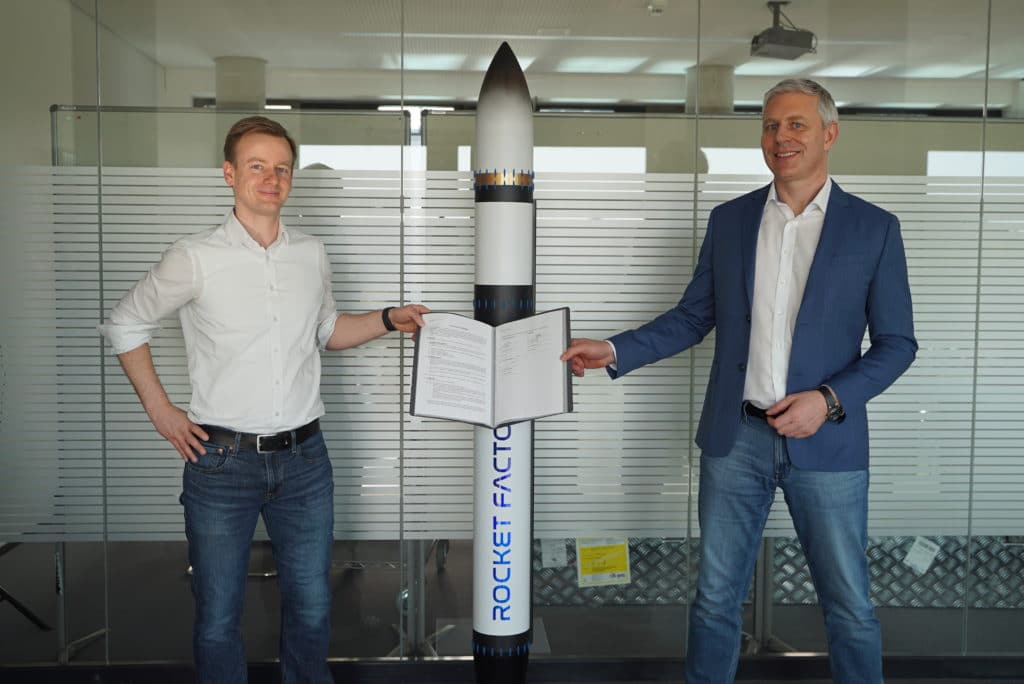
Augsburg, Germany, 11th April 2025 – The supervisory board of Rocket Factory Augsburg has appointed Prof. Dr. Indulis Kalnins as the new chairman of the company’s management board. Prof. Dr. Kalnins succeeds Dr. Stefan Tweraser. 

With Prof. Dr. Kalnins comes an experienced space engineer to the company who will lead the way to the first launch of RFA ONE. Together with the RFA team he will focus entirely on the successful initial test flight of the rocket: „I have known RFA since it was founded almost seven years ago and have always followed its progress with great interest. I have been working with RFA for some time now, so I know that I have a great, motivated, and technically excellent team that is eager to get off to a successful launch as quickly as possible “, says Indulis Kalnins. Kalnins has a wide range of expertise and a large network thanks to his various professional positions in both education and in the space industry. 

Jean-Jacques Dordain, chairman of the supervisory board at RFA, explains: „We would like to thank Dr. Stefan Tweraser for his commitment and his time at RFA. For the tasks that now lie ahead, we are focusing on technical progress and the path to the launchpad. With the wide range of skills that Dr. Kalnins brings to a highly motivated team, we believe that RFA is well on its way to continuing to prepare for the first launch attempt as the priority to get access to the market of launch services. “ 

„We must focus all our energy on the technology and the first launch,“ adds Marco Fuchs, chairman of the board at OHB. „I am very pleased that we have been able to appoint a recognized expert for RFA in Kalnins. I have known Dr. Kalnins for almost 30 years and therefore know about his exceptional expertise “, continues Fuchs. 

Board members Dr. Stefan Brieschenk (Chief Operating Officer) and Jörn Spurmann (Chief Commercial Officer) have only recently extended their appointments to the executive board and will remain in their current positions on RFA’s executive board.  


+++ END +++  

About Rocket Factory

Rocket Factory Augsburg was founded in 2018 with the vision to enable data generating business models in space to better monitor, protect and connect our planet Earth. Against this background, the company’s goal is to offer launch services of up to 1.300kg into low Earth orbits and beyond on a weekly basis at highly competitive prices. With this, RFA wants to democratize access to space and reduce the launch costs in the space industry. The RFA ONE launch service combines three key competitive advantages: A customer focused service with precise in-orbit delivery and a high degree of mission flexibility through its Redshift OTV; at a highly competitive price; made possible by superior staged combustion technology, low-cost stainless steel structures and usage of industrial components.

For more information, please visit: www.rfa.space

Follow us also on our social media channels:


Press Contact: 

Mr. Jonas Kellner 

Phone: +49 821 999576-21  

Email: jonas.kellner@rfa.space 


Rocket Factory Augsburg AG 

Berliner Allee 65 

86153 Augsburg 

Germany 


Chairman of the Supervisory Board: Jean-Jacques Dordain 

Board of Directors: Indulis Kalnins, Stefan Brieschenk, Jörn Spurmann 

Seat of the company: Augsburg 

Registry Court: AG Augsburg, HRB 34251 

USt-ID/Tax-ID: DE319402838 

Interested in featuring us?

RFA receives launch licence from the UK

First licence for vertical orbital launches from European mainland

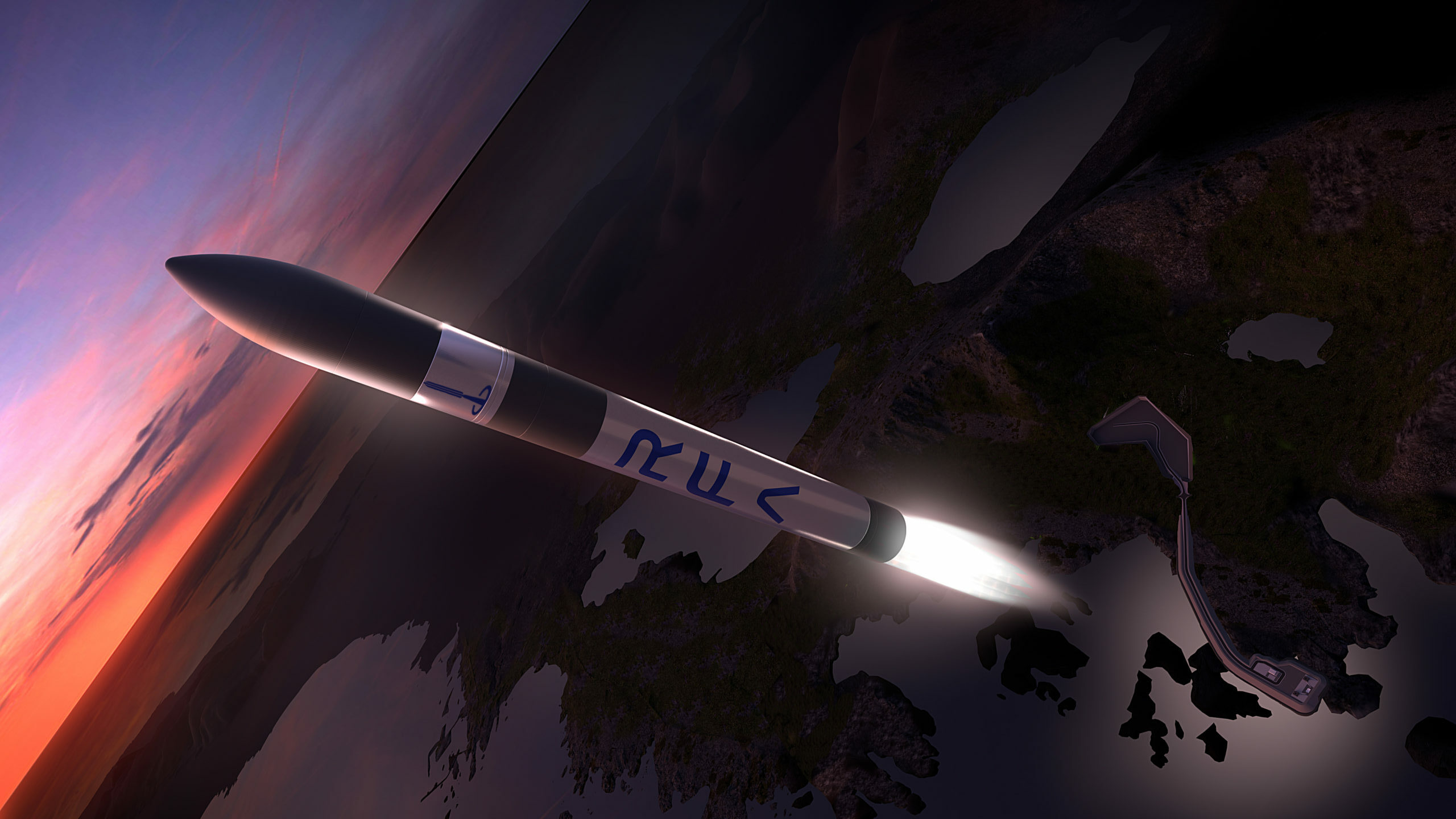
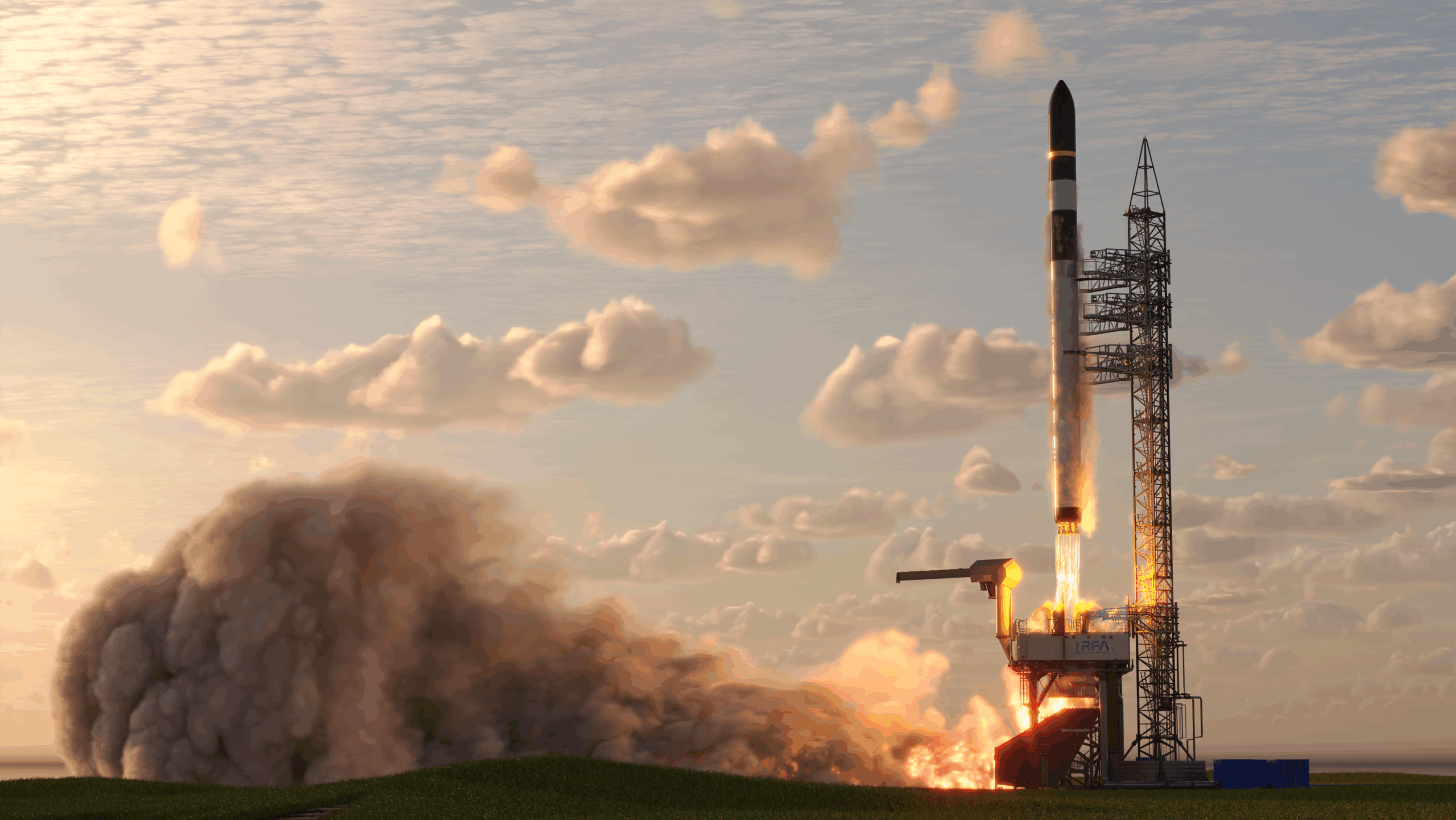
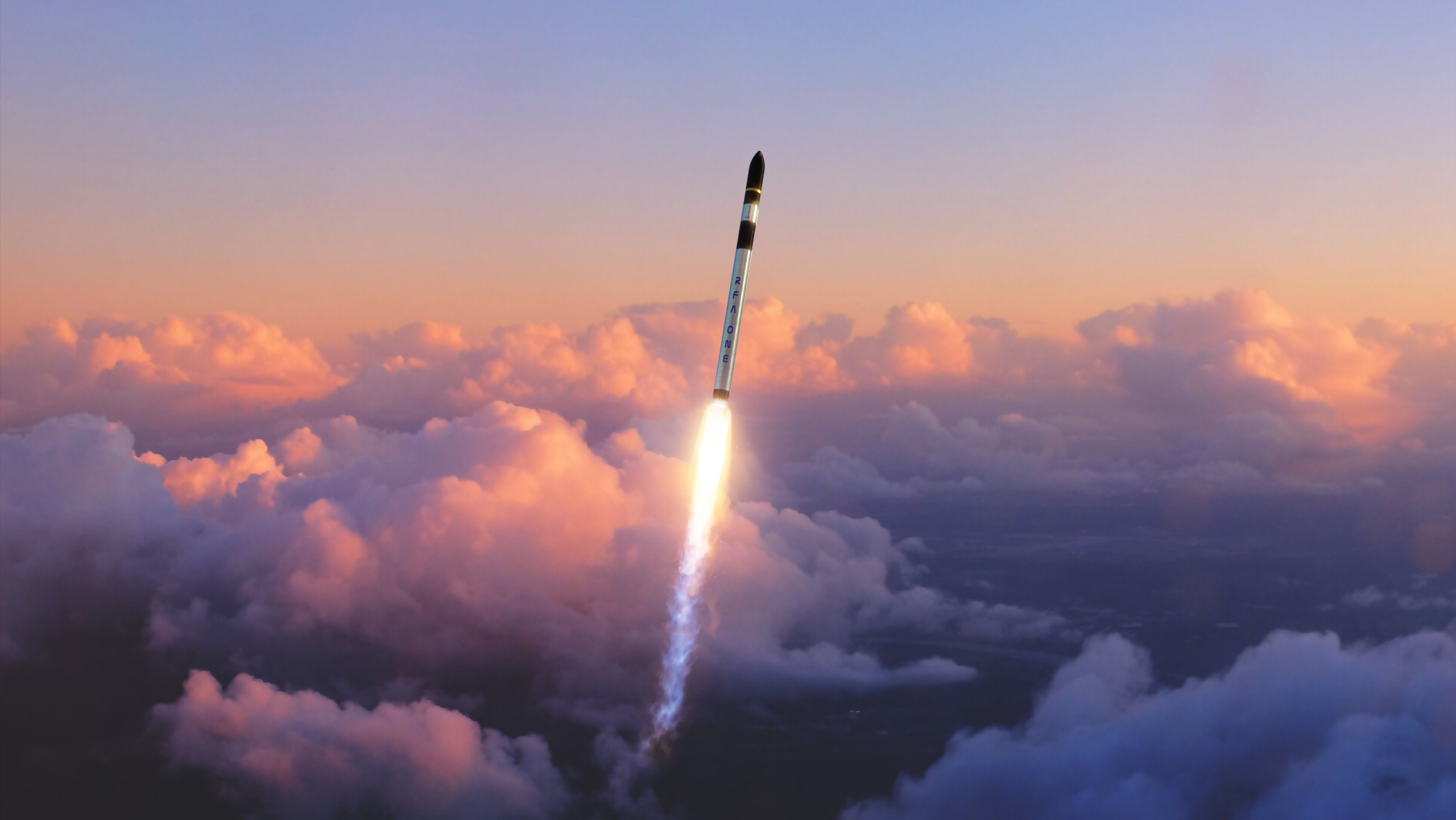
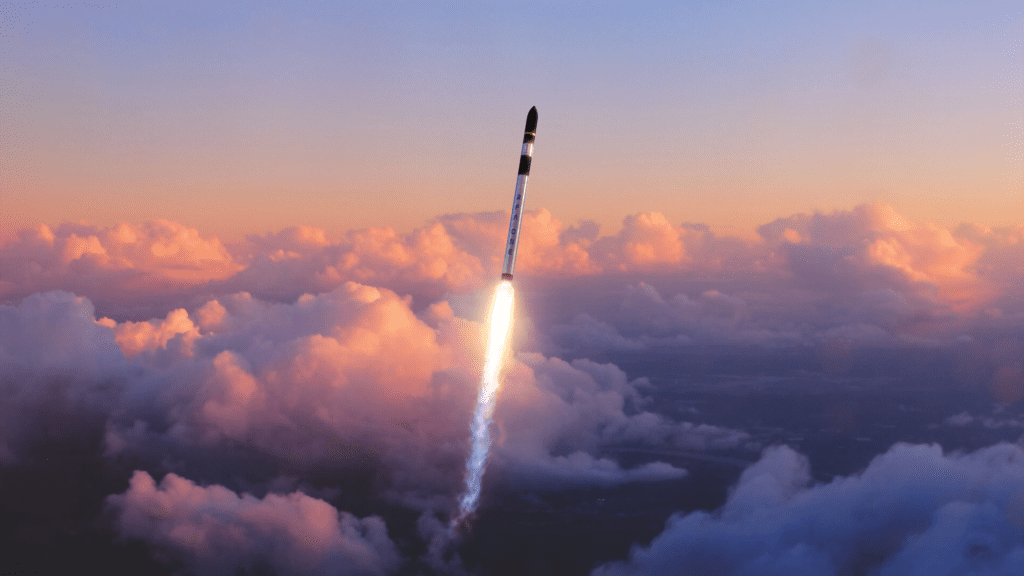
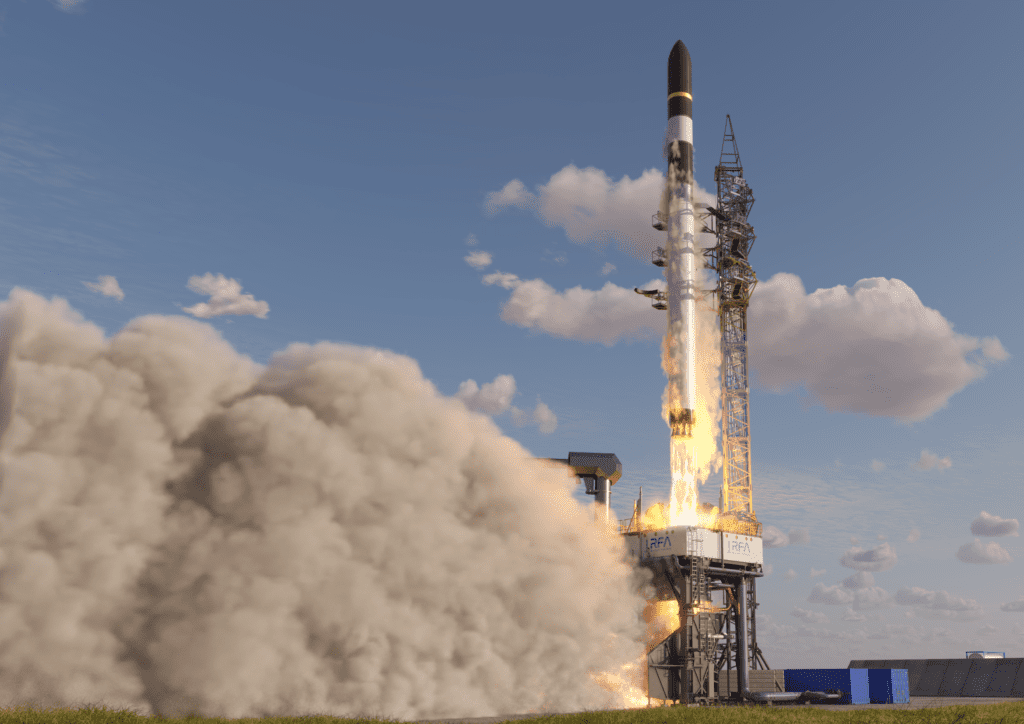
RFA ONE launches from SaxaVord Spaceport in Scotland in a beautiful sunset scenery

Augsburg, Germany – January 16th, 2025. Rocket Factory Augsburg (RFA), a European leader in developing flexible and low-cost launch services, proudly announces that it has officially received its spaceflight operator licence from the UK Civil Aviation Authority (CAA). In combination with the spaceport licence and the range control licence from SaxaVord Spaceport, all three critical regulatory licences required for a test flight in 2025 from Scotland are therefore granted.

The spaceflight operator licence, also called launch licence, is of historic significance: RFA is the first company in Europe to receive such a licence for vertical launches of a privately developed orbital rocket. With this, RFA now has regulatory approval from the United Kingdom´s Civil Aviation Authority (CAA) to launch into space from Scotland. The licence is not limited in time and covers a wide range of orbits and trajectories. It validates RFA’s commitment to meeting stringent safety and operational standards, reinforcing the company’s readiness to execute its first test flight in 2025. Obtaining this historic approval demonstrates the trust that the CAA and UK have in RFA’s technology, team and philosophy.


With this regulatory green light in place, RFA is now shifting its focus to the final technical preparations for the first test flight. The company has already completed major development milestones, including the successful flight qualification of the RFA ONE’s second stage, its advanced Redshift orbital transfer vehicle (OTV), and its payload fairing system. The remaining efforts are centred on building the rocket´s first stage with nine Helix staged-combustion engines, and conducting a full hot fire test on the launch pad at SaxaVord Spaceport, Scotland.

“This is a groundbreaking moment for RFA and for Europe’s space industry,” said Jörn Spurmann, Co-founder and Chief Commercial Officer of RFA. “Securing the first-ever launch licence outside ESA’s established site in Kourou is not just a regulatory milestone – it’s a powerful endorsement of our technical excellence and a turning point for European space innovation. This license marks Europe’s bold step toward independent, competitive, and sustainable space access. By enabling cost-effective and flexible launches from European main land, we are laying the foundation for a new era of space exploration and commercialization, ensuring Europe remains at the forefront of the global space race. Together with the CAA and our partners, we are driving the future of accessible and reliable spaceflight, unlocking opportunities that will shape industries and inspire generations.”

Rob Bishton, CEO of the UK Civil Aviation Authority, said: “This is a new era for aerospace and granting the first vertical launch licence from UK soil builds towards a historic milestone for the nation. This licence is the culmination of extensive hard work behind the scenes to put appropriate safety and environmental measures in place before launch. Through effective licensing and regulation we are enabling the expanding space sector to reach new heights.”

Matt Archer, UK Space Agency Director of Launch, ISAM, and Space Sustainability said: “This licence approval is a landmark moment, as it signals the start of vertical rocket launches from European soil. The achievement, driven by effective collaboration between RFA, SaxaVord Spaceport, the regulator and government partners, highlights the growing strength of the UK’s launch capabilities and our international relationships. What’s more, ambitious companies like RFA are creating high-skilled jobs, catalysing investment, and inspiring the next generation to see their future in space.”

As Europe strives for greater autonomy and flexibility in space access, the RFA spaceflight operator license highlights the importance of developing privately driven, innovative solutions to meet the rapidly growing demand for satellite launches. The upcoming test flight of RFA ONE will position RFA as a key player in Europe’s spaceflight ambitions, providing a reliable and affordable launch service for small satellites, right from European mainland.

+++END+++

About Rocket Factory

Rocket Factory Augsburg was founded in 2018 with the vision to enable data generating business models in space to better monitor, protect and connect our planet Earth. Against this background, the company’s goal is to offer launch services of up to 1.300kg into low Earth orbits and beyond on a weekly basis at highly competitive prices. With this, RFA wants to democratize access to space and reduce the launch costs in the space industry. The RFA ONE launch service combines three key competitive advantages: A customer focused service with precise in-orbit delivery and a high degree of mission flexibility through its Redshift OTV; at a highly competitive price; made possible by superior staged combustion technology, low-cost stainless steel structures and usage of industrial components.

Media Contact RFA:

Mr. Jonas Kellner

Telefon +49 821 999576-21

Email: jonas.kellner@rfa.space

Rocket Factory Augsburg AG

Berliner Allee 65

86153 Augsburg

Germany

Chairman of the Supervisory Board: Jean-Jacques Dordain

Board of Directors: Stefan Tweraser, Stefan Brieschenk, Jörn Spurmann

Seat of the company: Augsburg

Registry Court: AG Augsburg, HRB 34251

USt-ID/Tax ID: DE319402838

Interested in featuring us?

RFA ONE: The Most Comprehensive Guide to Our Launch Vehicle

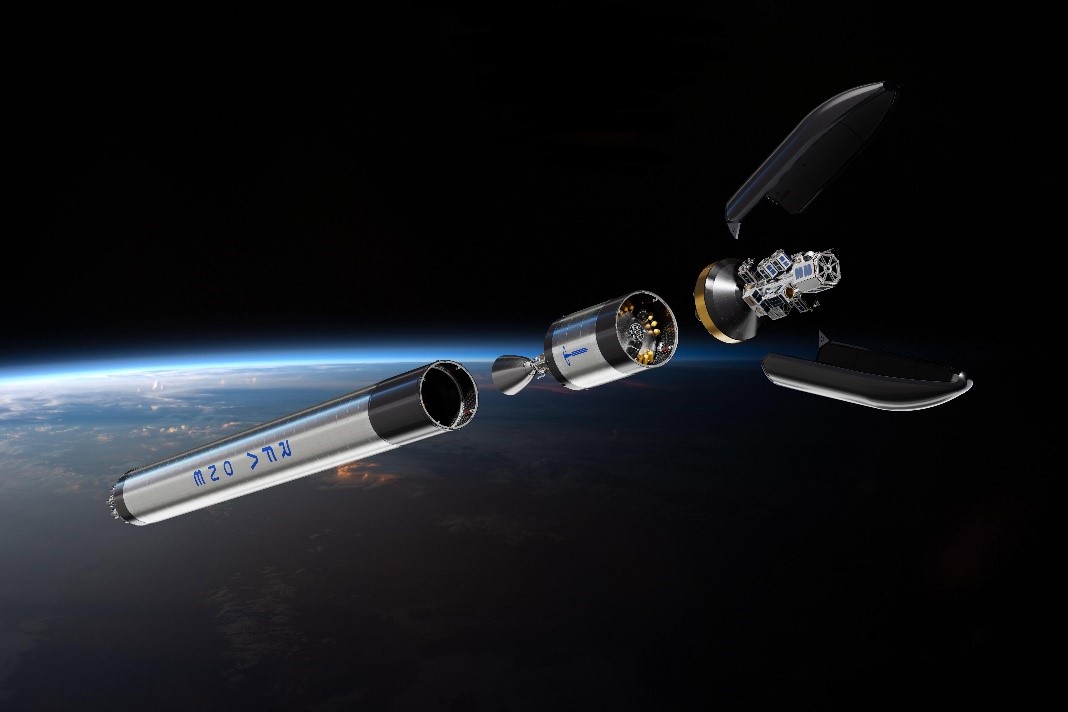
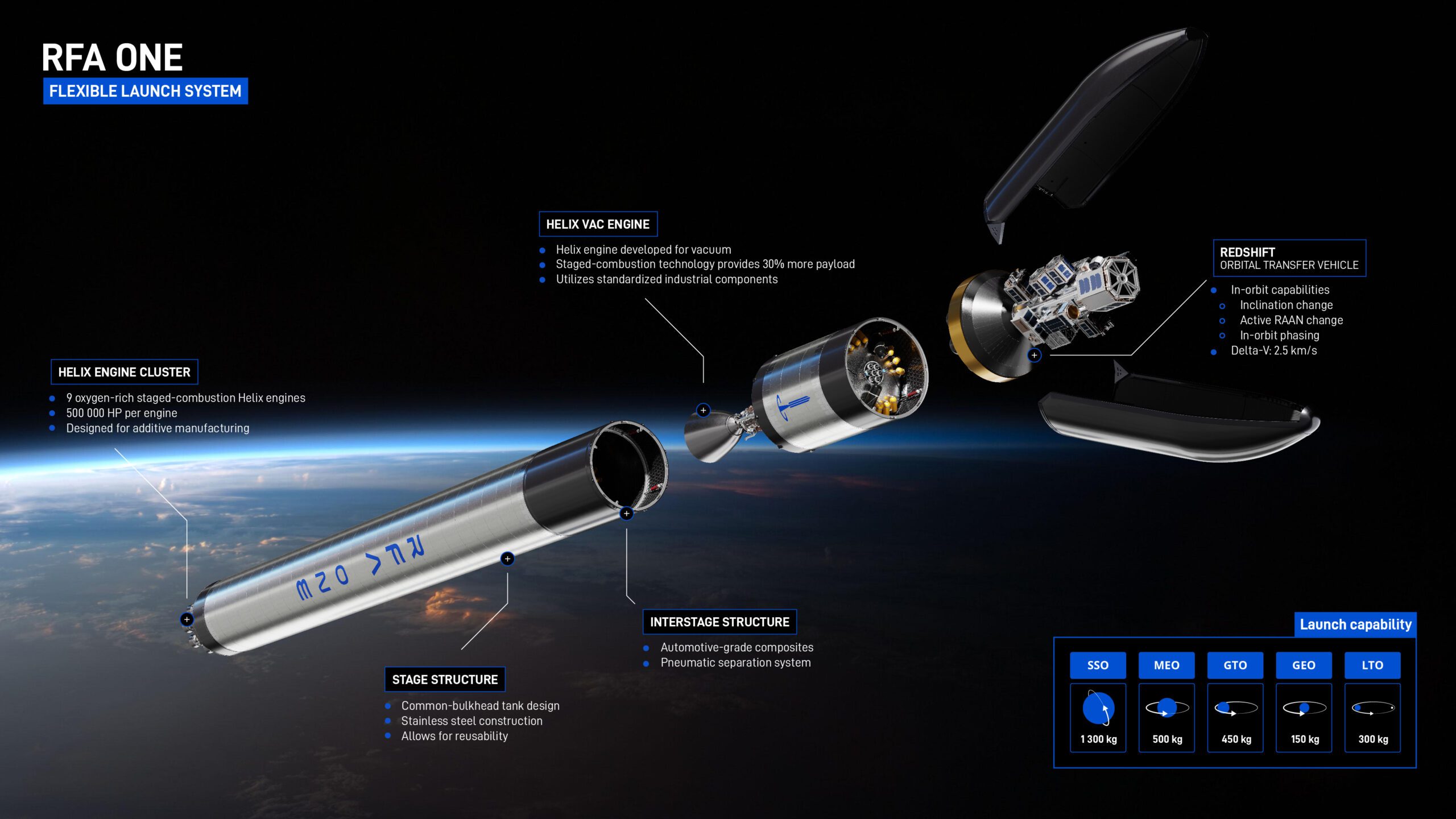
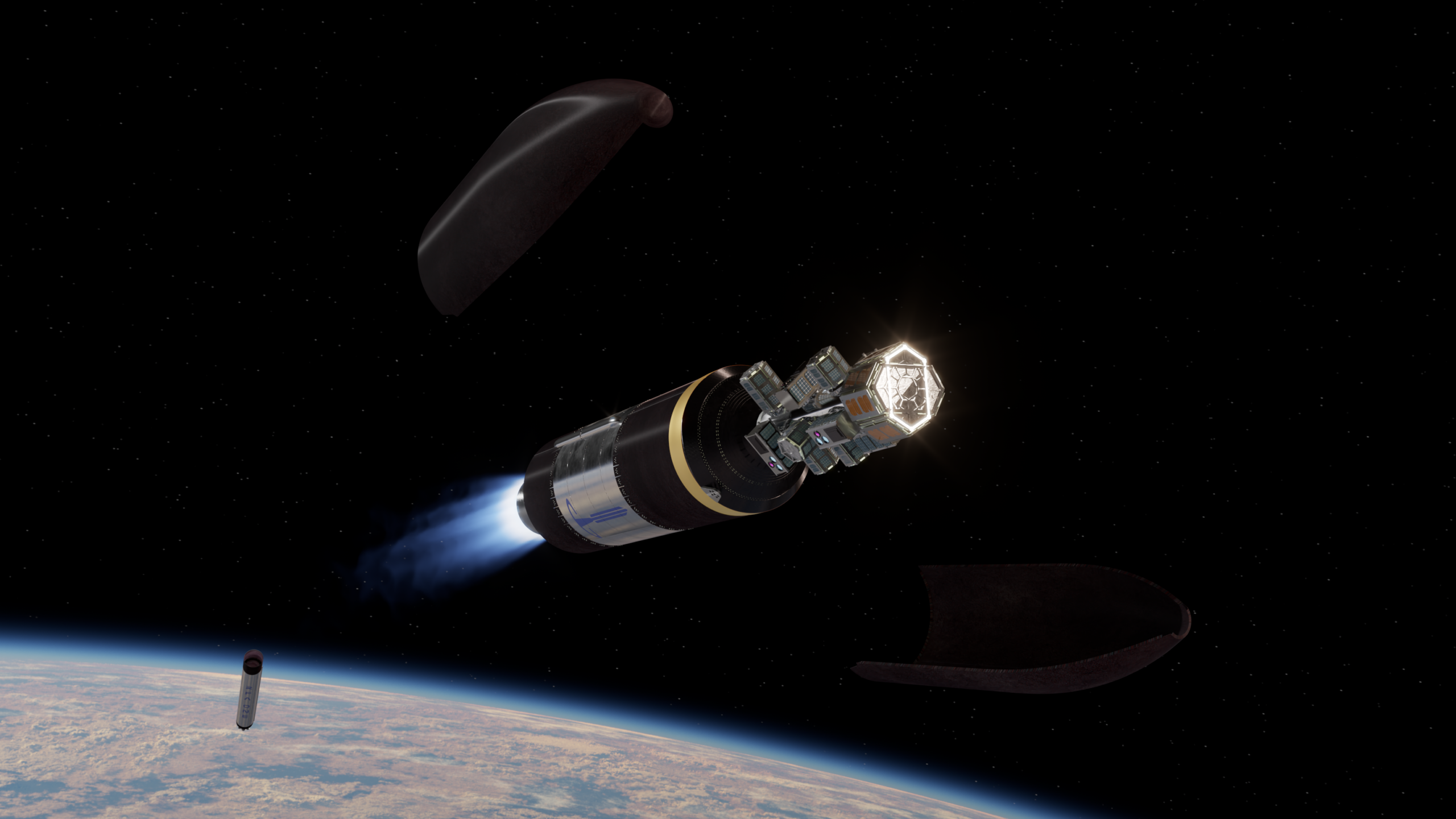
3D render of an exploded RFA ONE vehicle to show all 3 stages and elements.

We’ve got one mission at Rocket Factory Augsburg: to provide cost-effective, flexible, and frequent access to space.

At the heart of this mission is our RFA ONE launch vehicle. With three stages, innovative engine designs and a – for this rocket class – above-average payload capacity, it is built for maximum efficiency and performance.

Our previous blog post about our stage zero launch pad was a huge success so we thought we would share a deep dive look into the vehicle itself.

Diagram of RFA ONE vehicle with text information on each stage and major system.

RFA ONE – Stage 1

The first stage of RFA ONE is designed with the sole purpose of getting the rocket off the ground and propelling our payloads through the thicker atmosphere with maximum efficiency. It’s the main workhorse of the rocket.

Stage Structure and Durability

RFA ONE’s first stage is a common-bulkhead tank design made from stainless steel, making it durable, reusable and able to withstand the intense forces of liftoff and atmospheric pressure.


Stainless steel might seem like an odd choice when the standard material for rocket structures are aerospace-grade carbon fiber or aluminum. But we don’t do things the standard way, do we? 😉


Our goal when sourcing materials was to learn what would work best in term of costs, simplicity and reusability. The solution? Beer tanks. We leverage the high-quality manufacturing skills and extensive experience of the beverage industry and order pre-welded storage tanks. Then we conduct all necessary testing and qualification in-house.


Additionally, we use a specific alloy that gains increased stiffness when filled with cryogenic fuels. This allows us to make the tank walls thinner (currently 1mm), saving valuable mass without compromising on strength. Stainless steel beer tanks are also super cheap, lending them to our low-cost approach. Furthermore, they already have the structural strength required for rocketry and are suited for serial production and reusability. What’s more, we can easily pop out any dents in minutes (literally).

Helix Engine Cluster – Why 9 Engines?

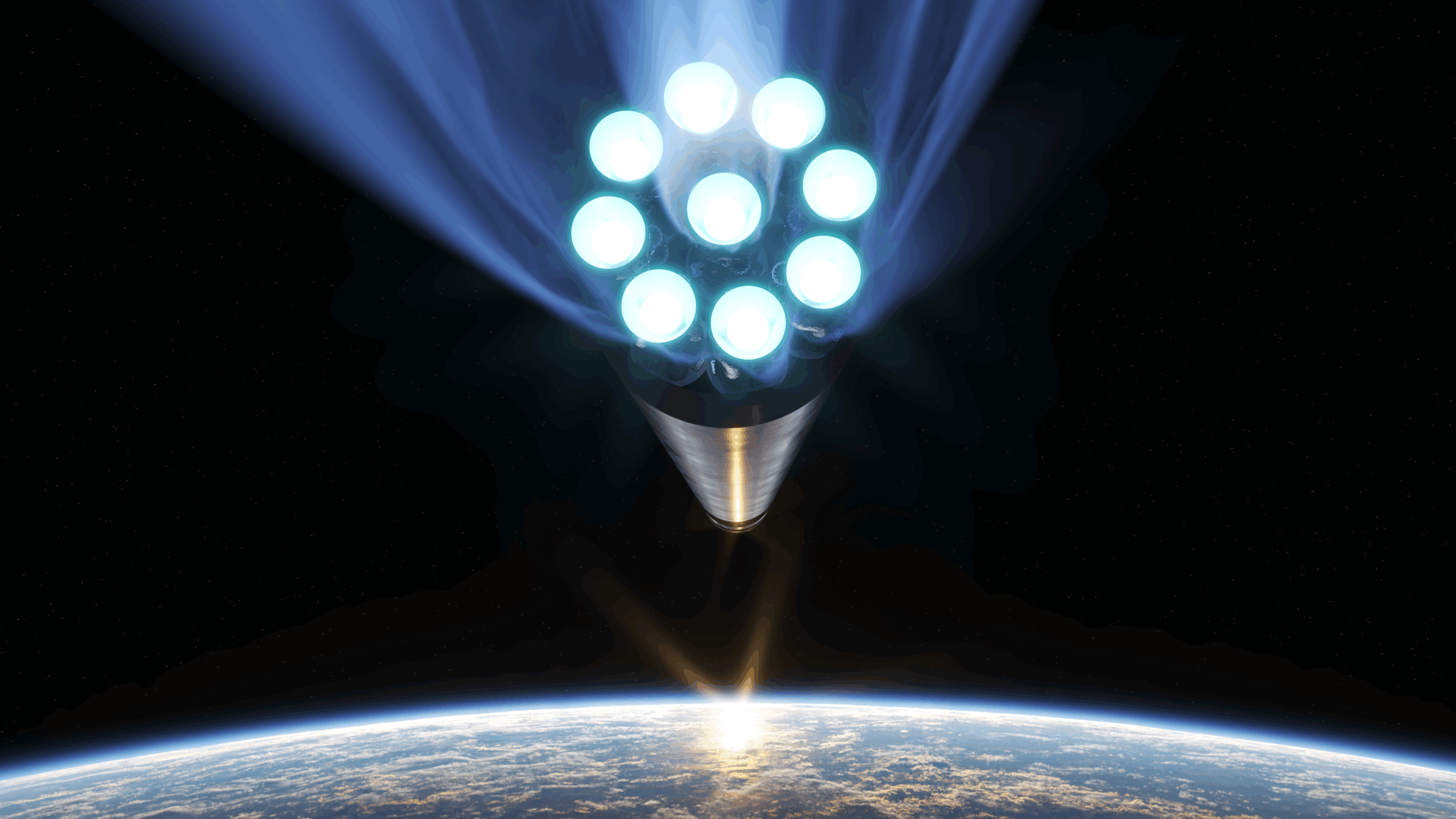
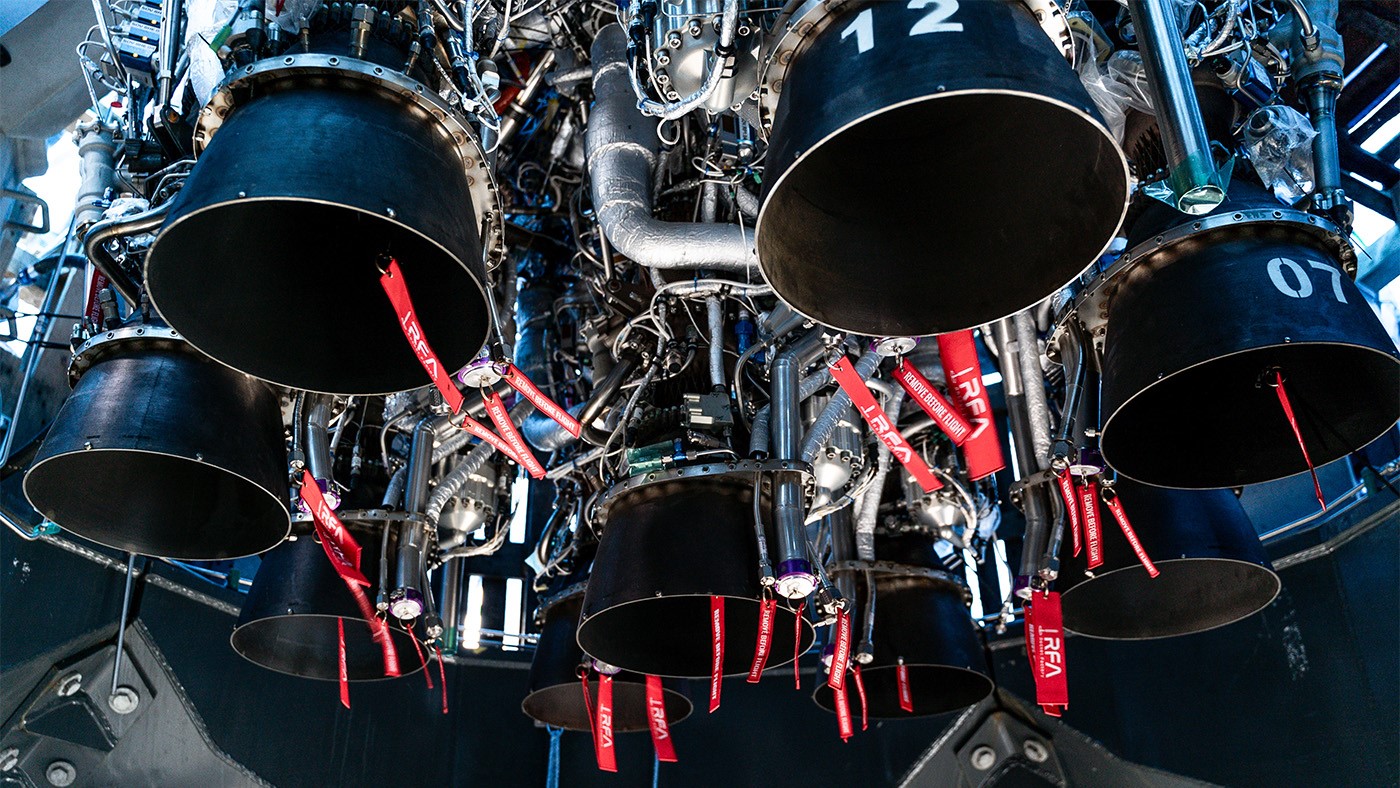
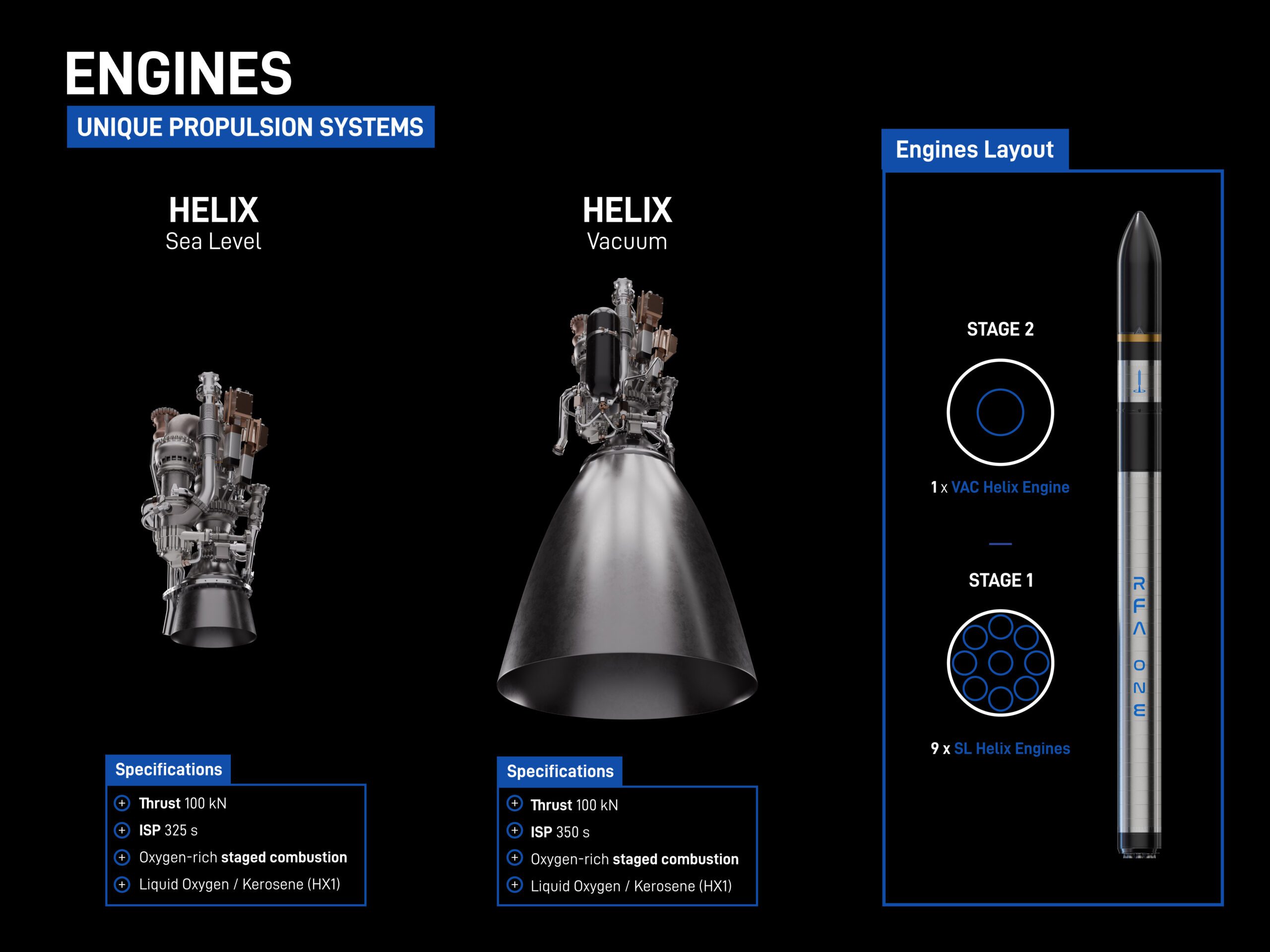
Sitting at the very bottom of stage one is a cluster of nine Helix engines that propel RFA ONE off the launch stool toward orbit.

We often get asked why we chose nine engines. This configuration was specifically chosen for several reasons.


The first is clustering increases redundancy – if one engine fails, the others can compensate. Second, using nine engines allows for greater control during ascent. We can individually throttle and gimbal each engine to steer the rocket accurately. Finally, smaller engines are way easier and quicker to produce and handle.

Our goal is to get to orbit successfully in the most efficient way – a nine-engine cluster allows us to do that.

RFA ONE Helix Engine Specifications

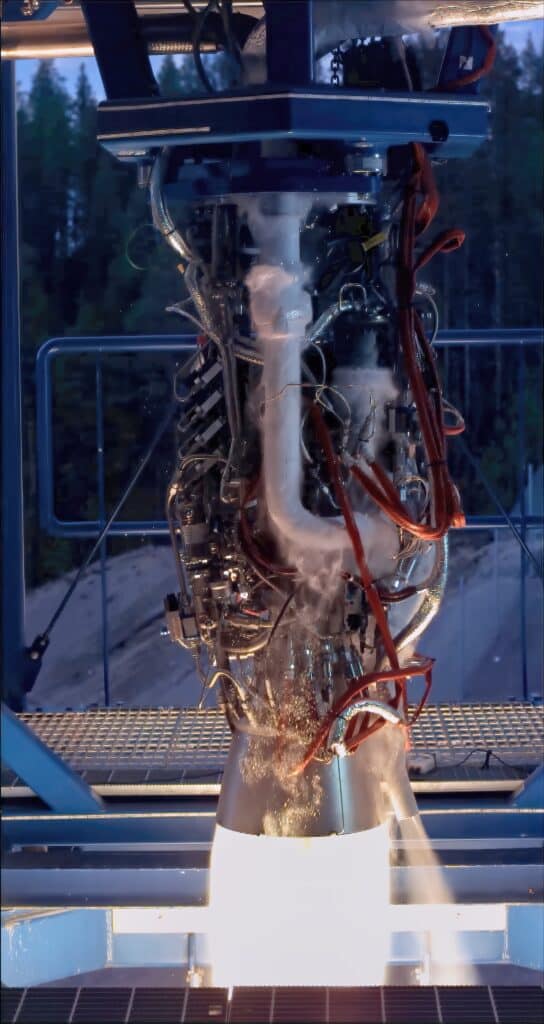
Our Helix engine is particularly unique. Developed in-house by our team of excellent engineers, it’s an Oxygen-Rich Staged Combustion (ORSC) engine that delivers 100kN (roughly 500,000 hp) per engine.


The staged combustion technology gives Helix up to 7% more efficiency which allows us 30% more payload and higher performance than traditional open-cycle rocket engines.


Staged combustion works by feeding the partially unburned exhaust gases from the turbopump into the main combustion chamber, burning the available fuel more completely, getting the most out of it. This also makes it more environmentally friendly.


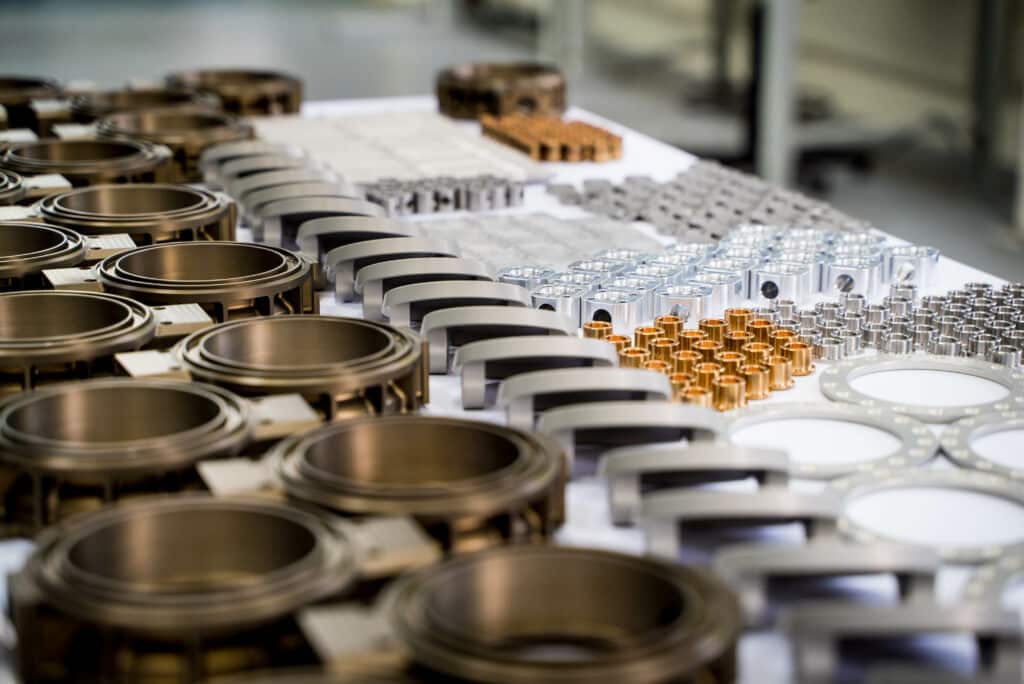
We designed Helix and its turbopump entirely in-house for additive manufacturing, using standardized parts wherever possible, and quick and easy assembly by just a few mechanics.


In July 2022 we became the first company in the European Union to successfully develop and test a staged combustion engine in flight configuration. It also made us the third commercial company in the world to successfully test this type of engine on a large scale.

The Interstage – connecting stage 1 and stage 2

The interstage is a vital component of RFA ONE. Designed to connect stage 1 and stage 2, it is responsible for ensuring a smooth separation between the two stages. It also serves to protect the HelixVAC engine during ascent. Made from automotive-grade carbon fiber, the interstage is designed to minimize weight while maximizing structural integrity. In fact, RFA ONE is the only rocket in the world utilizing this unique stainless steel-carbon-fiber-hybrid design!


Fun fact: creating the interface between the rigid carbon fiber and stainless steel tanks was a challenge for our engineers. The tanks contract when filled with cryogenic liquid oxygen, adding complexity, but the result is a flexible interface that maintains the structure’s overall rigidity.

RFA ONE – Stage 2

Structurally, stage 2 shares the same robust design as Stage 1, but in a more compact form. Like Stage 1, it’s crafted from stainless steel tanks, applying the same cost-efficient and high-quality approach. As dictated by fundamental rocket physics, the higher you go in the rocket, the smaller the stage needs to be. That is why we have optimized Stage 2 in terms of weight, length, capacity and engine performance.

Graphic comparing Helix SL engine with HelixVAC engine

HelixVAC Engine

Alongside our standard Helix engines (Helix SL = sea level), we also developed the HelixVAC (Helix vacuum) engine for stage 2. The key differences between the Helix SL and HelixVAC engines lie in their start systems and engine nozzle.


At sea level, the Helix engine is designed to handle atmospheric pressure that pushes against the exhaust plume. To prevent flow separation and maintain exhaust jet stability, the nozzle is made smaller. However, in the vacuum of space, where there’s no atmospheric pressure, the HelixVAC engine has a much larger nozzle. This allows for targeted acceleration of exhaust gases over a longer duration, improving efficiency in space.


An interesting detail about the HelixVAC engine is that its nozzle glows in space because it isn’t actively cooled at the lower end. Despite reaching nearly the same temperature as the exhaust jet, it doesn’t melt. Woohoo, engineering!


Both engines use a spin start system that gives the turbopump an initial boost using helium before the preburner ignites. For the first stage, the launch pad’s helium system is used to save weight on stage 1. In contrast, stage two carries its own high-pressure helium bottle.

Graphic showing explanation of Redshift Orbital Transfer Vehicle on RFA ONE

RFA ONE – Stage 3 (Redshift Orbital Transfer Vehicle)

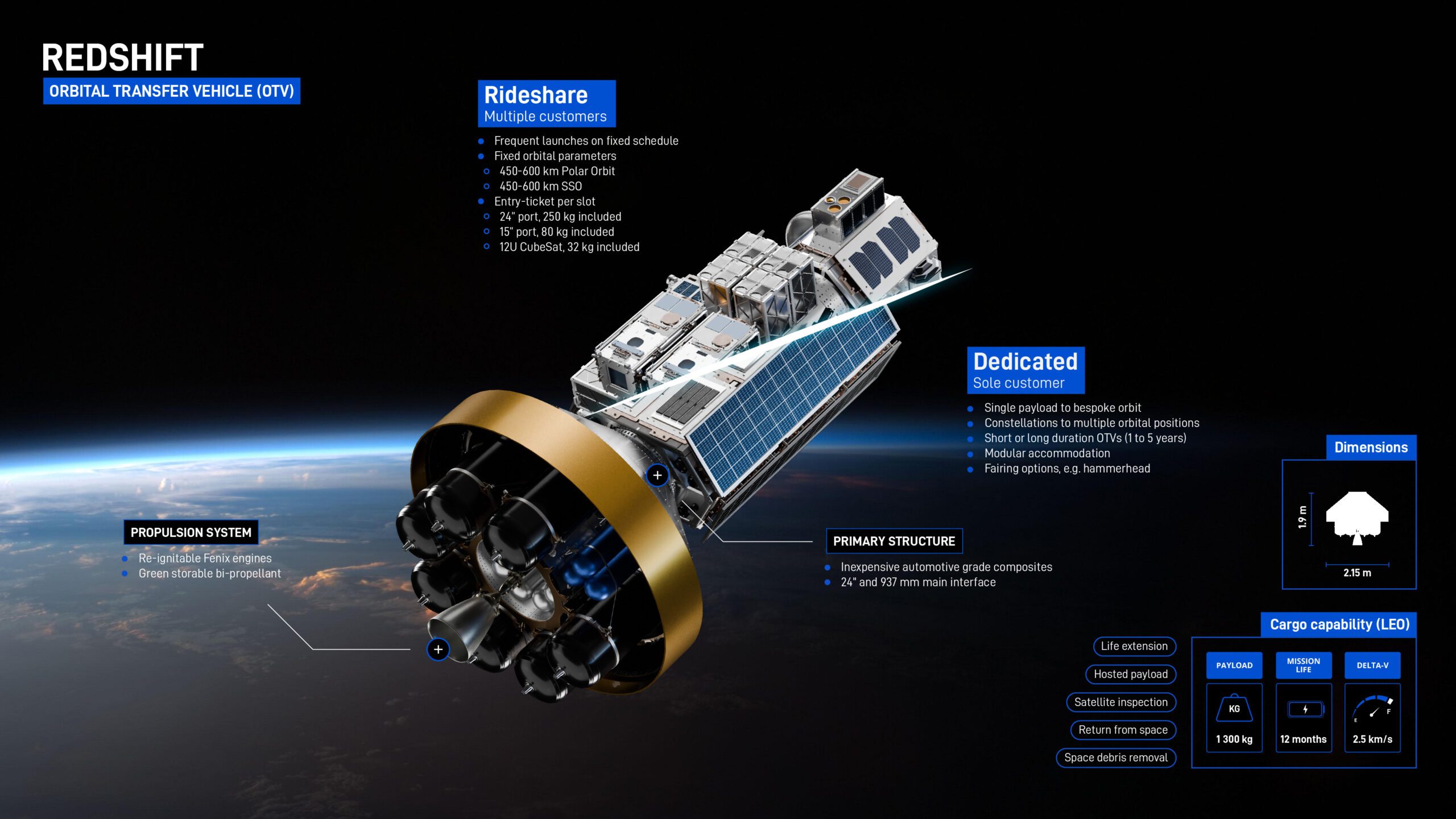
Stage 3, also known as Redshift, is our Orbital Transfer Vehicle (OTV). When RFA ONE reaches orbit, Redshift takes over and deploys the payloads.


The primary structure is made from inexpensive automotive grade composites and it is powered by our Fenix engine – a 1,5kN, re-ignitable engine run on green, storable bi-propellant.

Payload Capacity

Our Redshift Orbital Transfer Vehicle (OTV) can carry up to 1300 kg of payload into orbit.


It can serve multiple customers at a time with rideshare capabilities or serve a single customer with a dedicated payload to a bespoke orbit. There are further configurations and customizations available – Redshift can be tailored to the needs of every customer.


You can discover more about RFA ONE’s payload capabilities in our Payload User Guide.

In-Orbit Capabilities

Redshift’s in-orbit capabilities are what really sets it apart. Going beyond just delivering multiple payloads in different orbits (altitude-and inclination-wise), it can in a not-to-far future host payloads for extended missions, assist with life extension and perform space debris removal.

These versatile capabilities make it an invaluable asset for complex and multi-faceted space missions.

The Power of Standardized Components (COTS)

One of the key innovations behind RFA ONE is our use of standardized components, or Commercial Off-The-Shelf (COTS) parts. By integrating high-quality, low-cost components from industries like automotive and oil & energy, we are able to significantly reduce both development time and production costs. This approach also ensures that our rocket benefits from the proven reliability and mass-production efficiencies of these sectors.


For example, we use stainless steel sourced from the beverage industry for our tanks, a cost-effective material that meets our high-performance needs. Or connectors, which can be found in every car harness. Or valves that usually operate welding robots. This allows us to offer a highly competitive price for launch services without compromising on quality or safety.

RFA ONE – the most unique small launcher in Europe

RFA ONE has the potential to reshape the European space industry. Built to handle the growing demands of modern space missions, RFA ONE offers customer-oriented transport services at a much lower price point. By leveraging low-cost materials like stainless steel and employing standardized components from other industries, we´ve created a flexible and cost-effective solution for access to space that can benefit any industry that wants to connect, understand and protect our Earth with data from space.

RFA ONE flies into space

Standing on the shoulders of a giant: An overview of our launch pad

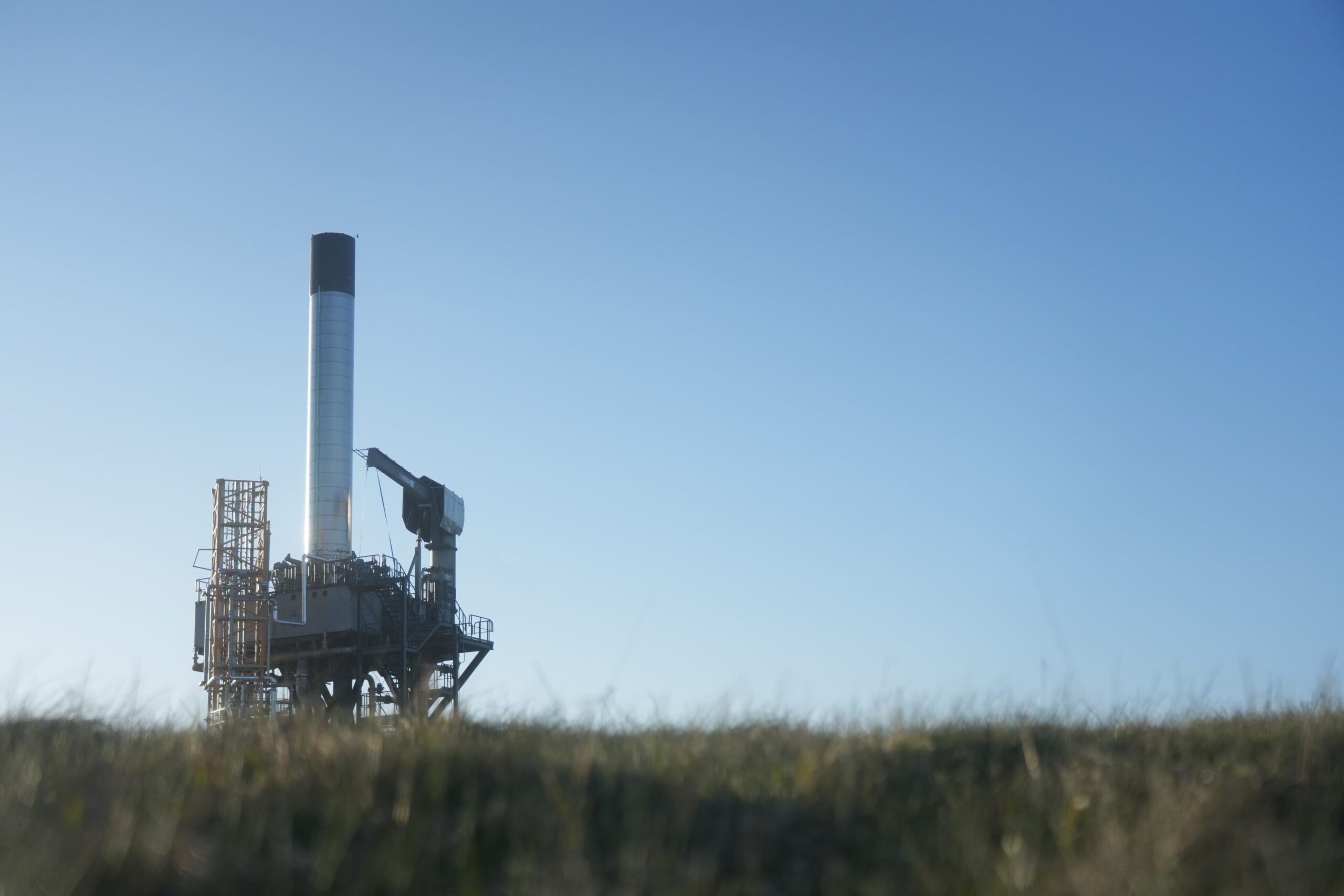
Photo of Stage 1 on the RFA launch site at SaxaVord Spaceport from the perspective of a nearby field.

Reaching the launch pad is a monumental milestone for any rocket company, but building the launch pad is an entirely different challenge. It is essential for launching a rocket, yet it often remains an unsung hero in the background. At Rocket Factory Augsburg (RFA), we’re dedicated to sharing the story of our “Stage Zero” and giving you a behind-the-scenes look at our process.

While most people focus on the rocket itself (which is completely fair), we delve deeper into the question: “But how do we make it actually happen?” The entire process is incredibly complex and requires meticulous planning. Our launch pad must store, amongst others, thousands of liters of fuel, LOx, Nitrogen, and Helium. It then has to fill our three rocket stages at precise temperatures, to a specific time, provide power to all systems and sensors, and protect itself from the immense power of our nine Helix engines roaring to life.

Why SaxaVord? The Strategic Location of Our Stage Zero

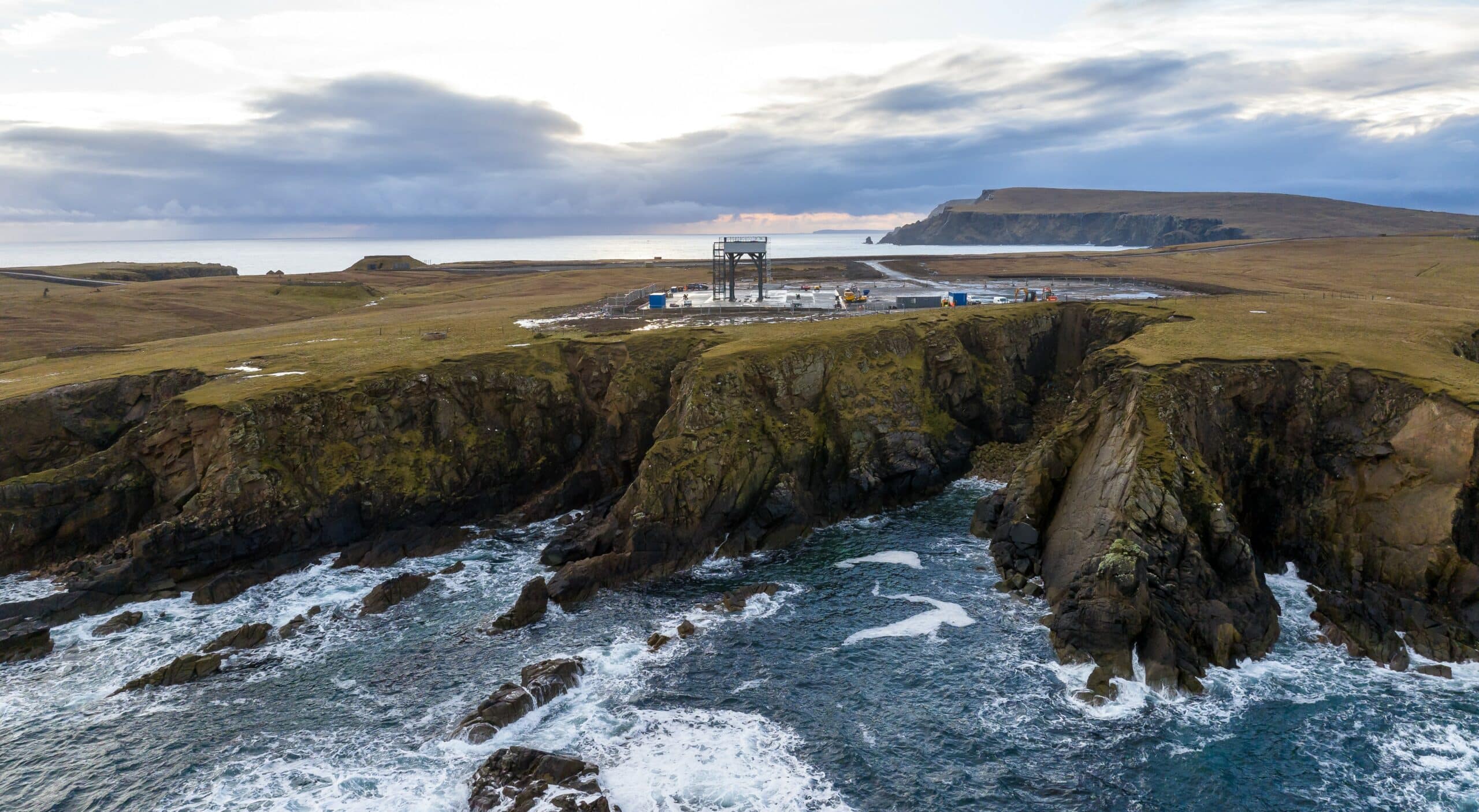
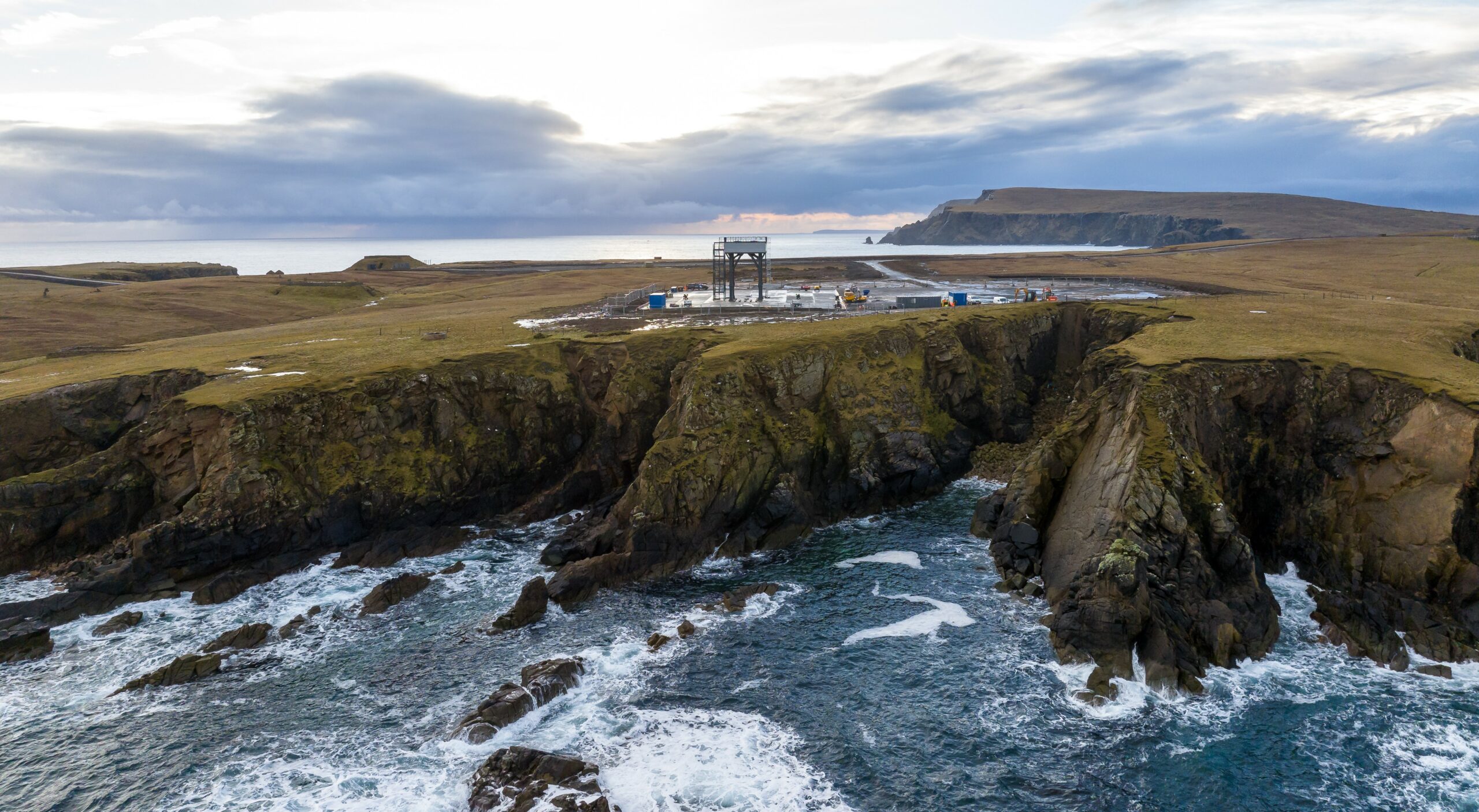
Photograph of the peninsula of the Isle of Unst in the Shetland Islands in Scotland. The photo shows the Rocket Factory Augsburg launch pad at SaxaVord Spaceport.

Believe it or not, we didn’t just close our eyes and point to a map.


Choosing SaxaVord Spaceport as the base for our flight operations was a decision made after careful consideration of various factors: Firstly, SaxaVord and RFA are both private companies who share the same approach of cost-efficiency, a fast pace and “go-get-it”-mentality. Secondly, Shetland has a rich oil and fishing industry with existing infrastructure (e.g. industrial harbors, tool stores, suppliers). Finally, it is perfectly located for launches into polar low earth orbits.


While launching from the equator provides additional speed from the Earth’s rotation, this advantage is primarily relevant for higher or further orbits (e.g., GEO, Lunar, or interplanetary). For our purposes, proximity to the equator is not a crucial factor since we will be launching in a direct north/south direction. We’re primarily targeting polar and sun-synchronous orbits as that is the optimal location for the more commercially interesting constellations and Earth Observation (EO) satellites.

The Technical Backbone of the Launch Pad

Now, as we set the scene in Scotland, building a rocket launch pad involves much more than just concrete and steel.


Our team of engineers has worked tirelessly to design and implement the technical infrastructure needed to support our rockets. From fueling systems to communication with, and erection of the RFA ONE, every detail has been carefully planned to make sure we have a safe, efficient, and successful launch. Let´s have a look at some of the main elements:

Key Components of Our Launch Site

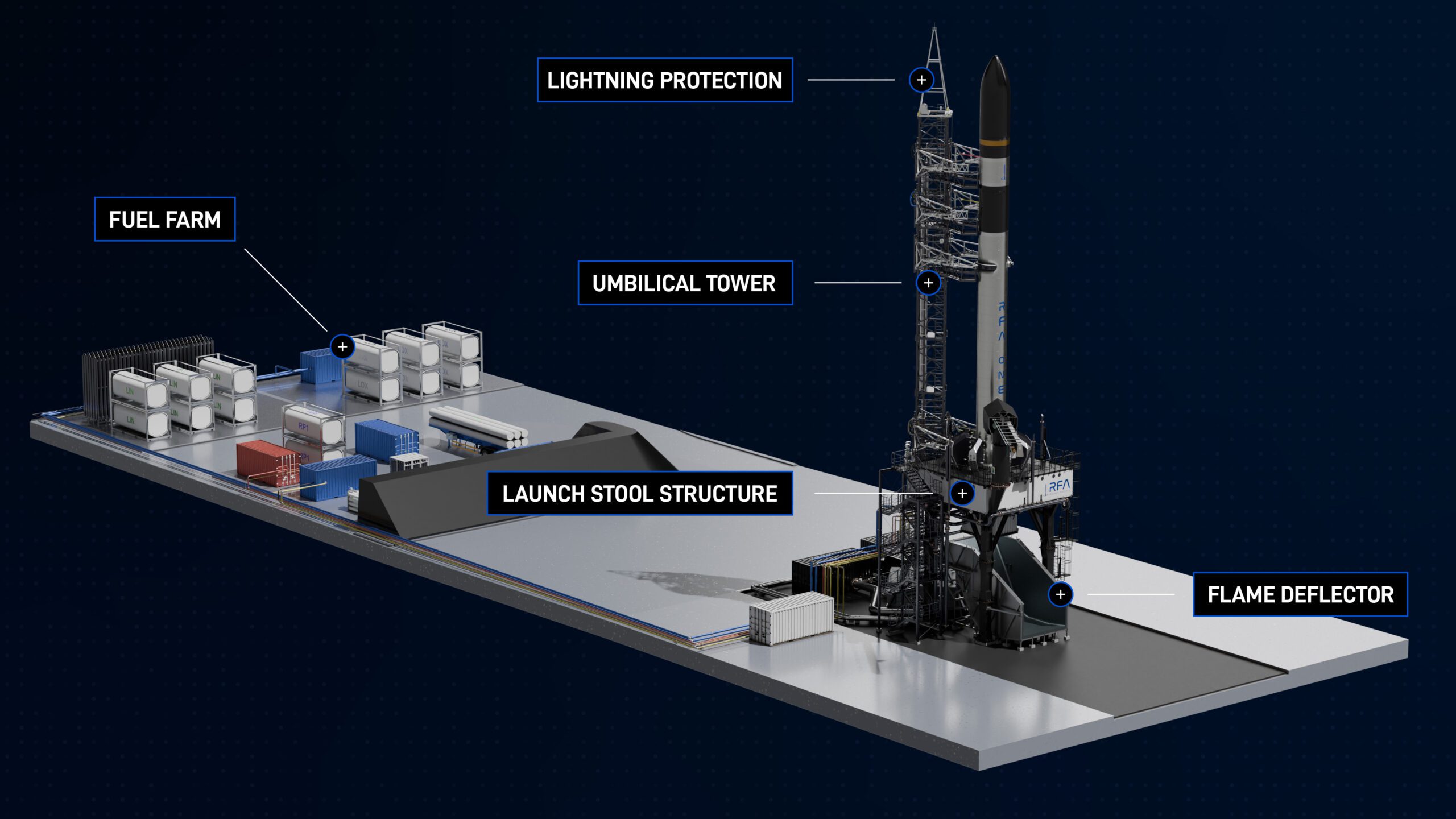
3D render of the RFA launch site with labeling. The render shows the Umbilical tower, fuel farm, launch stool structure, lightning protection and flame deflector.
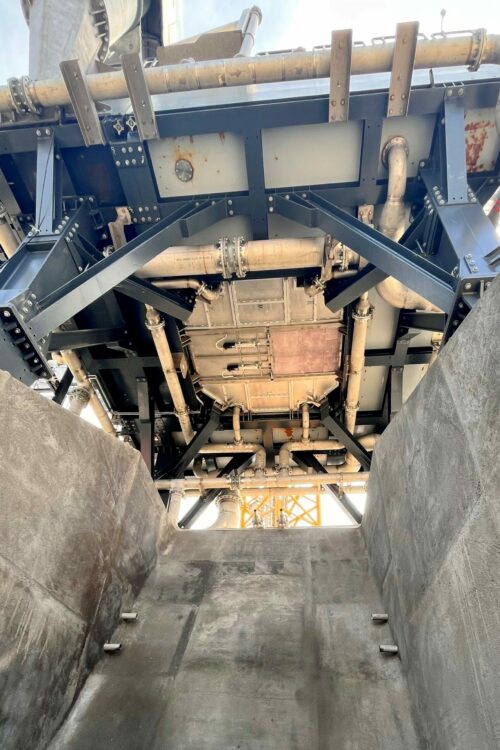
  • Launch Stool Structure: You know what it looks like. A large, gray steel structure on four legs, to put it simply. But the launch stool does not just hold our RFA ONE in place before launch. It also allows us to work on things like the engines when the vehicle is fully integrated and vertical. The structure is made of stainless steel and has to withstand the strong winds and salty (corrosive) sea air. By the way: The company that built the launch stool for us comes from the maritime structural engineering sector. We want to go beyond highly specialized (and correspondingly paid) aerospace suppliers – not only for RFA ONE but everywhere.
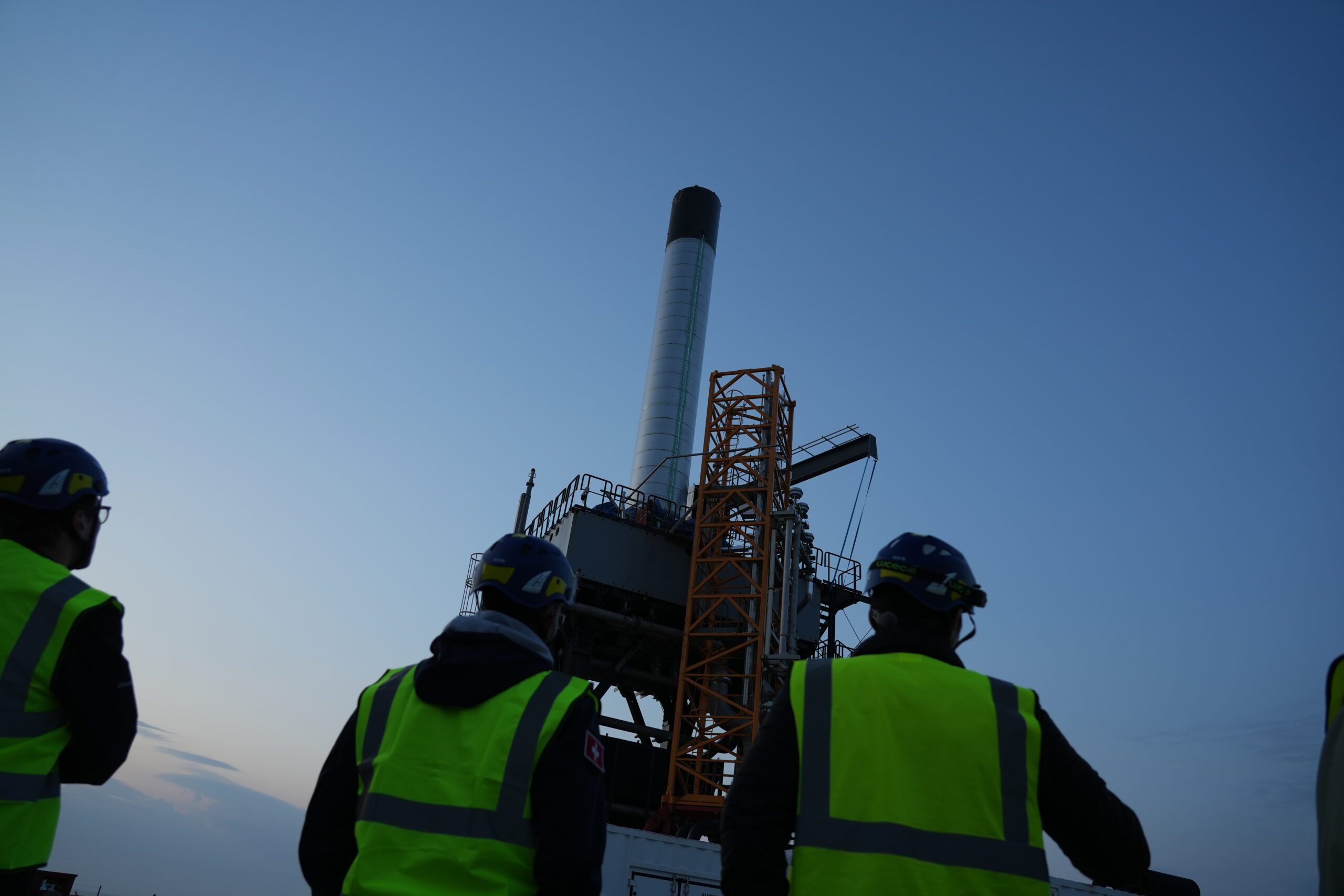
Photo of RFA employees looking up at Stage 1 standing on the launch pad at SaxaVord Spaceport.
  • Fuel Farm: Our so-called fuel farm is where we store everything we need to fuel our launch vehicle. Inert gases, propellants, oxidizers and other liquids are all kept here until it’s time to fill RFA ONE with them in a precisely timed and temperature-controlled manner. For example, LOX gases off at an ambient temperature so we have to continuously cool it and fill it into the rocket at precisely the right temperature so that it is perfectly fueled for launch. The fuel farm is protected by an earth wall and connected to the launch stool by several different sized pipelines. We have many sensors and valves on that ground support equipment (GSE) ensuring everything is perfectly coordinated – keeping track of everything is crucial and an art in itself!


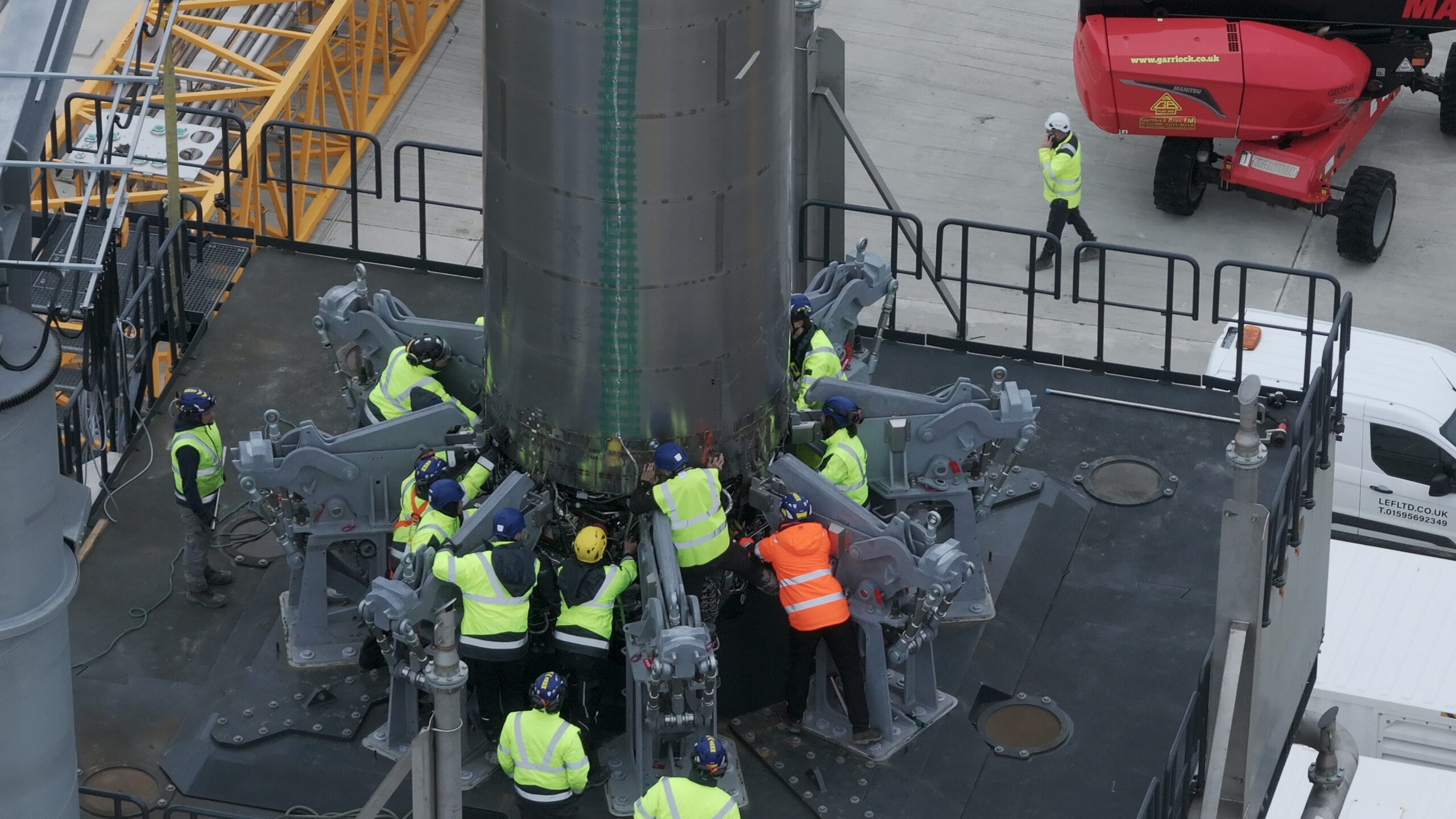
  • Umbilical Tower: The large yellow tower is our umbilical tower. All fuel pipelines, power and data cables run up the rocket to the respective stages via this tower using interfaces. These only get disconnected when we get to lift off. If one of them gets stuck unplanned, we’ll have a problem. Further up the umbilical tower, we have collar clamps to stabilize the rocket in windy conditions. There are also eight massive hold-down clamps at the lower end. These clamps only let go when the thrust is right and all systems are running as planned. By the way, we made our umbilical tower by repurposing a decommissioned and commercially available construction site crane. Classic, cost-effective, pragmatic RFA. 😉
  • AIT (Assembly, Integration, Testing) Hangar: Like the launch stool, our hangar is another seemingly simple structure: a steel building with a concrete floor. But behind the doors, it’s the place where all the magic happens! We will conduct our final tests in this hangar before integrating all three stages of RFA ONE into the final launch vehicle. The hangar serves as our technical workshop, complete with a clean room for integrating our customers’ satellites with our Redshift OTV.
  • Mission Control Center: This is the central hub of activities on launch day. From our MCC, the core launch team will monitor and control all systems before, during and after the test flight.

Safety Considerations

  • Flame Deflector Ramp: We have constructed our own ramp that sits directly below the rocket. This serves to deflect the powerful exhaust jet of RFA ONE so it exits horizontally. Without it, the exhaust jet would go straight into the ground, causing dust and stones to be thrown upwards against the rocket and into the engines. While the ramp is made of stainless steel (what else), we have applied a very special and fire-resistant concrete to it to make it reusable.
  • Water Deluge System: Just before those nine powerful Helix engines ignite, we inject the water into the sides of the exhausts. This reduces the heat from flames and dampens noise and shock waves, maintaining the structural integrity of the stool and protecting the vehicle. This is also what creates the large white cloud you usually see during rocket launches – it’s just water vapor.


  • Lightning Protection: The umbilical tower is also the highest point on the entire SaxaVord peninsula. So we have installed a lightning conductor, just in case – better to be safe than sorry!


  • Communication Systems: The most important safety consideration when on our launch site, especially so when the stages are on the launch pad and we are testing. It is essential to communicate with both the rocket and each other continuously. We have to ask questions like: Is the pressure right? How much fuel do we have in the tank? Are the engines cold enough? Are all the valves working? Does the flight computer have everything under control? To monitor this, we (currently) have many sensors on RFA ONE and the launch pad. They automatically check the health of all ground systems and the rocket and send the data to our team who communicate with each other via a radio system.

From Design to Assembly to Lift Off: It’s All About the Journey

The process of building Stage Zero was a journey marked by challenges and collaboration. In true RFA fashion, the design philosophy for the launch site was to aim for low-cost and standardization. We achieved this by building the site from the ground up and designing all our systems and modules to fit into standard shipping containers. It made it easy to transport everything from Augsburg to Shetland and beyond. Our launch site can be packed down and put up anywhere in the world, further adding to our flexible and low-cost approach.


Ultimately, designing and building Stage Zero has been a challenging but highly rewarding experience for everyone involved. Our recent first stage hot fire has shown that the systems are working well and that we can now push on with finalizing everything for our first test flight. Our hope with this blog post is to shine a little more attention on this marvel of engineering.


The rocket is one thing – what it takes to really get this thing off the ground is a story all of its own.

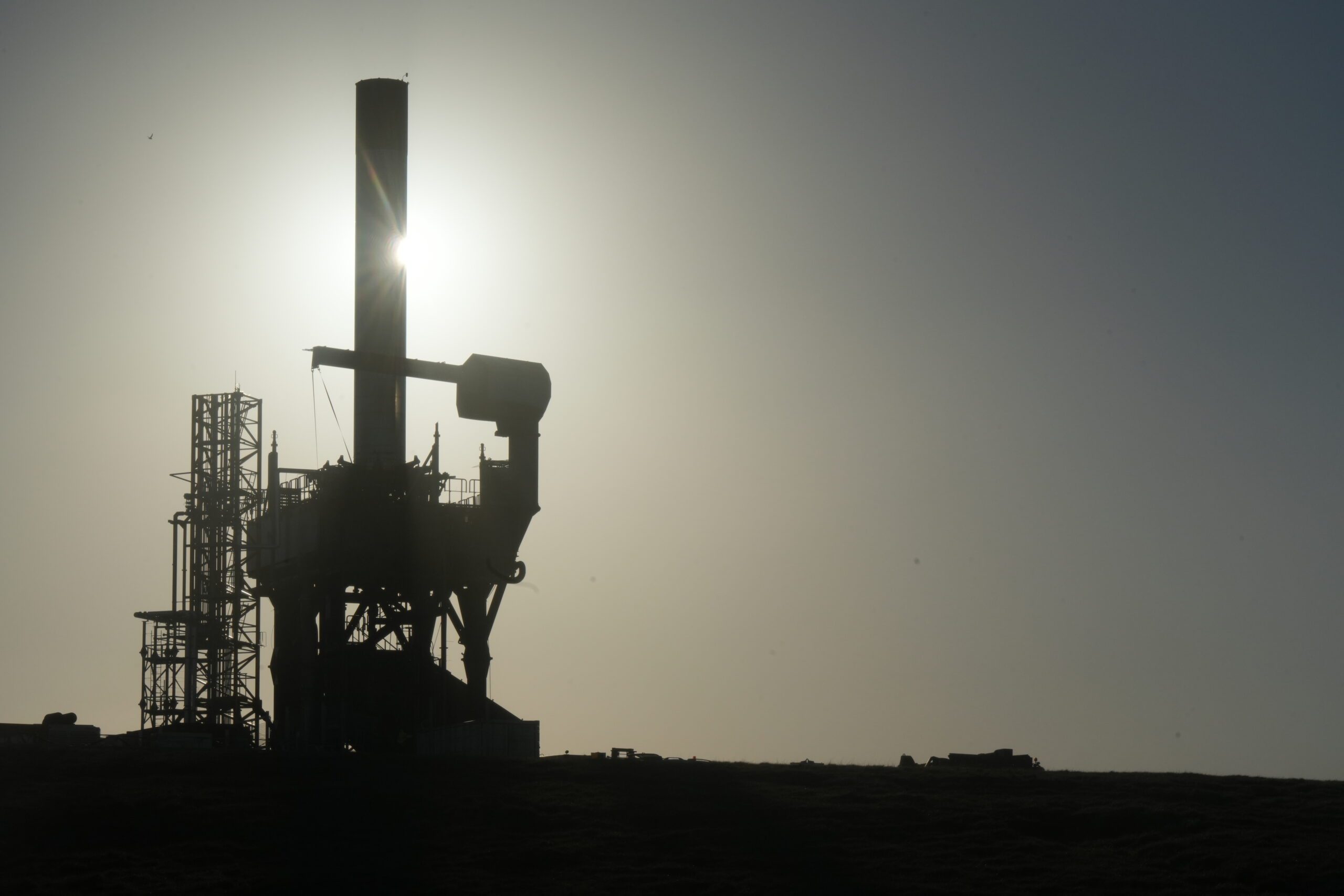
Photo of stage 1 of RFA ONE stood on the launch pad at SaxaVord Spaceport in a silhouette.

The Ultimate Guide to Argo: Our Cost-Effective Cargo Capsule

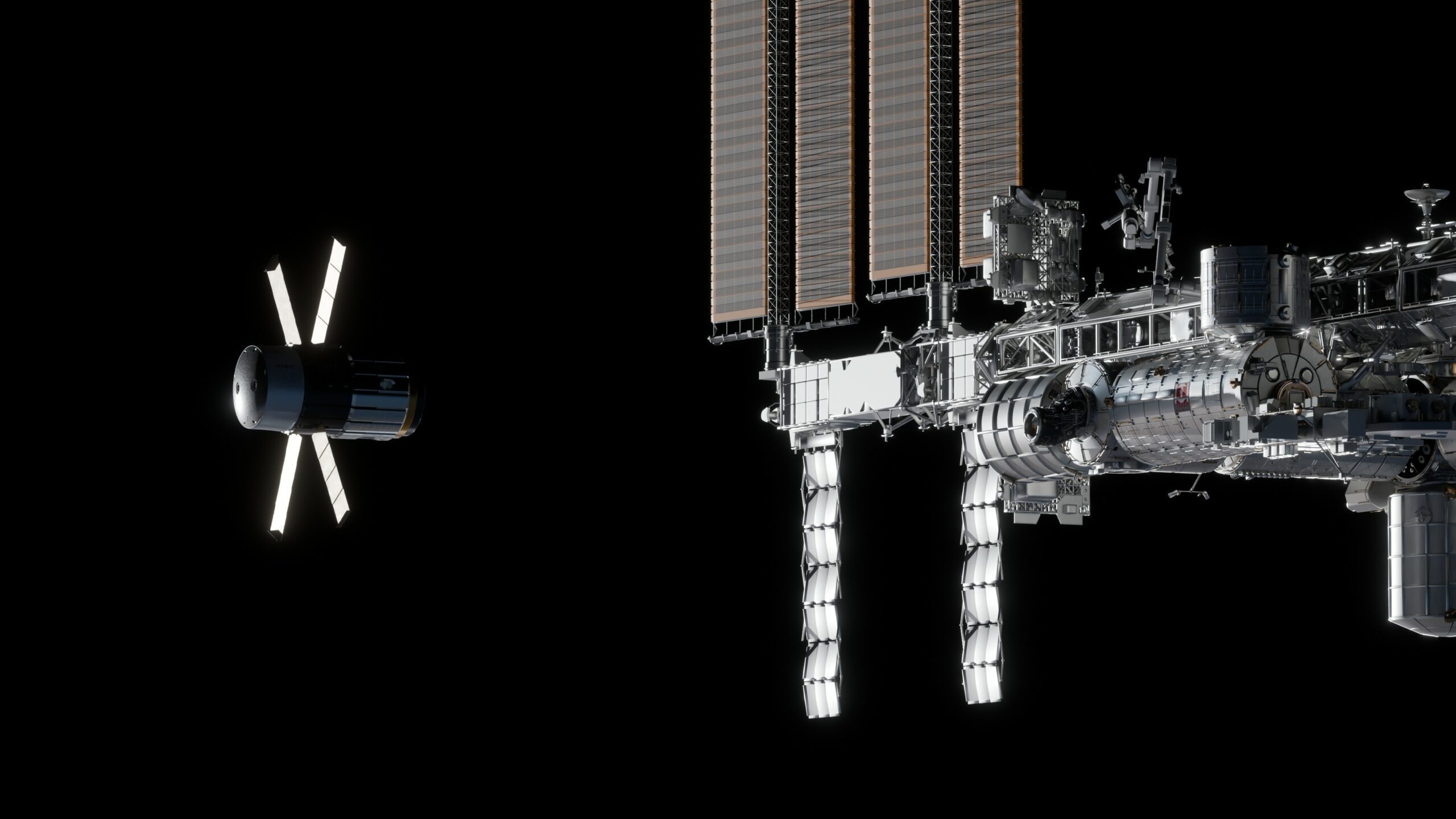
The image shows the ARGO capsule approaching the International Space Station

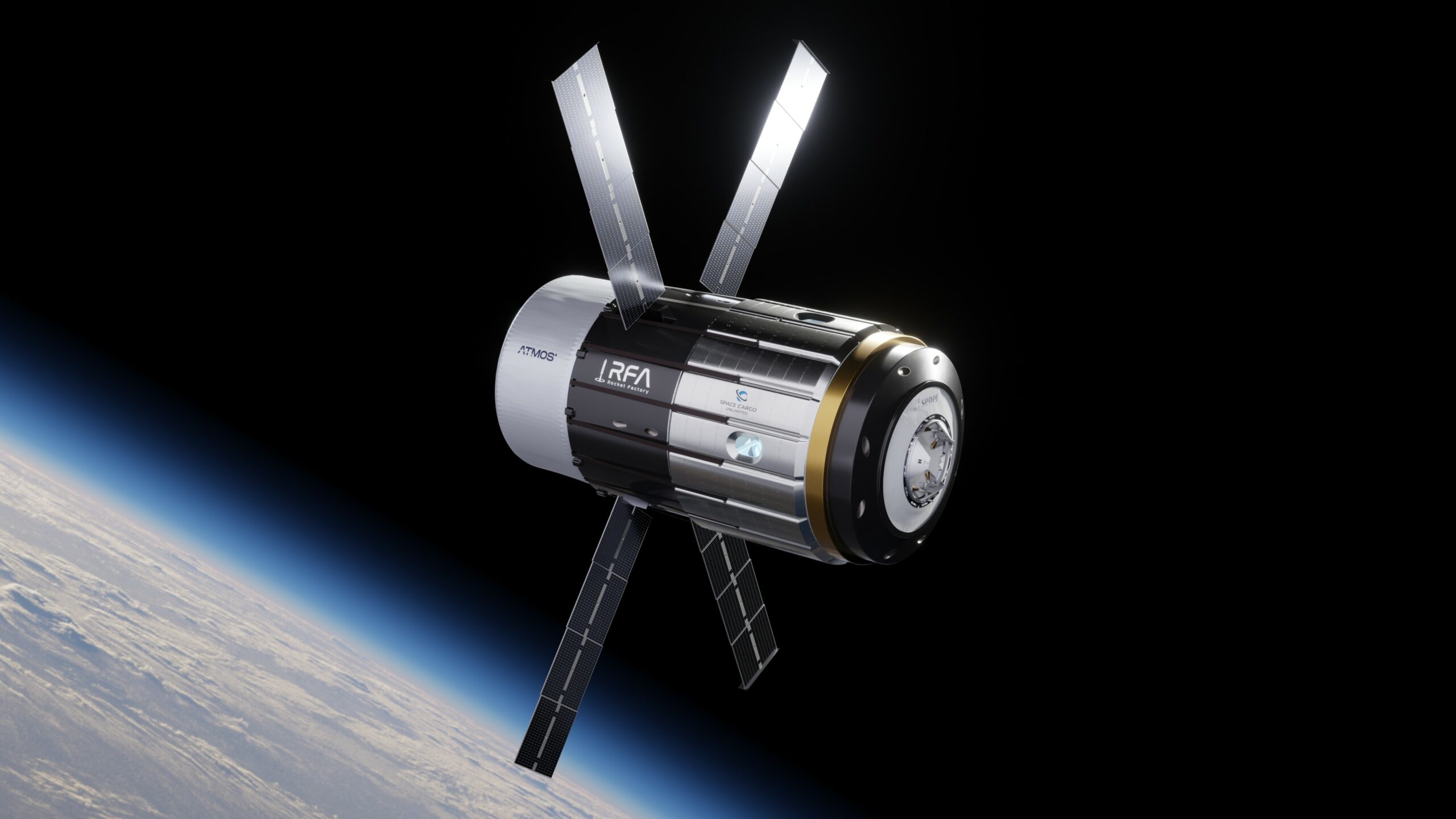
Meet Argo, our cost-effective space cargo capsule. Optimized for flexibility and reliability, Argo offers an end-to-end service at a low price point of just €150M. Led by RFA, the bidding consortium combines our expertise with that from Space Cargo Unlimited, along with partners like ATMOS Space Cargo to offer a fully reusable solution for the European Space Agency and commercial clients.

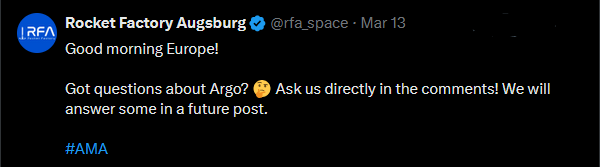
Instead of giving you a formal press release, we decided the best way to talk about Argo would be to talk directly with YOU. So, we asked you to submit any pressing questions you had about Argo and promised to answer some of them in a future post.

Rocket Factory Augsburg post on X (twitter) that reads: "Good morning Europe! Got questions about Argo? Ask us directly in the comments! We will answer some in a future post."

However, you came up with such great questions that we decided we couldn’t choose just some to answer. So we’re giving you answers to every single one! Before we dive into your questions, let’s first take a look at why Argo, as a concept, exists in the first place.

Table of Contents

Chapter 1: Why Europe Needs Space Cargo Capabilities

While Europe’s space capabilities are still world class, it is no longer the space power it once was due to the lack of autonomy.


But with a booming New Space industry and innovative initiatives, the doors are open to achieve the European Space Agency’s ambition to position Europe as a global space power once again by 2035. One such initiative is the competition opened by ESA in November 2023 for a European cargo service to and from space stations in Low Earth Orbit. Since the termination of ESA’s Automated Transfer Vehicle (ATV), we have had to rely on international sources for our space cargo needs. The recent call from ESA shows their commitment to developing Europe’s future as a global space leader once more.


Argo is our answer to this call. But it’s also more than that. Argo is not “just” a supply service for space stations. It stands as a symbol of Europe’s leadership and innovation in the New Space economy.

The Inspiration Behind Argo

Image of a reply received on X (Twitter) asking why RFA is sending a Fiat to space with an external link to the Wikipedia page about the Fiat Argo.

As much fun as it would be to send a Brazilian-built Fiat to space, that’s not quite what we had in mind when we came up with the name for our cost-effective cargo capsule.


The meaning behind the name Argo is two-fold. The main reason is simple: It’s Cargo, without the (C)osts. The second reason is that our pre-development team was inspired by the legendary Argo ship in Greek mythology.


Now that we’ve cleared that up, let’s get on with the rest of your questions. We’ve broken them down into categories, so please don’t stress if we don’t answer all questions shown in the screenshots in one go.

Chapter 2: Launch Details and Vehicle Compatibility

1) Which rocket will launch Argo into orbit?

Unsurprisingly, but understandably, we got a LOT of questions about Argo’s launch vehicle.

According to the requirements of ESA, Argo is developed for use on any launcher. At a minimum, it is compatible with current and future European medium to heavy-lift launch vehicles, but can also fly with other medium or heavy-lift launch vehicles if needed.

This approach makes Argo launch agnostic and capable of offering a 100% flexible and customer-oriented service.

2) Will Argo launch on an RFA-built launch vehicle?

Although Argo is compatible with other existing and upcoming launchers, the most cost-effective solution would be to launch on our very own medium or heavy-lift launch system. This enables us to offer a full end-to-end cargo service for 4,000kg to and from orbit.


As one person pointed out, RFA ONE is indeed too small to carry Argo. But that was never our plan. ESA’s requirement is that we must launch Argo by 2028 – and by then the European Launcher Challenge will presumably provide the framework for the development of a larger RFA rocket. So we move step by step and start with our RFA ONE which, you’ll know, is due to launch in summer 2024 and is already fully booked for its two test flights.

3) When is the maiden flight planned?

the image shows a twitter comment asking for technical and financial aspects of Argo

Tying in nicely to the previous point, we can confirm that we plan to implement Argo’s first demo mission in 2028.

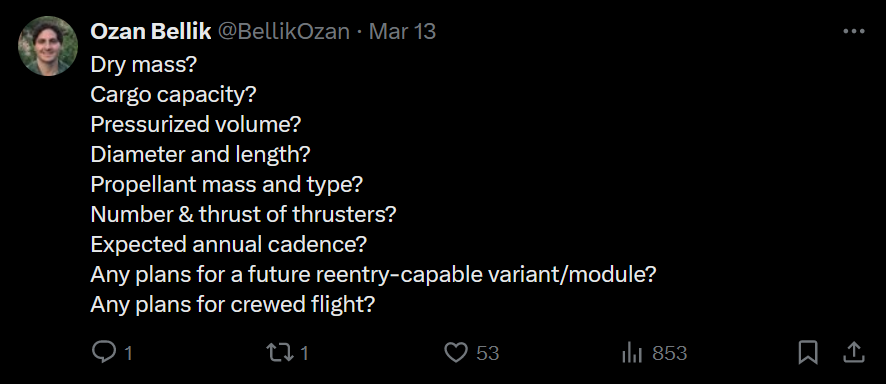
4) What is the expected annual cadence?

the image shows a twitter comment asking for technical data about Argo

During our market research, we found a substantial global demand for cargo transportation missions. After its first demo mission in 2028, we plan to make the service commercially available from 2029 onward, with the aim to increase cadence as needed to serve the market.

Chapter 3: Design and Specifications

1) What are the dimensions of Argo?

Argo will be 3.7 m in diameter and 7.7 m long (without its fairing). It will have a 1:1 ratio between its up and down cargo mass – one of its most unique features. How do we achieve the same up-and-down mass? With an Inflatable Atmospheric Decelerator (IAD), provided by our partner Atmos Space Cargo.


The main structural elements of Argo can easily be scaled in a fast and cheap way. Using our building block approach, it’s possible to add segments to the existing capsule. We can also scale the propulsion system and propellant storage with minimal changes elsewhere, making Argo more flexible for future space stations in LEO. Of course, service evolution depends entirely on market demands and trends. But what we’re saying is that we will be ready!

2) What is the internal volume and cargo capacity?

Argo has a dry mass of 5,200 kg without cargo, a total internal pressurized volume of 27.9 cubic meters and a pressurized cargo volume of 15.5 cubic meters. It can carry up to 4,000 kg of cargo to and from orbit.

3) What rocket engines will be used on Argo?

the image shows a twitter comment asking for technical data about Argo

Two RFA Fenix engines will power Argo in orbit, with an additional 24x 100 N Thrusters for the Reaction Control System (RCS). The Fenix engines use bi-propellant and will already have flight heritage from RFA ONE. Argo has an estimated propellant mass of 3,082 kg.

Chapter 4: Functionality and Operations

1) Can it carry cube sats or unpressurized cargo?

Cube Sats are a critical part of the LEO research environment. Our RFA ONE with Redshift OTV already offers satellite deployment capabilities, but we also see potential future opportunities for adding dispensers to Argo to complement the Redshift service.

2) Can it bring cargo back down to Earth?

Argo will utilize its Inflatable Atmospheric Decelerator to allow the entire vehicle to return to Earth and safely land with up to 4000 kg of cargo. The position of the Inflatable Atmospheric Decelerator (IAD) was moved from the front in Version 1 to the back in the current version, but this doesn’t change the functionality or effectiveness of the return module. We can confirm that Argo is capable of safe re-entry.

3) How long can Argo stay in space?

Our demo mission in 2028 will last a total of 25 days. Argo will spend three of those days getting to the ISS, 20 days docked, and 2 further days for undocking, re-entry and recovery. However, Argo is designed to service our customers and their needs. Therefore, it’s possible for Argo to remain in orbit for over one year, if required.

4) What will be the delta v?

the image shows a screenshot of an instagram story in which an user asked: "what will be the delta v of Argo and will it be compatible with other launch systems as well?"

For the demo mission in 2028, we have enough delta v to reach ISS and safely re-enter – around 1,000 m/s.

5) What about a reaction control system?

the image shows a screenshot of an instagram story in which an user asked: "are you going to develop a reaction control system for the Argo?"

Yes. As previously mentioned, the primary propulsion system uses the existing Fenix engine and 24 100 N thrusters make up the Reaction Control System.

6) Is the entire capsule pressurized?

the image shows a screenshot of an instagram story in which an user asked: "is the whole capsule under pressure? Is there a roadmap for publicity?"

The front of the vehicle is pressurized, with the middle section containing the service module and the rear end comprising the Inflatable Atmospheric Decelerator and Fenix engines.


For more information on the specifics of each module, you can watch our animation video.

Chapter 5: Mission and Usage

1) Will Argo service other space stations apart from the ISS?

The first question has a very simple answer: ESA requested docking. This makes Argo compatible with other planned commercial stations. So yes, Argo will be able to service other space stations in the future.


Currently, there are no plans for Argo to refuel a space station, but it can provide significant orbit-raising maneuvers.

2) Can it be used for in-orbit experiments?

the image shows a twitter comment asking if Argo could be used for in-orbit science experiments, without docking to the ISS

Absolutely! Argo can be used for in-orbit experiments with or without docking to the ISS or any other space station. Specifically, Argo can induce spin to generate up to Martian gravity along the cylindrical hull of the pressure vessel.

3) Is Argo only for LEO?

The image shows a screenshot of a twitter comment which says: "only for LEO or will it have a luna rated heatshield?"

With its current re-entry profile and decelerator (heatshield), Argo is specifically optimized for LEO. However, our preliminary analysis did not find any showstoppers for modifying the trajectory and/or decelerator for re-entry after departing from Gateway, so who knows what could happen in the future…👀

Chapter 6: Reusability

1) How is Argo fully reusable?

Argo will be fully reusable. This reusability starts from the first mission with immediate post-recovery actions like de-salting and unloading payload, followed by refurbishment. Argo returns to Earth enveloped and protected by the cutting-edge technologies of the large IAD, allowing a fast turnaround time on refurbishment and expedited reuse. This also helps keep costs low and offer short response times for emergency delivery.


Its design is based on existing technologies from our partners and also our RFA ONE and Redshift OTV. This allows us to provide modularity and be cost-competitive, but we also have the goal of full reusability. After our first demo mission with Argo, we will analyze and further refine the reusable aspects to meet our goals effectively.

Chapter 7: Market and Commercial Viability

1) Is Argo just a smaller ATV?

the image shows a twitter comment asking if argo is like a smaller version of the ESA's ATV

Sure, Argo is similar in appearance to ATV. But most importantly, Argo is unique because, until now, it has not been possible to return cylindrically shaped capsules to Earth. This will be possible with Argo thanks to the Inflatable Atmospheric Decelerator. By the same means, Argo is also capable of returning to Earth with the same amount of mass as it delivers to orbit. Overall, Argo benefits from several decades of development since ATV and the heritage from RFA ONE launch system.

2) What makes Argo different to other commercial vehicles?

the image shows a screenshot of an instagram story post, where the question appears, "what makes argo different to other commercial vehicles?"

It all comes down to the Inflatable Atmospheric Decelerator (IAD). This technology enables the uniqueness of using a stainless steel cylindrical capsule. It is this benefit that makes us different thanks to three key commercial factors:

  • Competitive service price point starting at 150 million EUR
  • Equal up and down cargo ratio of 4000 kg
  • Offering a fully integrated end-to-end service with an RFA launch system

3) Can commercial industries book Argo?

the image shows a screenshot of an instagram story in which an user asked: "can the space craft be booked by commercial industry, to perform resurching in zero gravity?"

Yes! Argo is strategically oriented towards commercial viability. We warmly welcome collaboration and partnership from diverse commercial sectors and encourage companies to leverage Argo for innovative scientific research and exploration.

4) Is there a roadmap?

the image shows a screenshot of an instagram story in which an user asked: "is the whole capsule under pressure? Is there a roadmap for publicity?"

In short: Yes. From the start, we envisioned Argo as more than just a cargo delivery system to LEO. Together with our partners, we have created a detailed roadmap on how further capabilities can be achieved in a reasonable time frame. If you’re asking what exactly that roadmap is, well, you’ll just have to wait and see…

Chapter 8: Cost and Budget

1) How much does an Argo mission cost?

Argo’s services start at 150 million EUR per launch.

Our analysis was based on publicly available information and showed that Argo is highly competitive and significantly undercuts the prices offered by competitors. For reference, ATV claimed to be 300 million EUR per launch.

Chapter 9: Partnerships and Outreach

1) Will you reveal more at Space Creator Day 2024?

the image shows a twitter comment asking if community will see more at the next space creator day

You’ll just have to come along to find out. See you there to discuss Argo, RFA ONE, Redshift and other awesome space things!

2) Can you share more on your partnership with Space Cargo Unlimited?

the image shows a LinkedIn comment asking for details on a partnership with Space Cargo Unlimited.

Space Cargo Unlimited is committed to developing, delivering and operating the outfitting capabilities of Argo to play the role of commercial services provider for microgravity research in space at a high-value benefit on Earth. Their REV1 vehicle is considered an alternative return solution that will be further investigated during the project in line with the technical feasibility and/or the market needs  The core of Argo would remain the same, and another scenario could see REV1 Max added to the front end of the capsule.

Chapter 10: Testing and Development

1) Is there an Argo prototype?

The picture shows a tweet asking "How far are you in building a prototype?" dated March 13th

Lucky for us, Argo is based on a combination of existing technology through European partnerships. Therefore, we can use a building blocks approach to build the capsule. The Fenix engines will see their first flight on RFA ONE this year. A subscale IAD has already been tested and is planned to gain its flight heritage on the SpaceX Transporter mission in 2025. And the stainless steel tanks and CFRP structures will also be flight-qualified on RFA ONE. We are confident that all critical systems of Argo will reach TRL 6 in 2026 for its first demo mission in 2028.

2) Have you started parachute testing?

the image shows a twitter comment asking if RFA stared parachute testing

The beauty of Argo is that parachutes are not needed. The Inflatable Atmospheric Decelerator (IAD) fully covers re-entry and deceleration prior to splash down in the ocean.

Chapter 11: Future Development

1) Any plans for a crewed version of Argo?

Along with questions about the launch vehicle, this question popped up most often. We understand why – you’re curious!


And we want to be transparent. Argo’s journey does not end with cargo delivery to LEO. It is deliberately designed to evolve into a comprehensive exploration and transportation system to push the boundaries of human presence in space.

the image shows a screenshot of an instagram story in which an user asked: "can I be shipped in argo too?"

To answer this, we’ll just say: Have patience.


And we’ll leave this here…

the image shows the ARGO capsule flying threw the orbit

Discover More About Argo

We hope you enjoyed this deep dive into Argo. We certainly enjoyed answering all your questions! If you want to check out more details about Argo, you can see some of our recent social media posts.


Alternatively, you can visit our dedicated Argo webpage at https://rfa.space/argo

SUBSCRIBE

Stay up to date with The Preburner blog and all of our latest posts by signing up.

Interested in featuring us?

RFA flies eight customers on second flight

DLR and the German Space Agency announce eight customers for RFA ONE's second flight

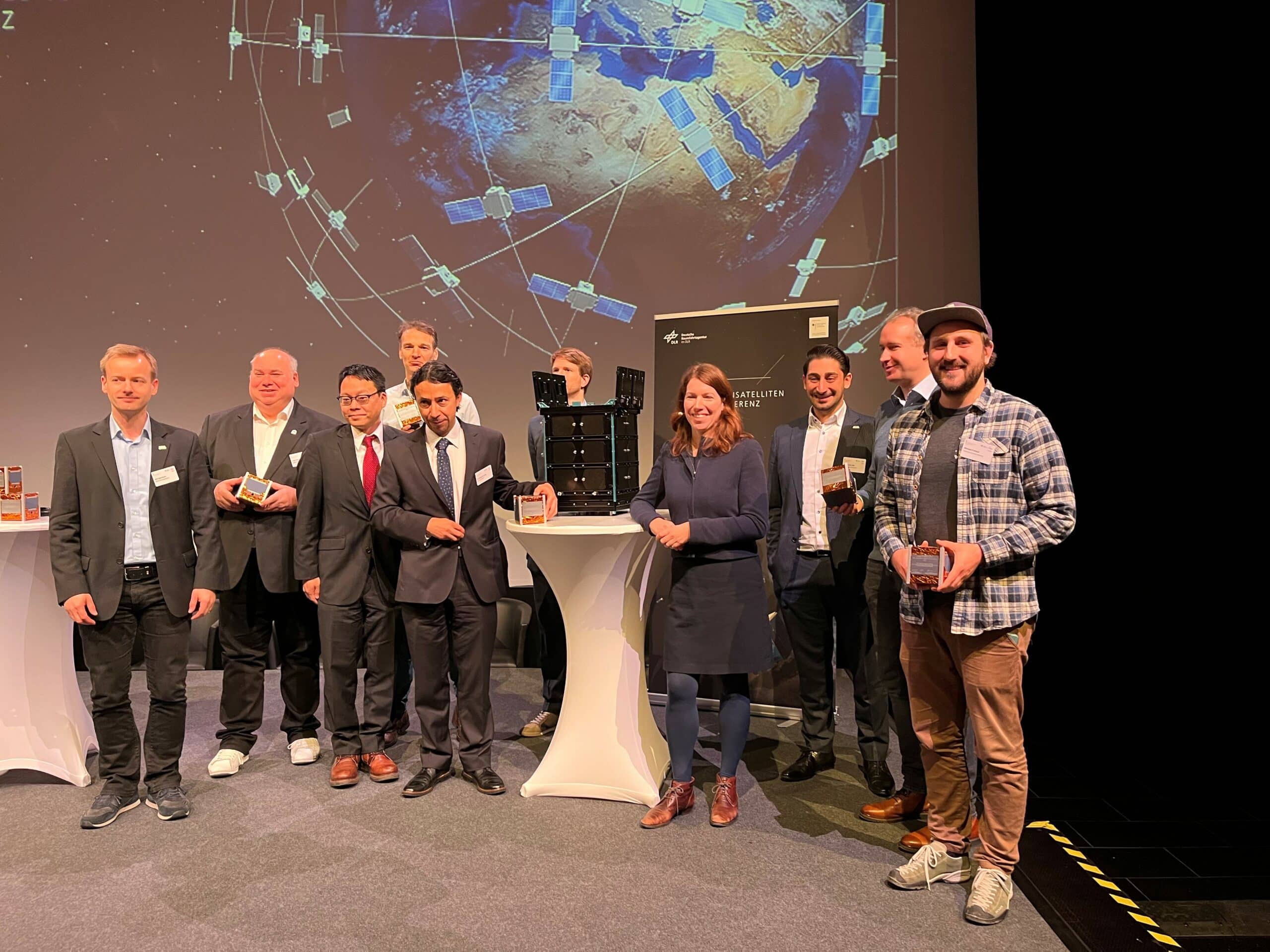
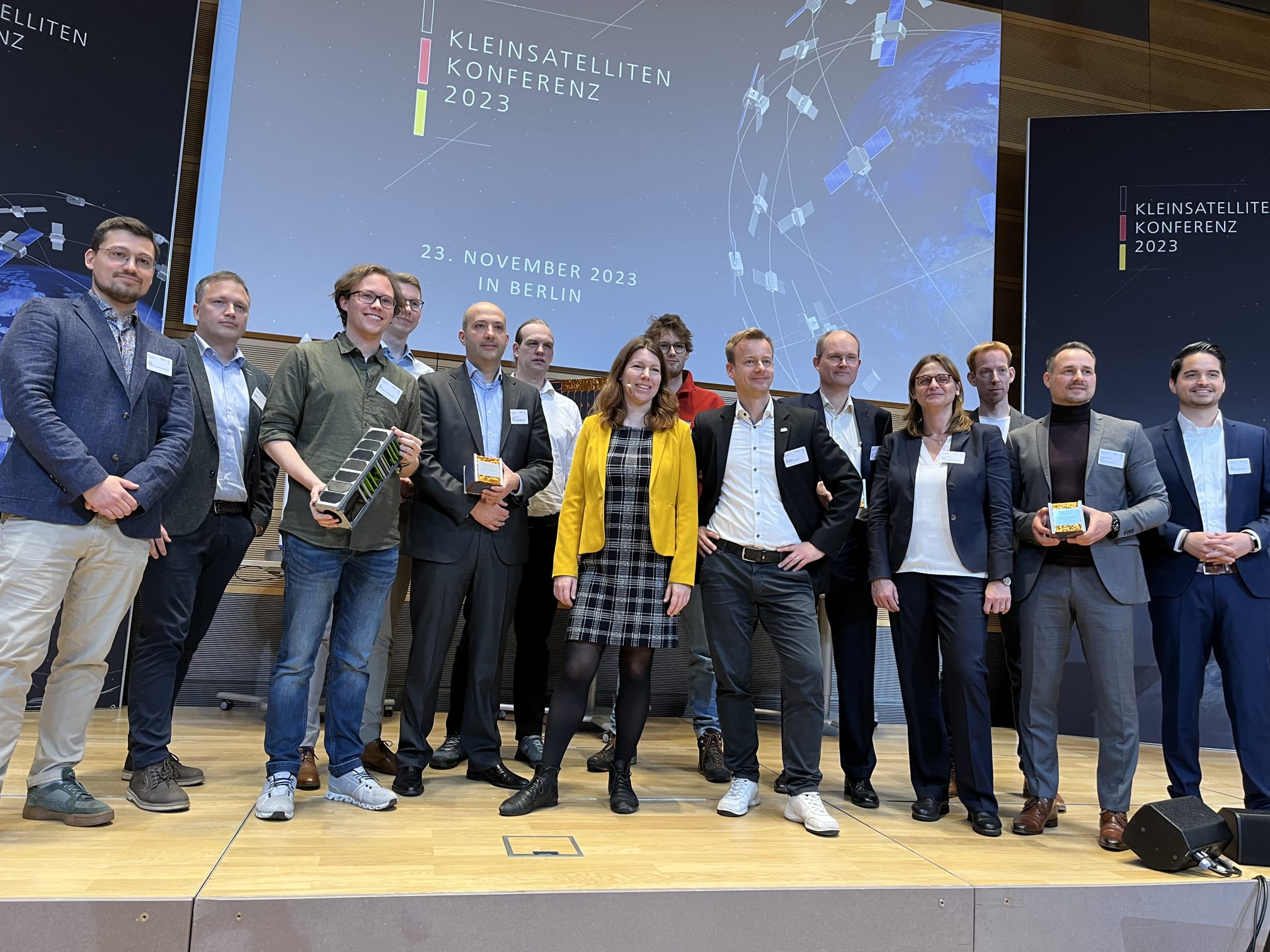
Berlin, 23 November 2023 – Rocket Factory Augsburg (RFA) and the German Space Agency in the German Aerospace Center (DLR) today announced the winners of the second round of the payload competition for German launcher systems at an event in Berlin. Eight customers with a total payload of 200kg will fly on the second test flight of the RFA ONE. After the first flight of the RFA ONE was fully booked, there was more demand than capacity for the second flight.

After RFA won the DLR Microlauncher competition organized by the German Space Agency in the German Aerospace Center (DLR) in April 2022, the company was awarded prize money of 11 million euros. As part of this, RFA was able to secure the German government as an anchor customer for the first two flights. Following this success, satellite manufacturers, research institutes and start-ups were invited to apply for these flights in a call for tenders issued by DLR. A jury of experts has now selected eight missions/winners with a total payload of 200 kg for the second test flight of RFA ONE, which will reach a sun-synchronous orbit at an altitude of 500 km. In this orbit, the satellites will be precisely positioned and can be rapidly commissioned to fulfil their individual missions. The launch is planned for the end of 2024.

DLR received more applications for the second flight of RFA ONE than for any other small launcher. The demand was significantly higher than the available capacity. The fact that the second flight is fully booked once again confirms RFA’s technological and commercial leadership.

Jörn Spurmann, RFA’s Chief Commercial Officer, said: “We are delighted with the high demand for our second launch, which underlines the growing confidence in our launch service product and the RFA team. The successful partnership with the German Space Agency (DLR) is seen as a pioneering model for efficient cooperation at the European level. The European Launcher Challenge, initiated by Germany, is a promising approach to increase the use of private launch services by institutions and countries. We are now doing all we can to lay the foundations for these promising developments with the first flight next year”.

The payload competition is part of the German Space Agency’s micro-launcher competition at the German Aerospace Center. The aim of this programme is to drive forward the commercialization of European space and to improve the independence and competitiveness of companies and research institutions, particularly in the field of smaller payloads.

“We see these competitions as a catalyst and pioneer for the commercialization of space activities in Germany and Europe,” says Dr. Walther Pelzer, DLR Executive Board Member and Director General of the German Space Agency at DLR.

The following missions will be on board the second test flight of RFA ONE:

MIDAS

DLR Cologne

Germany

MIDAS will investigate the self-assembly of structures formed by active self-propelled microswimmers, and the long-term stability of these aggregates under microgravity conditions. Microswimmers are model systems that mimic the motion of cells and microorganisms. In suspension, they form aggregates that can be solidified into so-called active materials that can convert energy into mechanical motion on a microscopic scale. Such active materials possess great potential in applications as smart materials that can adapt their physical properties to changes in the environment. The proposal is in line with the ESA SciSpaceE White Paper defining the road map for Soft Matter and Biophysics (§2.6). The payload proposed here is derived from a payload previously flown several times on the MAPHEUS sounding rocket.

SPACEMAST

DLR Braunschweig

Germany

The SpaceMast Camera Mast is a deployable camera mast mounted directly to the Redshift OTV of RFA ONE. Once the Redshift OTV reaches the first target orbit, a 7m composite mast is deployed with a camera on its tip, to full (7m) or intermediate length (e.g. 2 m) for overview or closer view video footage of the OTV and the payloads being released/deployed. The camera mast can be retracted for further OTV transfer maneuvers and deployed again to make video footage of further payloads to be deployed.

More info: https://event.dlr.de/ila2022/spacemast/

Platform 9

Endurosat

Bulgaria

Platform-9 is part of EnduroSat’s Shared Satellite Constellation, which offers visionary companies the shortest and most affordable path to orbit for deploying their services, in-orbit testing and validation. EnduroSat’s unique software-defined NanoSat architecture allows for multiple sensors to operate together reliably on a single satellite, resulting in outstanding sustainable space service. Fewer satellites in orbit, used with much higher efficiency, shared as a common resource in orbit. Furthermore, EnduroSat’s redundant multi-master architecture provides unique payload operations reliability.

More info: https://www.endurosat.com/

VIBES Pioneer

Hochschule Bremen

Germany

VIBES Pioneer is a 3U CubeSat. The goal of the mission is to improve the optical performance of spacecraft using digital technologies. The spacecraft hosts an optical payload equipped with a light and cost-effective disturbance measurement and management system. During each image acquisition, accelerometers log the perturbations emitted by reaction wheels and their propagation along the satellite structure. Passive isolators placed on the structural path between the reaction wheel and the camera will reduce the disturbances. An active line-of-sight system for fine-pointing control of the payload will further improve the performance. The generated image data and satellite status information will be delivered to the ground with a software-defined radio.

More info: https://www.hs-bremen.de/die-hsb/fakultaeten/natur-und-technik/institute-of-aerospace-technology-iat/vibes-the-digital-satellite-launching-bremen-into-the-future-of-spaceflight/

PW3-Sat3

University of Warsaw

Poland

PW-Sat3 is the third satellite constructed by the Students’ Space Association at the Warsaw University of Technology in Poland. Following the deorbit sail demonstration performed by the PW-Sat2 team, the student team designed a butane warm-gas propulsion system with an additional heating chamber and membrane for pressurization. According to the mission plan, the device will perform orbit correction and deorbiting maneuvers to address the collision risk and space debris problems.

More info: https://pw-sat.pl/en/home-page/

Flamingo

Vyoma

Germany

Flamingo is a pilot mission for a satellite constellation to be deployed in an orbit around Earth. The remaining ten satellites shall be deployed from 2025 (the so-called Flamingo NextGen mission). Current trends point to a continuous increase in congestion of the near-Earth space environment, and novel approaches to detection, characterization, tracking and management of traffic must be sought to ensure space remains a safe, integral part of societies and economies worldwide, in a cost-effective manner. Vyoma’s satellites will passively monitor the space environment using optical onboard cameras and provide frequent updates to the ground. The data generated by the constellation shall enhance current space situational awareness (SSA) capabilities and enable satellite owners to make informed operational decisions.

More info: https://www.vyoma.space/

3Cat-8

Universitat Politecnica De Catalunya

Spain

The 3Cat-8 mission is a comprehensive satellite project encompassing educational, scientific, and technological objectives. It offers a unique educational opportunity, being primarily executed by students with support from industry contributions, including advanced technologies like an ionic thruster and OWL. The mission also focuses on ground-breaking scientific endeavours, notably the near-simultaneous ionospheric scintillation monitoring using GNSS Radio Occultation, and capturing the ionosphere’s multispectral polarized emission imaging. This is complemented by Radio Frequency Interference monitoring in both L- and K- bands.

More info: https://nanosatlab.upc.edu/en

MOVE-BEYOND

Technische Universität – WARR e.V.

Germany

The MOVE-BEYOND mission is dedicated to testing the innovative MOVE-BEYOND bus system, a pivotal development in satellite technology. This system is designed with a novel approach that emphasizes scalability and flexibility, enabling it to accommodate a diverse range of payloads. In line with this, it presents a unique opportunity for payloads that do not yet have a defined bus system. This mission represents a significant step forward in making satellite technology more adaptable and inclusive of various research and application needs, potentially revolutionizing how payloads are integrated and deployed in space missions.

— END —

About the German Space Agency at DLR

The German Aerospace Center (Deutsches Zentrum für Luft- und Raumfahrt; DLR) is the Federal Republic of Germany’s research centre for aeronautics and space. The organisation also conducts research and development activities in the fields of aeronautics, space, energy, transport, security and digitalisation. Within DLR the German Space Agency implements the Federal Government’s space strategy. More than 330 employees based in Bonn coordinate all of the German space activities at national and European levels and represents German space interests worldwide on behalf of the Federal Government. The tasks of German Space Agency at DLR include the planning and implementation of the national space programme and the management of Germany’s contributions to the European Space Agency (ESA) and the European Organisation for the Exploitation of Meteorological Satellites (EUMETSAT).

About Rocket Factory

Rocket Factory Augsburg was founded in 2018 with the vision to enable data generating business models in space to better monitor, protect and connect our planet Earth. Against this background, the company’s goal is to offer launch services of up to 1.300kg into low Earth orbits and beyond on a weekly basis at highly competitive prices. With this, RFA wants to democratize access to space and reduce the launch costs in the space industry. The RFA ONE launch service combines three key competitive advantages: A customer-focused service with precise in-orbit delivery and a high degree of mission flexibility through its Redshift OTV; at a highly competitive price; made possible by superior staged combustion technology, low-cost stainless-steel structures and usage of industrial components. In June 2023, RFA became the first company in Europe to fire a complete upper stage with a staged combustion engine for the entire duration of the flight. In August, American investor KKR acquired a stake in RFA.

Media Contact RFA:

Mr. Jonas Kellner

Telefon +49 821 999576-21

Email: jonas.kellner@rfa.space


Rocket Factory Augsburg AG

Berliner Allee 65

86153 Augsburg

Germany


Chairman of the Supervisory Board: Jean-Jacques Dordain

Board of Directors: Stefan Tweraser, Stefan Brieschenk, Jörn Spurmann

Seat of the company: Augsburg

Registry Court: AG Augsburg, HRB 34251

USt-ID/Tax-ID: DE319402838

Interested in featuring us?

UK Space Agency supports RFA UK through BOOST!

RFA ONE flies into space
  • Launch service provider RFA UK (Rocket Factory Ltd) has received £3.5 million from the UK Space Agency. The funding was awarded as part of the European Space Agency (ESA), Boost! Programme.
  • This makes RFA AG the most endorsed commercial launch service development within the C-STS Boost! Programme.
  • RFA UK will use the funding to develop and operate the infrastructure and test equipment needed to enable them to launch the RFA ONE launch system.
  • The first launch from SaxaVord Spaceport is planned for Q2 2024.


Grantown-on-Spey, Scotland – October 27, 2023. Launch service provider RFA UK (Rocket Factory Ltd) has received £3.5 million to support its plans to launch from SaxaVord Spaceport in the Shetland Islands. The announcement comes as UK Science Minister, George Freeman, visits SaxaVord Spaceport to see progress at the site and meet key members of RFA UK.


The funding was awarded by the UK Space Agency as part of the European Space Agency (ESA), Boost! Programme, which aims to help innovative companies develop new launch technologies and bring them to market. With the UK contributing as the third nation to the RFA ONE development via C-STS Boost!, RFA AG is the most endorsed commercial launch service development within the C-STS Boost! Programme.


RFA UK will use the funding to develop and operate the infrastructure and test equipment needed to enable them to launch the RFA ONE launch system from SaxaVord Spaceport, planned for Q2 2024. RFA UK and SaxaVord Spaceport anticipate around 90 skilled jobs will be created locally when the spaceport arrives to full operational capability including spaceport operations and administration, integration, testing and launch.


A subsidiary of Rocket Factory Augsburg AG (RFA AG), the UK company is headquartered in Grantown-on-Spey, Scotland. RFA AG will have exclusive access to the SaxaVord’s ‘Fredo’ launch pad from where it plans to provide a regular cadence of launch services as one of the spaceport’s anchor customers. RFA UK was set-up to implement and operate launch-specific system and test equipment to support RFA AG’s planned launches from SaxaVord Spaceport.


Measuring 30 metres tall and 2 metres wide, the RFA ONE launch vehicle is a three-stage launch vehicle capable of deploying up to 1,300 kg to a 500 km polar orbit. The rocket uses efficient and environmentally friendly Helix staged-combustion engines, stainless steel tanks and standardised components from other industries to offer flexible, low-cost and precise transportation into orbit with its Redshift OTV.


Jörn Spurmann, Managing Director, RFA UK and Chief Commercial Officer, RFA AG

The support received from the UK Space Agency underscores their strong confidence in our approach. We are eagerly anticipating our inaugural orbital launch from the SaxaVord Spaceport in the UK. This event will further cement our position as the pioneers in European commercial spaceflight. At the same time, it demonstrates the unwavering confidence the European Space Agency has in our strategy.


With the UK contributing as the third nation to the RFA ONE development via C-STS Boost!, we solidify our role as a genuine European launch service provider and the most endorsed commercial launch service development within the C-STS Boost! Programme. We are absolutely delighted to reciprocate this faith and support.


George Freeman MP, Minister of State at the Department for Science, Innovation and Technology, said:

“The UK’s high growth £17bn space industry is on the frontline of advanced satellite manufacturing and satcomms technology and services, and set to grow fast as the commercial Low Earth Orbit (LEO) Satellite sector expands in the next decade. Through our c£1.5bn UK space funding programmes the Government is backing satcomms technology, space science, missions and infrastructure to support the commercial satellite sector.


This £3.5 million investment will enable RFA UK to develop the technologies necessary to launch from SaxaVord Spaceport in Scotland, creating dozens of jobs locally and growing the Scottish cluster as a key part of the UK space sector.”


Matt Archer, Director of Launch, UK Space Agency said:

“Our investment to Rocket Factory Augsburg (RFA) UK demonstrates our continued commitment to make the UK Europe’s leading destination for launch by encouraging the development of launch companies. This contract will help RFA UK and SaxaVord Spaceport prepare for their first launch, creating high skilled jobs and supporting Government’s vision for the UK to be Europe’s most attractive launch destination by 2030.” 


Scott Hammond, SaxaVord Spaceport deputy CEO, said:

We are delighted that the UK Space Agency has awarded this funding to our client to help them progress towards launch from our site in Unst, the UK’s first vertical launch spaceport.


UK Government Minister for Scotland, John Lamont, said:

The Scottish space sector continues to go from strength to strength with the latest figures showing an almost £40 million increase in income and more than 100 new highly-skilled jobs with support from the UK Government. This new funding will help support launches from SaxaVord Spaceport in Shetland, and maintain UK leadership in this sector.”

+++ END +++

About Rocket Factory

Rocket Factory Augsburg was founded in 2018 with the vision to enable data generating business models in space to better monitor, protect and connect our planet Earth. Against this background, the company’s goal is to offer launch services of up to 1.300kg into low Earth orbits and beyond on a weekly basis at highly competitive prices. With this, RFA wants to democratize access to space and reduce the launch costs in the space industry. The RFA ONE launch service combines three key competitive advantages: A customer focused service with precise in-orbit delivery and a high degree of mission flexibility through its Redshift OTV; at a highly competitive price; made possible by superior staged combustion technology, low-cost stainless-steel structures and usage of industrial components.

Media Contact RFA:

Mr. Jonas Kellner

Telefon +49 821 999576-21

Email: jonas.kellner@rfa.space

Rocket Factory Augsburg AG

Berliner Allee 65

86153 Augsburg

Germany

Chairman of the Supervisory Board: Jean-Jacques Dordain

Board of Directors: Stefan Tweraser, Stefan Brieschenk, Jörn Spurmann

Seat of the company: Augsburg

Registry Court: AG Augsburg, HRB 34251

USt-ID/Tax-ID: DE319402838

Interested in featuring us?

“This is the day the European launcher sector will totally change.”

An interview with former Director General of ESA, Jean-Jacques Dordain.

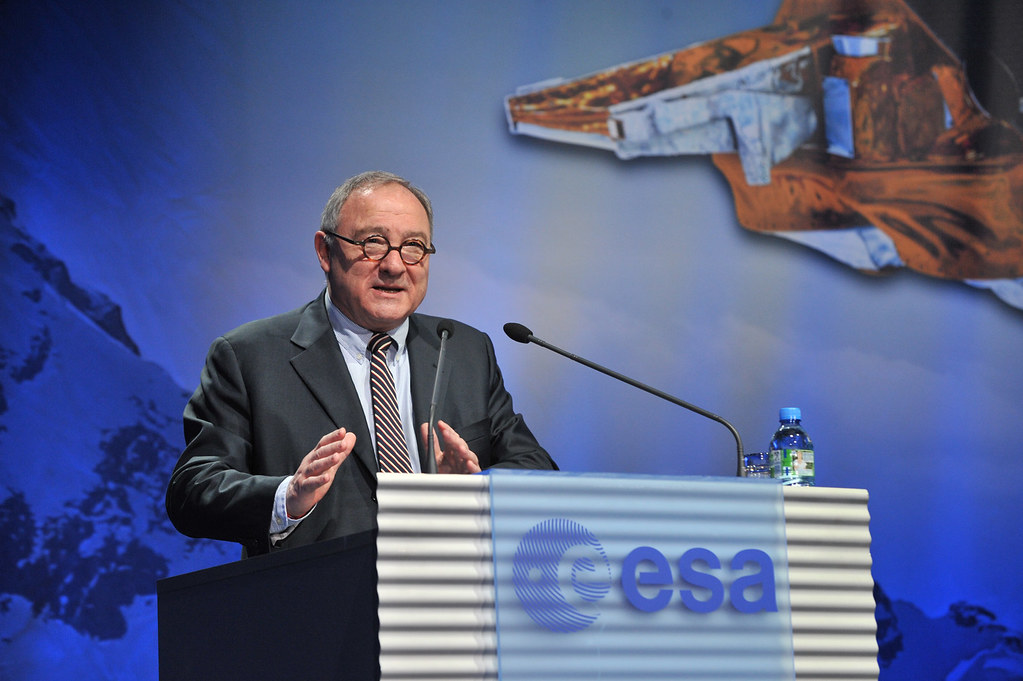
Jean-Jacques Dordain speaking at the CryoSat-2 launch event in 2010. Image credit: ESA

Jean-Jacques Dordain is Chairman of the Supervisory Board at Rocket Factory Augsburg AG. Having been professionally involved in space travel since the 1970s, he brings a wealth of experience to the table and is a highly valued member of our RFA family. From his dreams of being an astronaut to becoming Director General at ESA and eventually joining RFA, Jean-Jacques has a unique story to share!


We sat down with him to talk about his professional journey, the challenges he faced, his view on the current developments and why he is so passionate about what we are doing at Rocket Factory.

You were Director General at ESA for 12 years from 2003 to 2015. How did you get that role?

I was already working at ESA and became the first Director General to be promoted from within ESA itself, so that was easier for me than my predecessors because I already knew the people at ESA.  I was the Director of launchers when I was invited to apply for the Director General role by the Nordic ESA member states. The selection process is very complex. But after a few months, I was appointed Director General.


It was a very special position to be in because on the one hand, you have this fantastic team of 2,000 people supporting you. But on the other hand, when it comes to making crucial decisions, you are alone.

That can’t have been easy.

You get great advice! But in the end, making decisions is always the most difficult part. Because there is a difference between making a decision and making a choice. When you make a choice, you should have all the elements to choose from. When you make a decision, there are always some uncertainties and thus some risks.

Jean-Jacques Dordain speaking at the CryoSat-2 launch event in 2010. Image credit: ESA
Jean-Jaques Dordain speaking at the CryoSat-2 launch event.
Image Credit: ESA / www.juergenmai.com

What was your job as a Director General like?

There was a lot of politics and diplomacy. I had to propose new projects and ideas to the member states of ESA. And therefore convince 22 countries to make joint decisions at the same time. This is where politics and diplomacy are very important because you have to explain to 22 countries that they should combine their specific interests into one mutual interest. And after that, you have to implement the decisions within the ESA rules together with the industry and all the ESA partners. It’s a lot of work, but all of it materializes into fantastic projects.

What are you doing now?

Now, I support young enterprises to make their dreams come true. I still have the pleasure of working in space but I don’t have the responsibility or do any of the administrative tasks anymore. It’s much better. Just the fun parts.

Is it true that you originally wanted to become an astronaut?

I tried to become an astronaut back in 1977. I did not make it, but I was among the final five candidates selected by France. Sometimes I joke that my dream was always to become an astronaut, being Director General of ESA was just the backup!

Space is a passion for me, not a job. Not many people are able to live their passion as I did and still do. I would still fly into space if I was offered the opportunity. That dream remains alive.

While you were at ESA, what was the most exciting thing happening in spaceflight?

There were so many events. Landing on Titan with the Huygens probe is one because it was the first marking event of my first mandate. Landing on this faraway moon of Saturn with its thick atmosphere was fantastic. ESA was the first to ever achieve this. But I was just the lucky Director General at the end of a chain of successive Director Generals doing the proposal, studies, development and the launch of that project.


Another one was the landing of Rosetta on a comet because it was the last marking event of my last mandate. I was just lucky to be there when it landed. I don’t take credit for this amazing mission. It was a multi-generational team effort.

So it´s all about the team.

Absolutely! It´s the same here at RFA. The biggest asset of RFA is its dedicated team and the pleasure of feeling part of the team.

Let’s talk a little bit about JUICE and JWST, which also happened during your time. How was your experience there?

James Webb was just a continuation of the NASA-ESA cooperation for the Hubble Space Telescope. When NASA decided to create the next generation of space telescope, they naturally discussed the idea with ESA, because of the success of Hubble.

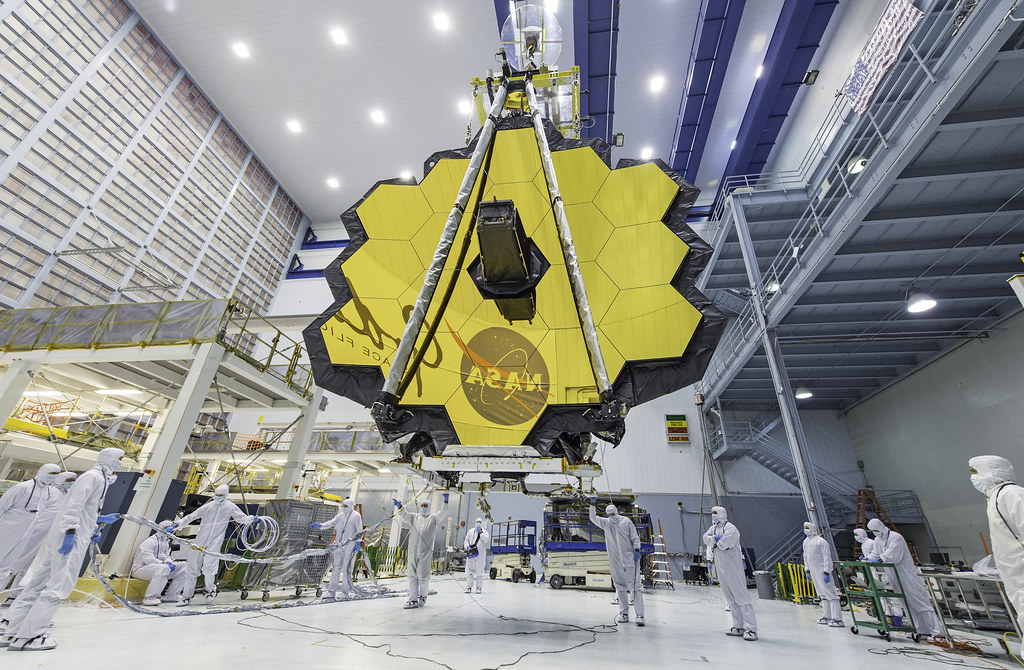
James Webb Space Telescope that Jean-Jeacques discusses during the interview with RFA.
James Webb Space Telescope. Image Credit: NASA/Desiree Stover

One of the ideas that emerged was the use of a European launcher to launch JWST. That was significant because it is unusual for NASA to put such a big project on top of a European rocket. This shows the confidence they had in our capabilities. Making the deal between NASA and ESA was the easy part. The hard part was for NASA to explain to the US launch operators that it preferred to launch with Europeans and for ESA to explain to the European scientists that we were using money for science to purchase a launcher.

Why is that so important?

The launch is always a very critical part of a space project. You work decades for a mission and then the launch is 10 minutes of bottlenecks and stresses. It’s all or nothing. This is the reason why it’s the launch of any mission that is always very, very emotional. No launch is easy. When I was the DG, I used to quote Winston Churchill before any launch: “You can never guarantee your success, but you must always deserve it”. And after a successful launch, I would say “my only regret is that it looks easy.”

What was your first touch point with private spaceflight?

It was – of course – SpaceX in 2002. Traditionally, we had always taken a government-driven top-down approach. But New Space works from a privately-driven bottom-up approach. It’s a totally different approach, but the two are not antagonists. They are both necessary. What traditional space agencies can do is promote and help new private enterprises.

I remember my first meeting with Elon Musk. He said that he thought space agencies were representative of the traditional space industry. But he also quickly realized that he could not do without the agencies. There is always interaction between the two worlds.

This year Europe lost its independent access to space. Ariane 6 is late, Vega-C had critical failures and is grounded. What are your thoughts?

My thoughts are first going to all those who are giving their best to get both Ariane 6 and Vega-C into orbit. It confirms that launching into space is not easy.


But it also demonstrates that the model European space access relied on for decades must be adapted to a world where commercial offers are available at much lower prices. Ariane has been the most reliable launcher in the world for decades, but being reliable is not enough anymore.


The guarantee of access to space will be more robust if it relies upon several competitive sources, as is currently the case for satellites in Europe and launchers in the US. Competition is good for both companies and customers. It provides customers with the best prices and companies with the motivation to continuously improve to keep making competitive offers. This is where RFA is so important!

You saw this potential of a new business model decades before the likes of RFA, Latitude, Isar Aerospace, OrbEx and all these companies came along.

Yes, I was convinced we could develop a launcher totally differently and with much lower costs.  As a young research engineer on rocket engines, I met Lutz Kayser. He was a German entrepreneur who founded the private company OTRAG, which developed orbital launchers in the 1970s. He was the first guy that I knew of to try and use this private model and make launchers at a low cost using tubes, pipes and other parts he could buy in the shop next door. Fascinating!


Unfortunately, his project was ultimately unsuccessful. Among other reasons, it was too early. But it was the first time I heard that it could be possible to make a launcher privately.

image of a SpaceX rocket launch
Falcon Heavy Demo Mission. Image Credit: Official SpaceX Photos on Flickr

Do you think the only way Europe can maintain access to space now is to commit to commercializing the industry, where institutions buy privately developed products and services instead of developing them themselves?

Yes.  because it’s exactly what NASA is doing successfully. They are just purchasing services through competition bidding among several US commercial operators.  In addition, they support new technologies available as open sources.


Interestingly, when I went to the German Parliament last year on behalf of RFA, I was told the European market is not big enough to sustain several sources.

And I said “I never said that we shall stay within the European market. What we wish is to be competitive in the world market.”


Our competitors are not just Isar Aerospace or the Ariane Group. Our competitors are also SpaceX, Blue Origin and ULA. We want to be successful in the world market, not just the European market. At least this is the end goal. Of course, we are not yet there and first we have to launch!

What brought you to RFA in the end? What was something that drew you in?

I’m here for two reasons. First, I had made a commitment to Manfred Fuchs back in 2006. I was Director General at ESA and we were in a meeting with OHB when the topic of Elon Musk was raised. With Lutz Kayser still in my memory, I told Manfred “If you put 100 million on the table today, I will leave ESA tomorrow and come with you to make the best launcher in the world.”


Of course, he did not do that. But years later, his son Marco Fuchs came to me after I had left ESA and said “Do you remember what you promised my father?” He confirmed that he was financing the start of a new enterprise. I told him I was ready to do for him what I had promised his father. And that new enterprise became RFA.


But I have a second motivation.


Even before the Ariane6 project started in 2014, I had already tried to change the European launcher sector several times within the framework of ESA but I did not succeed. It showed me that changing from the inside without being challenged from the outside was very difficult. So, my wish is to make RFA the outside challenger helping to change the European launcher sector I could not change when I was at ESA.


Thus, the success of RFA will be much more than the success of RFA. It will prove that we can make a launcher totally differently. The day RFA demonstrates this with two or three launches is the day the European launcher sector will totally change.

What do you think defines the New Space industry? What are the key points that make a successful modern launcher and how do you apply those to RFA?

Costs, costs and costs. It’s all about significant cost reduction. That’s the key to the future. And that´s the main driver of RFA.


Obviously, it has to work and be reliable and, as I said already, we are not yet there. But the key driver is cost. I have met costs at RFA that I never believed were possible when at ESA. And what’s interesting is that RFA is using parts from different industries to build their launcher.


It’s a totally different approach which is 100% cost-driven. What RFA has been able to do so far with just 50 million is incredible: A functioning Helix staged-combustion engine, a qualified first stage, and an upper stage that was hot-fired for its full flight duration of 280 seconds multiple times. We are on a good track to fulfill our commitment to complete the full development and two first launches within six years and within 100 million Euros.


But we have to demonstrate and prove we can successfully fly into space. Until we have demonstrated that it works, it’s just hope. It’s not a reality yet.

What are the things that make you confident in our ability to build a working launcher?

The people. Definitely the people. The biggest asset at RFA is the dedicated team. When I come to Augsburg, I try to spend one or two hours with four or five people on the team and I really enjoy that.


Each time, I measure the expertise, I feel the passion and I appreciate the ownership. I also value the diversity of culture. There are more nationalities in the 200+ people at RFA than in the 2000 people at ESA! I learn every day I meet the people of RFA.

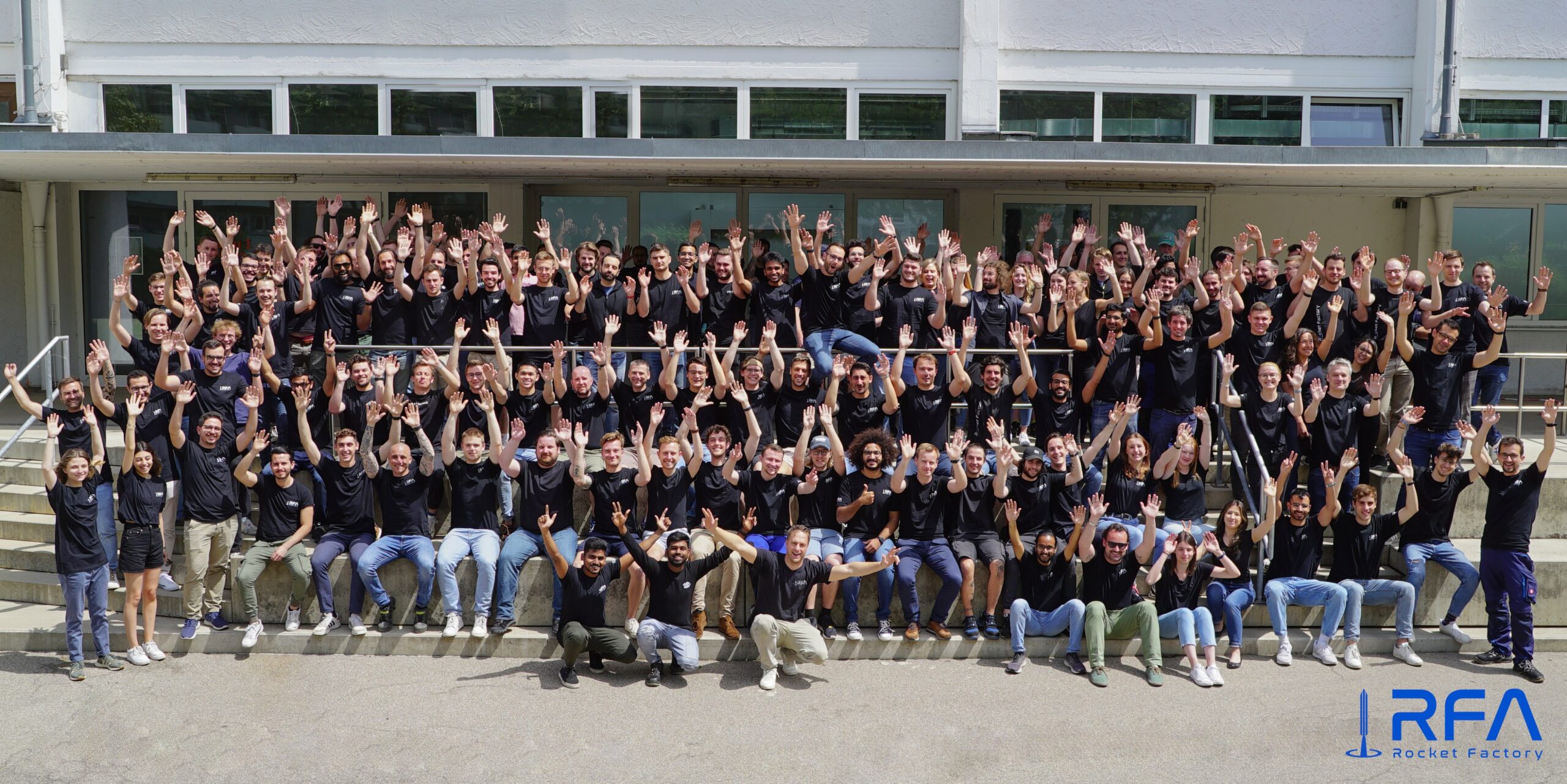
Rocket Factory Augsburg Team Photograph 2022

What was your greatest moment so far at RFA?

The whole journey has been exciting, but of course, the biggest moment so far was our successful upper-stage hot fire in May 2023, where we integrated the Helix engine into an upper-stage tank system and hot fired for a full duration of 280 seconds. It is an incredible achievement. RFA was the first private space company in Europe to achieve this success with a staged combustion engine. This hot fire test was the first big step for RFA in proving their technology and business case to the world.


But the most exciting moments are the ones still to come, and among them are the firing test of the first stage on the launch pad and ultimately the first launch. As a rocket engineer, of course, I especially love things that involve fire. Controlling fire and bundling it into engines of this power is an incredible achievement of mankind.


Controlling fire. That’s a great line to end on. Thank you very much for your time, Jean-Jacques Dordain!

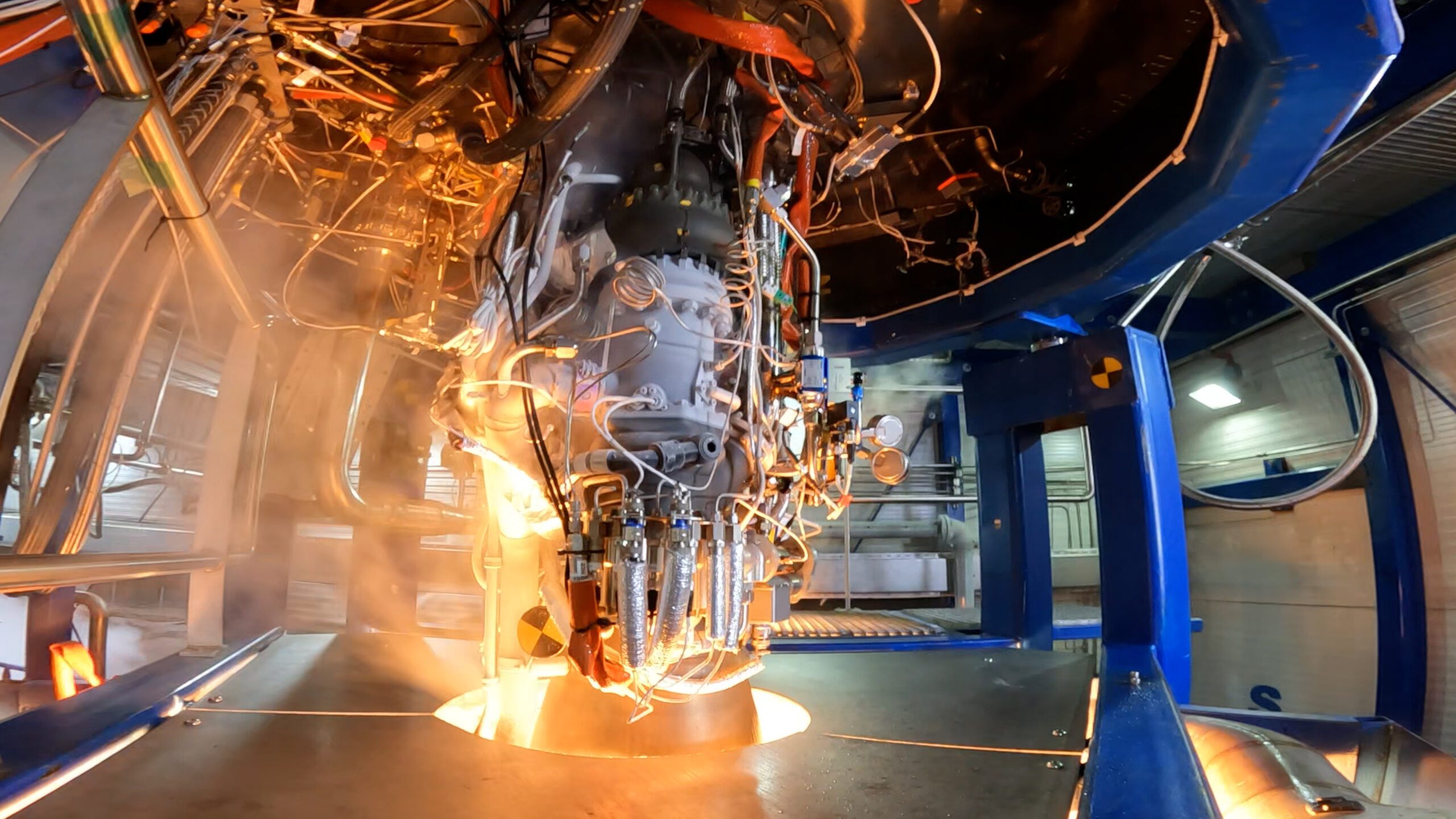
Rocket Factory Augsburg upper stage IST

SUBSCRIBE

Stay up to date with The Preburner blog and all of our latest posts by signing up.

Interested in featuring us?

Three German NewSpace companies launch “Eva”, the world’s first end-to-end microgravity service for biotech research and product development

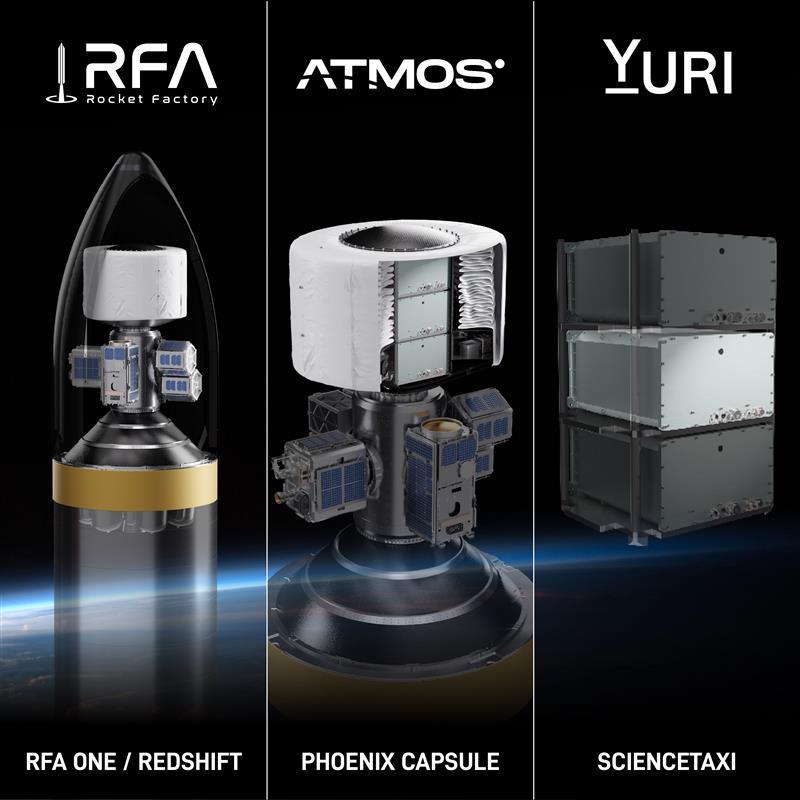
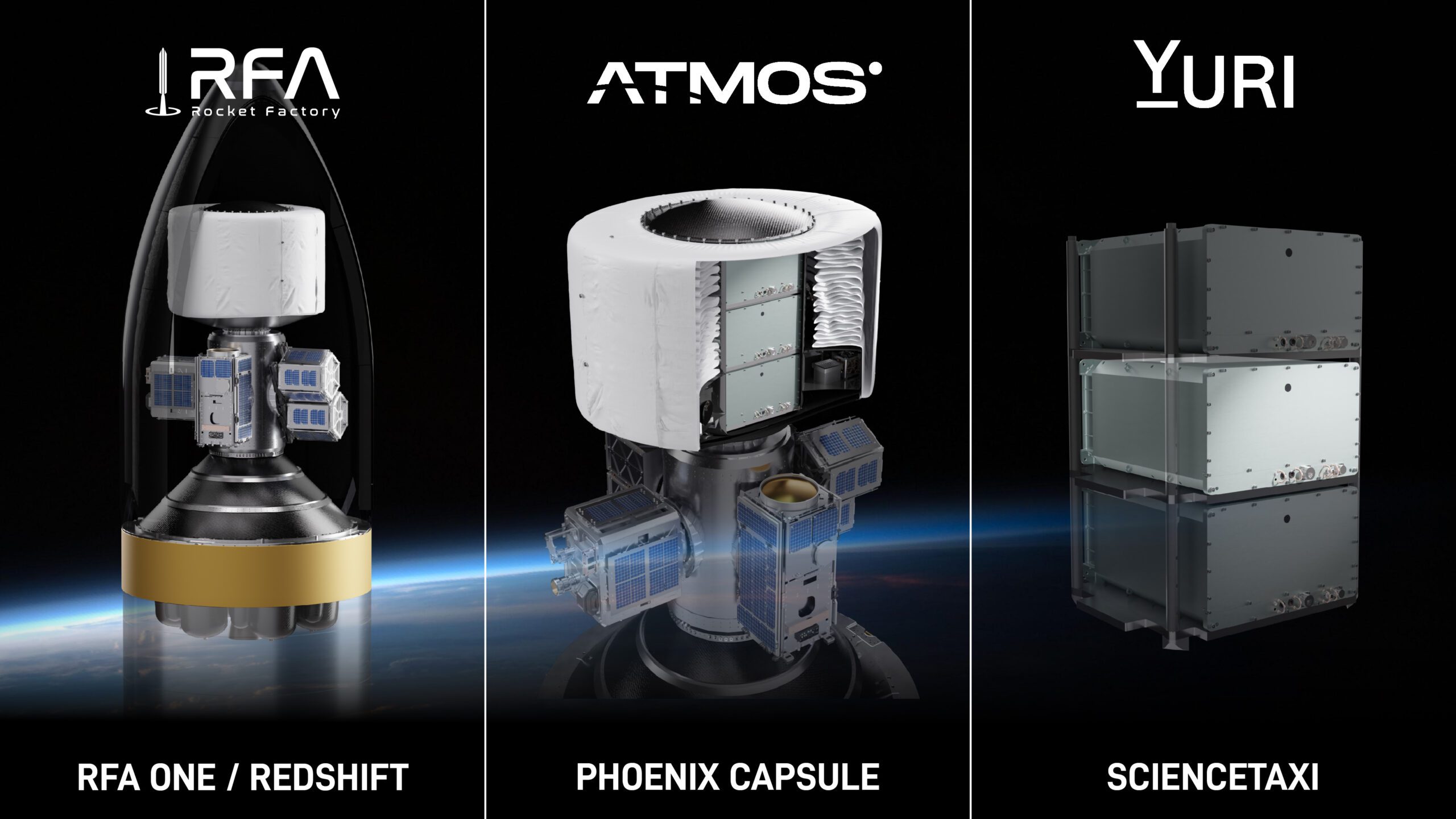
Render of the world's first end-to-end microgravity service by Rocket Factory Augsburg, ATMOS and Yuri.
  • Rocket Factory Augsburg (short: RFA) offers flexible and low-cost launch services thus providing affordable access to space
  • ATMOS Space Cargo develops reusable, modular, and highly scalable return space capsules for any scientific payload, experiment, or equipment
  • Yuri develops modular bioreactors and incubators to be used in microgravity environments to develop and manufacture superior biotech products in space
  • The new microgravity end-to-end service will be available from 2025.
  • This service is an answer to the growing demand of the life sciences industry. The total in-space manufacturing market is expected to reach €7 billion in 2030.

Weltraumkongress, Berlin, Germany – October 18, 2023.

Three pioneering German NewSpace companies, Rocket Factory Augsburg (RFA), Yuri, and ATMOS Space Cargo (ATMOS) announced their new partnership and launch of their joint end-to-end service for microgravity life science research and product development at this year’s edition of Weltraumkongress in Berlin, Germany. This holistic  solution represents an unprecedented and flexible alternative to the ISS laboratory and initiates a new generation for microgravity research and thus advancement in biotech, life science, and product development worldwide. 

THREE NewSpace experts - ONE microgravity service

In this consortium, Rocket Factory Augsburg is responsible for the entire launch service, including the launch system, infrastructure, outbound logistics, and the operational launch campaign. RFA will be delivering ATMOS Space Cargo’s Phoenix capsule with Yuri’s ScienceTaxi to the precise target orbit in a flexible and low-cost manner. The company will be responsible for the integration of the Phoenix space capsule onto its RFA ONE launch system while providing late access to the payload.

The launch campaigns are to be carried out from SaxaVord Spaceport (previously known as Shetland Space Center) on Unst, the most northerly of the Shetland Islands in Scotland, UK.

Yuri operates the ScienceTaxi, which will be integrated into the Phoenix capsule by ATMOS Space Cargo. With its groundbreaking life science incubator and bioreactor solutions, Yuri will be responsible for the execution of biotech research and manufacturing in space.

ATMOS Space Cargo is responsible for the re-entry logistics and operating the return mission of the Phoenix return capsule which will be carrying Yuri’s ScienceTaxi. ATMOS will supervise and execute the safe return from low Earth orbit (LEO) to the Azores and carry out the early retrieval of the capsule after landing as well as the recovery mission to the final location.

Jörn Spurmann, CCO at Rocket Factory Augsburg:
“With “Eva” we will set up a unique global service that will allow breakthrough insights in BioTech and product development. Customers receive a complete solution from three experts in their respective fields, allowing them to focus on their core business. We are also particularly proud to be able to fully map the value chain with our partners in Germany. This is a great sign of German NewSpace Industry capability.”

Maria Birlem, Co-CEO at Yuri:

“In this new era of space exploration and commercialization, Europe and Germany must not only witness, but actively shape the future. With the combined strengths of Rocket Factory Augsburg, ATMOS Space Cargo, and Yuri, we’re not just aiming to level the playing field with the USA; we’re setting our sights on pioneering new frontiers in LEO commercialization. It’s high time Europe takes its rightful place at the forefront of space innovation.”

Christian Grimm, Lead Systems Engineer and Co-Founder of ATMOS Space Cargo

“We are excited to establish the first full end-to-end service for biotech research in microgravity and thus creating new possibilities to utilize space for in-orbit product development. With our partners at Yuri and at the Rocket Factory Augsburg, we will boost the German NewSpace industry to the forefront of Europe’s expertise in space. This will mark the turning point for affordable in-orbit science and a possible role model for the commercialization of space – launch, return, repeat!”


— END —


About Rocket Factory Augsburg

Rocket Factory Augsburg was founded in 2018 with the goal to offer launch services of up to 1.300kg into low Earth orbits and beyond on a weekly basis at highly competitive prices. RFA wants to democratize access to space to enable the collection of data from above to better understand, connect and protect our planet Earth.

About Yuri

Yuri is a space biotech company that uses the microgravity environment of space to develop and manufacture superior biotech products. Yuri develops modular bioreactors and incubators for cell cultures, protein crystals or plants, launching them to the ISS and other spacecraft for scientists around the world.

About ATMOS Space Cargo

ATMOS Space Cargo GmbH specializes in the development and manufacturing of technology to return cargo of any size from space, from microgravity experiments, commercial products to entire rocket stages.

For press inquiries, please contact:
press@atmos-space-cargo.com
press@rfa.space


Rocket Factory Augsburg website:
rfa.space

Yuri website: yurigravity.com

ATMOS website: atmos-space-cargo.com

Media Contact RFA:

Mr. Jonas Kellner

Telefon +49 821 999576-21

Email: jonas.kellner@rfa.space


Rocket Factory Augsburg AG

Berliner Allee 65

86153 Augsburg

Germany


Chairman of the Supervisory Board: Jean-Jacques Dordain

Board of Directors: Stefan Tweraser, Stefan Brieschenk, Jörn Spurmann

Seat of the company: Augsburg

Registry Court: AG Augsburg, HRB 34251

USt-ID/Tax-ID: DE319402838

Interested in featuring us?

RFA secures €30m investment from KKR

Logo KKR and RFA with RFA ONE launch
  • KKR will become a leading investor in RFA alongside the existing strategic investor OHB
  • Investment comes after RFA’s successful completion of its upper stage hot fire test in May 2023, which was the first of its kind in Europe
  • With the capital from KKR, RFA will bring its RFA ONE micro launcher to the launchpad at SaxaVord Spaceport in Scotland
  • RFA offers cost-effective and flexible launch services to space as global demand for access to space rises

Augsburg, Germany –  August 7th 2023. Launch service provider Rocket Factory Augsburg AG (RFA) today announced that it has raised a €30 million investment from KKR, a leading global investment firm. The fresh funding is a vote of confidence for RFA as global demand for access to space continues to grow. The investment will facilitate RFA’s upcoming integrated first stage test and complete the company’s launch pad at SaxaVord Spaceport in Scotland, to eventually bring the RFA ONE microlauncher to the launchpad. The first flight is scheduled for Q2 2024. With its €30 million convertible bond investment, KKR will become a leading investor in RFA alongside the existing strategic investor OHB.

Stefan Tweraser, CEO at RFA: “We aim to provide cost-effective access to space and data-generating business models in space for monitoring, connecting, and protecting our planet. This new financing reflects confidence in RFA and validates our cost-efficient approach and technical achievements. Partnering with KKR as a long-term investor makes us proud – their financial resources, global network and industrial expertise will accelerate our mission, and support RFA towards our first launch next year and beyond.”

As global demand for cost-effective and flexible launch services to access space rises, RFA’s launch service offering is ideally positioned to benefit from this market opportunity. KKR’s investment follows the company’s successful completion of its upper stage hot fire test in May 2023, the first of its kind in Europe. This underlines investors’ trust in the business model of RFA, which prioritizes speedy and sustainable growth and maintains strong investment value for existing and new investors, and extends RFA’s technology and cost leadership.

Christian Ollig, Partner and Head of the DACH region at KKR: “KKR is excited to support RFA in its efforts to revolutionize access to space, which is crucial for emerging technologies that will shape our future. The team’s exceptional track record of achieving technical milestones and their unwavering focus on cost leadership are precisely the right strategy for future success in the global marketplace. We look forward to supporting RFA on its growth path.”

KKR’s investment comes from a holding company owned by its newest European private equity fund, KKR European Fund VI.

— ENDS —

About Rocket Factory

Rocket Factory Augsburg was founded in 2018 with the vision to enable data generating business models in space to better monitor, protect and connect our planet Earth. Against this background, the company’s goal is to offer launch services of up to 1.300kg into low Earth orbits and beyond on a weekly basis at highly competitive prices. With this, RFA wants to democratize access to space and reduce the launch costs in the space industry. The RFA ONE launch service combines three key competitive advantages: A customer focused service with precise in-orbit delivery and a high degree of mission flexibility through its Redshift OTV; at a highly competitive price; made possible by superior staged combustion technology, low-cost stainless-steel structures and usage of industrial components. In June 2023, RFA became the first company in Europe to hot fire a complete staged combustion engine upper stage over its entire flight duration. Including this milestone, RFA has invested a total of less than €50m.

About KKR

KKR is a leading global investment firm that offers alternative asset management as well as capital markets and insurance solutions. KKR aims to generate attractive investment returns by following a patient and disciplined investment approach, employing world-class people and supporting growth in its portfolio companies and communities. KKR sponsors investment funds that invest in private equity, credit and real assets and has strategic partners that manage hedge funds. KKR’s insurance subsidiaries offer retirement, life and reinsurance products under the management of Global Atlantic Financial Group. References to KKR’s investments may include the activities of its sponsored funds and insurance subsidiaries. For additional information about KKR & Co. Inc. (NYSE: KKR), please visit KKR’s website at www.kkr.com and on Twitter @KKR_Co.

Media Contact RFA:

Mr. Jonas Kellner

Telefon +49 821 999576-21

Email: jonas.kellner@rfa.space

Rocket Factory Augsburg AG

Berliner Allee 65

86153 Augsburg

Germany

Chairman of the Supervisory Board: Jean-Jacques Dordain

Board of Directors: Stefan Tweraser, Stefan Brieschenk, Jörn Spurmann

Seat of the company: Augsburg

Registry Court: AG Augsburg, HRB 34251

USt-ID/Tax-ID: DE319402838

Interested in featuring us?

RFA to launch from Kourou

Binding term sheet for launches from Diamant launch site signed

The rocket RFA ONE is lifting off the launch pad. On the left a big smoke plume is visible.

Paris, France – June 21, 2023. Launch service provider Rocket Factory Augsburg AG (RFA) has signed a binding term sheet with the French space agency CNES to offer its launch services from the Kourou Space Center (CSG) in French Guiana. RFA will launch from the ELM-Diamant launch complex beginning in 2025.


With access to arguably the European spaceport, launch service provider RFA will be able to offer customers all inclinations from equatorial to polar. This expands RFA’s portfolio of orbits available to customers to include low inclination orbits such as GTO, MEO, GEO, lunar and even interplanetary mission profiles. As a result, even more flexible and precise servicing of all types of missions for Earth observation, connectivity, or even entire constellations are possible. As part of CNES’ open tender process to open the Kourou Space Center (CSG) to commercial launch service providers, RFA ONE will launch from CSG starting in 2025.


In addition to the successful completion of the first European upper stage test of its kind in May 2023, RFA also confirms its commercial leadership position by securing the ELM-Diamant launch complex. With this second launch pad from RFA, the company will be able to deliver all mission profiles for ESA and its member states as institutional customers.

“By securing a launch site at the Diamant launch complex, this agreement allows RFA to offer GTO, MEO, GEO and even lunar and interplanetary flight profiles to its customers. By launching from Kourou, the European Spaceport, we can serve ESA and its member states as institutional customers for any mission profile they desire. Together with our successful upper stage hot fire test – a first in Europe – we have once again confirmed our technical and commercial leadership position in Europe,” said Jörn Spurmann, Chief Commercial Officer at RFA. “Just before the final launch of Ariane 5, this collaboration is a clear commitment to the future of European spaceflight from Kourou. We are very proud to launch from the historic Diamant launch site, where European spaceflight began its long and successful history. We look forward to continuing it.”
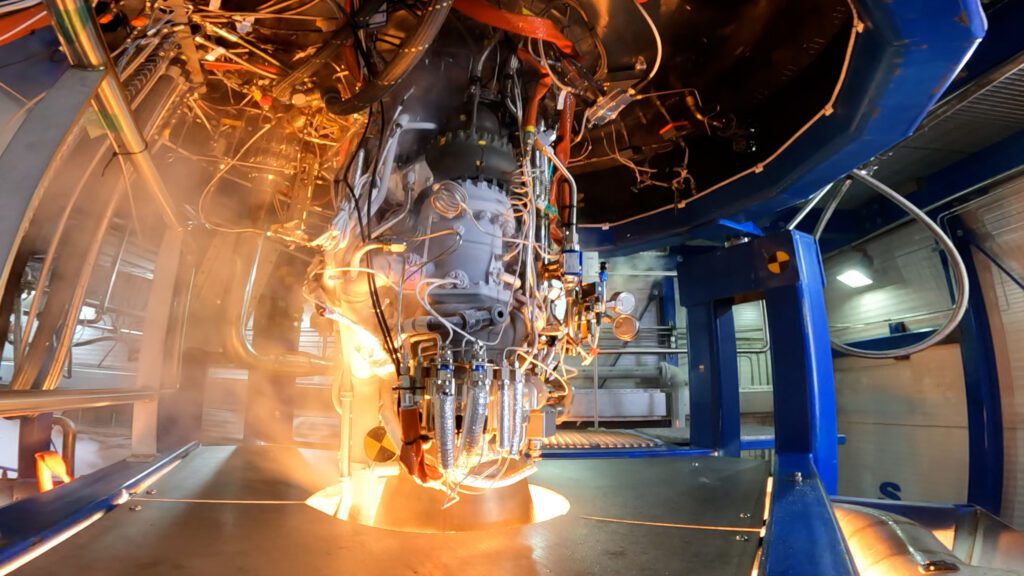
“CNES is proud to sign this agreement with RFA, which confirms RFA’s decision to launch from the ELM Diamond site at CSG’s European Spaceport,” said Dr. Paolo Baiocco, senior project manager for micro-mini launchers at CNES. “We look forward to working with RFA to further develop launch activities in Kourou. This is an important step for European spaceflight.”


Until now, the launch pad in Kourou has only been used by CNES for its Diamant rocket in the 1970s. Now the launch complex is to be given a new purpose, in the tradition of opening access to space through innovative and groundbreaking ventures. As such, RFA is one of the first NewSpace companies to be given the opportunity to use it. The new launch pad will be upgraded and equipped in the coming years with the aim of being used for launches from 2025.

About Rocket Factory

Rocket Factory Augsburg was founded in 2018 with the vision to enable data generating business models in space to better monitor, protect and connect our planet Earth. Against this background, the company’s goal is to offer launch services of up to 1.300kg into low Earth orbits and beyond on a weekly basis at highly competitive prices. With this, RFA wants to democratize access to space and reduce the launch costs in the space industry. The RFA ONE launch service combines three key competitive advantages: A customer focused service with precise in-orbit delivery and a high degree of mission flexibility through its Redshift OTV; at a highly competitive price; made possible by superior staged combustion technology, low-cost stainless-steel structures and usage of industrial components.

Media Contact RFA:

Mr. Jonas Kellner

Telefon +49 821 999576-21

Email: jonas.kellner@rfa.space

Rocket Factory Augsburg AG

Berliner Allee 65

86153 Augsburg

Germany

Chairman of the Supervisory Board: Jean-Jacques Dordain

Board of Directors: Stefan Tweraser, Stefan Brieschenk, Jörn Spurmann

Seat of the company: Augsburg

Registry Court: AG Augsburg, HRB 34251

USt-ID/Tax-ID: DE319402838

SUBSCRIBE

Stay up to date with The Preburner blog and all of our latest posts by signing up.

Interested in featuring us?

Lorem ipsum dolor sit amet, consectetur adipiscing elit. Ut elit tellus, luctus nec ullamcorper mattis, pulvinar dapibus leo.

280 seconds! RFA completes full duration upper stage hot fire

First full duration hot fire of a stagedcombustion stage in Europe 

Rocket Factory Augsburg upper stage IST

Augsburg, Germany June 2, 2023. Launch service provider Rocket Factory Augsburg AG (RFA) has successfully hot fired its upper stage for a full duration of 280 seconds. This marks the successful completion of the Integrated System Test (IST) campaign, in which a staged-combustion Helix engine was integrated into an upper stage tank system and hot fired several times up to full duration in the final test. This is the 1st time in Europe that a privately developed staged combustion upper stage has been successfully hot fired. 

In the now successfully completed IST campaign, all stage level systems and components were tested. The final test was a full duration burn of 280 seconds. This makes RFA the 1st private company in Europe to successfully hot fire a stage with a staged-combustion engine for its full duration. With this long duration burn, the Helix engine is now qualified at the same time for both first and second stage flight.

”The upper stage performed flawlessly and ran through the full 310s autosequence without tripping any redlines. The engine run-time was 280s and no damages could be identified after the test. This is the first successful qualification test of our upper stage, and we are super proud of our team for designing, building and testing in such a time- and money-efficient fashion” said Dr. Stefan Brieschenk, the company’s Chief Operating Officer. “The data we have collected will allow us to tune all stage sub-systems, for both the upper and first stage. Our next big step is the first stage hot firing test. We are approaching our first launch with great strides, it is getting serious. 

Dr. Stefan Tweraser, RFA’s Chief Executive Officer added: “This successful test is a massive leap forward for us. It’s a full confirmation of our strategy to develop a small launcher that is both very powerful and achieves cost-leadership. With this full duration test we have demonstrated again that we are able to complete more milestones with less, but smarter investments than any of our competitors”. 

The campaign, which was conducted at Esrange Space Center in Sweden, is the most important milestone in the development process so far: 280 seconds of steady-state combustion proved the functionality and compatibility of all upper stage systems, including fueling processes, fuel management, pressurization, sensors, propulsion and control. Valuable data was collected for further engine and stage optimization. RFA will now focus on the assembly of the first stage and continue the construction work on the launch pad. 

About staged combustion

Back in July 2021, RFA became the first company in the European Union to successfully develop and test a staged combustion engine with a successful eight-second hot fire test. This made RFA the third commercial company in the world to successfully test a staged combustion rocket engine on a large scale. This was followed in August 2022 by a hot fire campaign of the Helix in flight configuration with a total burn time of 74 seconds. The same engine was fired and stopped three times without having to replace any components. 


The staged combustion technology is characterized by higher efficiency and performance compared to conventional open-cycle rocket engines. The partially unburned exhaust gases from the turbopump are fed into the main combustion chamber, avoiding the release of unburned fuel. Recycling the exhaust significantly increases the efficiency of the launch vehicle while reducing launch costs and minimizing CO2 emissions during rocket launches.  

About Rocket Factory

Rocket Factory Augsburg was founded in 2018 with the vision to enable data generating business models in space to better monitor, protect and connect our planet Earth. Against this background, the company’s goal is to offer launch services of up to 1.300kg into low Earth orbits and beyond on a weekly basis at highly competitive prices. With this, RFA wants to democratize access to space and reduce the launch costs in the space industry. The RFA ONE launch service combines three key competitive advantages: A customer focused service with precise in-orbit delivery and a high degree of mission flexibility through its Redshift OTV; at a highly competitive price; made possible by superior staged combustion technology, lowcost stainless steel structures and usage of industrial components. 

Media Contact RFA:

Mr. Jonas Kellner

Telefon +49 821 999576-21

Email: jonas.kellner@rfa.space

Rocket Factory Augsburg AG

Berliner Allee 65

86153 Augsburg

Germany

Chairman of the Supervisory Board: Jean-Jacques Dordain

Board of Directors: Stefan Tweraser, Stefan Brieschenk, Jörn Spurmann

Seat of the company: Augsburg

Registry Court: AG Augsburg, HRB 34251

USt-ID/Tax-ID: DE319402838

SUBSCRIBE

Stay up to date with The Preburner blog and all of our latest posts by signing up.

Interested in featuring us?

Iteration – the unique RFA way to success

Smart iteration cycles and straight forward development

thumbnail of blogpost: circle of build test improve and repeat

Iteration is one of the most important aspects to make technical development fast, efficient and successful. RFA has a very original and unique way of keeping its iteration cycles short and moving quickly to further development steps. 

Technical progress thrives on an apparent contradiction: on the one hand, development is thought of in terms of the end product, but on the other hand, the focus is always on the next iteration. Think of it like software: A base product is released early to get customer feedback and gain traction in the market. Constant updates and frequent patches are the core of development. So in terms of RFA, we have a final product in mind, but will start with a less capable “minimum viable product” (MVP) at the initial launch. We will then iterate performance and capabilities from launch to launchSo let’s get right to the heart of this blog post: one of the unique elements to RFA’s success is our iteration cycles. Here’s why and how. 

Always on the move 

At RFA, engineers are given responsibility for a system. From concept to test to qualification. While there is already a frozen version for the first flight, iterations of the systems for the second launch are already underway. Each engineer has to improve his system a little bit for each subsequent flight, improving performance while at the same time, reducing mass and cost. However, reliability and function always come first. To accomplish all of this, it is important that everyone involved looks at the ideas and steps with a fresh eye every day and is also willing to question and adjust their own decisions. We can tell you that: It’s not always easy. But necessary and already successfully applied by us several times. 

We iterate in a different way 

RFA ONE helix engine atteched to testing stand
The best example of successful iteration: our Helix engine. Picture: RFA 

No simulation can give you the data and insight that a test in a real physical environment can. We stay practical and pragmatic and test as much as possible, once the analysis results have answered 50% of the questions at hand. In doing so, we think from big to small. That means we always take the most direct route to configurations when possible, testing entire parts and complete systems. A small team then takes care of the problem of a sub-component, while high-level testing can continue. This way, we are able to do large iterations and find quick and workable solutions. We never dwell too long on individual stumbling blocks, but simply flick away a pebble. In this way, we shorten development time and arrive at reliable iterations based on real world testing.  

Another crucial point is how we test. Protect test stands with sand-filled shipping containers. Qualify turbopumps with helicopter engines. Test IMUs on tiltable workbenches. Buy used vacuum chambers. It doesn’t all have to be shiny, new and expensive it has to work and fulfill its purpose which is to validate our concepts and components. Full stop. Our motto is always “testing over simulatingas no simulation can deliver results as quickly, comprehensively and effectively as a real test. Especially if it fails. 

So far, we can state that this path is leading us very successfully towards the first flight. In the course of development, we have overturned major future-oriented decisions and taken a completely new approach. But we have never stood still. New designs and parts are always being worked on while a team deals with challenges that have arisen. 

Do not reinvent the wheel 

We use as many industrial components as possible from, among others, the automotive, oil and energy industries. For those industrial components we can rely on years of experience and quality from existing industries. In concrete terms, this means that our rockets could have the same valves as your car. Or the screws that attach your TV to the wall. Or your favorite beer might have been brewed in one of the beer barrels from our suppliers for the rocket stages. No joke: when we were thinking about the best way to manufacture our stainless-steel tanks for our rocket stages, we found a supplier for breweries who builds the large brewing tanks for them. Well, this supplier now also builds rocket stages. In one sentence: We no longer develop equipment for space, but demonstrate that standard components function reliably in space. Of course, once we have found a suitable component in the existing industry, we iterate with the component manufacturer to ensure that the off-the-shelf parts are made specific for RFA, fulfilling the highest standards for reliability. This way, we integrate existing supply chains for other industries into our product, while establishing a price point that is unknown in the current space industry. A disruptive approach for the space industry.

As an integrator, we bring together our knowledge of the entire launch system with the external knowledge of our suppliers. At the same time, we have the choice between many industrial component suppliers. This way we are independent and can always choose the best supplier according to price and performance, avoid sources of error that would occur in in-house development and have partners and suppliers that have been with us for a long time, know us and have grown with us. 

Made in Germany and Europe 

parts of RFA ONE engine laying on desk
Parts of the Main Cryogenic Valve (MCV). These are continuously improved in performance and weight. Picture: RFA 

We are often asked why we chose Augsburg, of all places, as our headquarters. One elementary factor is that 80% of our suppliers are located within a radius of less than 200 km. They are important because we try to build a rocket from proven and reliable parts used in other industries. We believe in the engineering power of the German and European supplier industry, which is why we do not have the arrogance to say, for example, that we can build a better valve than someone whose component is used millions of times in cars. That is why we do not reinvent the wheel and use these components. Just because a part or technology wasn’t designed for space doesn’t mean it won’t work perfectly there. Of course, we still carry out test campaigns to ensure that these components are suitable for our use. So we iterate not only our own designs, but also purchased components. 

Made in Germany and Europe 

We are often asked why we chose Augsburg, of all places, as our headquarters. One elementary factor is that 80% of our suppliers are located within a radius of less than 200 km. They are important because we try to build a rocket from proven and reliable parts used in other industries. We believe in the engineering power of the German and European supplier industry, which is why we do not have the arrogance to say, for example, that we can build a better valve than someone whose component is used millions of times in cars. That is why we do not reinvent the wheel and use these components. Just because a part or technology wasn’t designed for space doesn’t mean it won’t work perfectly there. Of course, we still carry out test campaigns to ensure that these components are suitable for our use. So we iterate not only our own designs, but also purchased components. 

parts of RFA ONE engine laying on desk
Parts of the Main Cryogenic Valve (MCV). These are continuously improved in performance and weight. Picture: RFA 

The right mix: experienced non-space suppliers, in-house development, and a brilliant team 

We are working on our prototype, whose initial launch is drawing ever closer. However, we have already mastered the first steps towards industrialization and are making rapid progress. 

1 We iterate quickly and relentlessly. With all the capabilities in-house to produce, test and modify critical components ourselves, our test campaigns are designed for short iteration cycles and do not come to a stop due to failures. We basically rely on failures to learn as quickly as possible. With modern technology that we can update or realign at any time without much effort, we are flexible in production and, most importantly, immediately scalable.  

2 In addition, our suppliers build industrial components and do not normally supply aerospace. They supply components that meet established industry standards in reliability, quality and functionality, e.g. from the automotive industry. This means that we use components that have been proven and optimized. We then qualify them only for our application as space technology. Not everything that works in space has to be designed for space. 

3Our brilliant team thinks day and night about how to further iterate designs, hardware and processes for the next flight. To improve the product just like software. This mindset creates an inspiring environment and everyone contributes their part to building the rocket. Through openness to new approaches and an unpretentious attitude to the process, the way is the goal.  

Our team now consists of over 200 space enthusiasts from around 40 nations. We have experienced space professionals on board and people who come straight from university. A good mixture, that always questions well-trodden paths. 

In summary, strong industrial suppliers, in-house testing capabilities and an iterative mindset are creating a paradigm shift: We no longer develop a product that is optimized from the start and then sold unchanged for years. Instead, we pragmatically and practically improve product and its performance on an ongoing basis to achieve even higher reliability, quality and performance. We build with industrial components, permanently test at system rather than component level, and iterate from flight to flight to improve the performance of our RFA ONE rocket. Having built this process reliably, effectively and efficiently is one of the key success factors of RFA. 

SUBSCRIBE

Stay up to date with The Preburner blog and all of our latest posts by signing up.

Interested in featuring us?

We asked ChatGPT if spaceflight is necessary!

And then we commented it.

3d render of RFA ONE launch coming out a laptop screen

The hype around ChatGPT has been going around for some time now. So we decided to ask artificial intelligence if space travel is necessary. The generated article is surprisingly good, but (luckily?) it is not perfect – so we disagree or add in comments. You can see our comments when hovering with the mouse over the blue marks. Let’s look at where that is the case. ChatGPT, write a 2000-word essay about: “Is spaceflight necessary?”

The hype around ChatGPT has been going around for some time now. So we decided to ask artificial intelligence if space travel is necessary. The generated article is surprisingly good, but (luckily?) it is not perfect – so we disagree or add in comments. You can see our comments in blue. Let’s look at where that is the case. ChatGPT, write a 2000-word essay about: “Is spaceflight necessary?”

“Spaceflight has been a topic of discussion and debate for decades, with some arguing that it is a necessary endeavor for humanity, while others question its value and the resources that are being invested in it. In this essay, I will explore the arguments for and against spaceflight, and ultimately argue that it is indeed a necessary endeavor for humanity.

One of the most compelling arguments for spaceflight is its impact on technology and innovation. The development of new technologies and the drive to overcome the challenges of space exploration has led to countless innovations that have improved our daily live in countless ways. From satellite communication systems and weather forecasting to medical imaging and GPS navigation, space technology has had a profound impact on our world. This has not only made our lives easier and more convenient, but has also created new economic opportunities and has helped to spur technological advancements in other fields.

Another argument in favour of spaceflight is its scientific and educational value. Through space-based missions and observations, we have gained a deeper understanding of our planet and the universe. This has allowed us to better understand the natural processes that shape our planet, and to develop more effective ways of mitigating the impact of environmental degradation and climate change.

Moreover, spaceflight has inspired a new generation of scientists, engineers, and explorers, and has helped to foster a greater appreciation for science and technology.

In addition, spaceflight has also had a positive impact on international relations and diplomacy. Space has served as a platform for international cooperation, bringing together countries from around the world to work together on common goals and objectives. In addition, spaceflight has also had a positive impact on international relations and diplomacy. Space has served as a platform for national pride providing countries with an opportunity to demonstrate their technological capabilities and to showcase their scientific and engineering talent.

Another argument in favour of spaceflight is its potential economic benefits. The commercialization of space has created new markets and opportunities for entrepreneurs and businesses, from satellite-based telecommunications and remote sensing to space tourism and resource exploitation. This has opened up new avenues for growth and innovation, and has helped to spur economic development in many countries around the world.

Despite these compelling arguments, there are also those who question the value and necessity of spaceflight. One of the main criticisms is the high cost and the resources that are being invested in it. Given the many challenges and issues facing our world today, some argue that it is not a priority to invest in space exploration, when there are more pressing needs on the ground.

Another criticism is that spaceflight is inherently dangerous and carries significant risks significant risks. Space missions are subject to numerous technical and operational challenges, and there is always the risk of equipment failure, human error, and other factors that can lead to accidents and loss of life. Furthermore, the long-term effects of space travel on the human body and the environment are still unknown, and there is concern that it may have unintended consequences that we are not yet aware of.

Despite these criticisms, I believe that spaceflight is a necessary endeavour for humanity. The benefits and opportunities that it provides far outweigh the risks and costs, and its impact on technology, science, diplomacy, and economics cannot be overstated. Furthermore, space exploration has a unique ability to inspire people and to bring us together, reminding us of our shared humanity and our place in the universe. It has the power to spark curiosity, creativity, and a sense of wonder, and to motivate people to reach for the stars.

In conclusion, spaceflight is a necessary endeavour for humanity, and its benefits far outweigh its risks and costs. Through space exploration, we have advanced our knowledge and understanding of the universe, created new technologies and innovations, improved our lives, and fostered international cooperation and diplomacy. In a rapidly changing world, spaceflight provides a sense of stability, a common goal that brings people together, and a source of inspiration and hope for future generations. The pursuit of space exploration will continue to play a vital role in shaping our world and our future, and it is important that we continue to support and invest in this critical endeavour.

“Spaceflight has been a topic of discussion and debate for decades, with some arguing that it is a necessary endeavor for humanity, while others question its value and the resources that are being invested in it. In this essay, I will explore the arguments for and against spaceflight, and ultimately argue that it is indeed a necessary endeavour  for humanity. [Spoiler-Alert, but we really like where this is going.] 

One of the most compelling arguments for spaceflight is its impact on technology and innovation. The development of new technologies and the drive to overcome the challenges of space exploration has led to countless innovations that have improved our daily lives  [Did you know that 90% of baby food contains a discovery from space travel? NASA researchers discovered a natural omega-3 fatty acid while researching life support systems for a Mars mission. A second example is foam: it is hard to imagine our cars, pillows and houses without this material. Originally, the material was developed for the comfort and protection of astronauts. These are just two examples of the many applications of space technologies.] in countless ways. From satellite communication systems and weather forecasting to medical imaging and GPS navigation, space technology has had a profound impact on our world. This has not only made our lives easier and more convenient, but has also created new

economic opportunities   [Well, ok. Told you already above 😉]  and has helped to spur technological advancements in other  fields. [Let us pause for a moment at this point: The really sad thing is that at some point between The Beatles and Beyoncé, humanity lost interest in space travel. We’ve managed to put people on the moon and bring them back six times, but we haven’t gone beyond LEO with crewed missions for decades now. Who knows where we would be today had we built on that. We are working day and night to get Europe back into space and make up for the lost time.]

Another argument in favour of spaceflight is its scientific and educational value. Through space-based missions and observations, we have gained a deeper understanding of our planet and the universe  [Exactly that is what we are about! The paradox of our planet is that we have to get far away from it to understand it better. We want to use data and networks from space to protect and preserve our home planet. The added value of space travel is immense. Technological progress, but also tangible knowledge that we can use for better decision. And that is more important today than ever.] This has allowed us to better understand the natural processes that shape our planet, and to develop more effective ways of mitigating the impact of environmental degradation and climate change  [And to be very clear here: It won’t work without space travel! No ground-based station can provide the comprehensive data that satellites generate in orbit.

BUT: ChatGPT forgets one issue here: Orbits must also be protected from pollution. Our planet doesn’t end at the altitude of our plane taking us on a well-deserved vacation. You’d be surprised how much man-made space debris is floating around us. It is a threat beyond the horizon. If you want to learn more about it, read our blog post on space debris here.]

Moreover, spaceflight has inspired a new generation of scientists, engineers, and explorers, and has helped to foster a greater appreciation for science and technology. [This is true, but still far too few in relative terms! Awareness of space travel must continue to be created and the support of the general population must be won. That’s why we communicate as openly and transparently as possible to share our passion and fascination.]

In addition, spaceflight has also had a positive impact on international relations and diplomacy. Space has served as a platform for international cooperation, bringing together countries from around the world to work together on common goals and objectives  [The best and most well-known example: the ISS. But also numerous joint research projects on Earth or missions to other planets.]  This has helped to build bridges between nations and to foster a greater sense of global community and interdependence. Space exploration has also been a source of national pride  [That’s right. With not only a positive outcome. Space travel holds great potential, but it must be handled responsibly. Clear rules and agreements are necessary, as are bans on, for example, deliberate pollution of orbits through anti-satellite testing or militarization.] providing countries with an opportunity to demonstrate their technological capabilities and to showcase their scientific and engineering talent. 


Another argument in favour of spaceflight is its potential economic benefits. The commercialization of space has created new markets and opportunities  [Well said. But that doesn’t go far enough ioho: It can’t be done without commercialization! Space travel, like any other market, must obey the “laws” of price and performance. Even states should no longer build their own rockets, but finance private companies on a milestone basis – and then simply purchase the services. This promotes competition, lowers costs and increases the quality of products and services.] for entrepreneurs and businesses, from satellite-based telecommunications and remote sensing to space tourism and resource exploitation. This has opened up new avenues for growth and innovation   [That will only happen if access to space becomes cheaper and easier. We are working hard to achieve this. and has helped to spur economic development in many countries around the world.

Despite these compelling arguments, there are also those who question the value and necessity of spaceflight. One of the main criticisms is the high cost and the resources that are being invested in it  [Many people don’t even know what advantages we have through space travel. Benefits that pay directly into sustainability, environmental protection, resource conservation and much more. The benefits of space travel far outweigh the costs.] Given the many challenges and issues facing our world today, some argue that it is not a priority to invest in space exploration, when there are more pressing needs  on the ground [The data we get from satellites helps us solve these very problems here on Earth, for example, combating climate change, assessing disasters and crises, optimizing shipping routes, or planning a new road around nature reserves. The information we receive from space helps us make faster and better decisions to improve life on and with Earth.]

Another criticism is that spaceflight is inherently dangerous and carries significant risks [In other words: ”Immensely complex & high risk”?] Space missions are subject to numerous technical and operational challenges, and there is always the risk of equipment failure, human error, and other factors that can lead to accidents and loss of life  on the ground [Even if we don’t fly crewed, the challenge is still huge. But is that a reason not to try? What great discovery and achievement of mankind has fallen into our laps?] Furthermore, the long-term effects of space travel on the human body and the environment are still unknown, and there is concern that it may have unintended consequences that we are not yet aware of  [Regular and inexpensive flights into Earth orbit will do much to further explore precisely these developments and find solutions.]

Despite these criticisms, I believe that spaceflight is a necessary endeavour for humanity. The benefits and opportunities that it provides far outweigh the risks and costs, and its impact on technology, science, diplomacy, and economics cannot be overstated.  [This sentence sums it up well. We are already facing major challenges today. The technologies, data and information that space travel provides us with will be a core factor in solving the problems on our planet! The investments are worth it and must even increase!] Furthermore, space exploration has a unique ability to inspire people and to bring us together, reminding us of our shared humanity and our place in the universe. It has the power to spark curiosity, creativity, and a sense of wonder, and to motivate people to reach for the stars.  [We believe we are at the very beginning of something big. Humankind is striving for space and we can tell our grandchildren that we were eyewitnesses of the early space age.]

In conclusion, spaceflight is a necessary endeavour for humanity, and its benefits far outweigh its risks and costs. Through space exploration, we have advanced our knowledge and understanding of the universe, created new technologies and innovations, improved our lives, and fostered international cooperation and diplomacy. In a rapidly changing world, spaceflight provides a sense of stability, a common goal that brings people together, and a source of inspiration and hope for future generations. The pursuit of space exploration will continue to play a vital role in shaping our world and our future, and it is important that we continue to support and invest [A crucial keyword. Space and its commercialization must continue to receive financial support. Europe is currently without access to space, institutional systems are severely delayed and very expensive. Commercial solutions, which are supported with milestone-based funding programs, can offer low-cost and service-oriented flights.]  in this critical endeavour.

That was interesting! You can see from our comments that the topic is only answered on the surface and often in generalities by ChatGPT. What do you think about its point? Post a comment and let us know where you agree or disagree and why.

SUBSCRIBE

Stay up to date with The Preburner blog and all of our latest posts by signing up.

Interested in featuring us?

Rocket Factory Augsburg's first launch to take place from SaxaVord Spaceport

SaxaVord Spaceport and RFA announce multi-year launch operations partnership


The RFA launch stool on the shetland island. In the front the dark blue ocean, in the back brown hills.

Augsburg, Germany & London, UK, 11th January 2023 – Launch service provider Rocket Factory Augsburg AG (RFA) and SaxaVord Spaceport have today announced their launch operations partnership. RFA will have exclusive access to Launch Pad Fredo for orbital launches, meaning the company’s first launch of its RFA ONE launch system – currently planned for the end of 2023 – will take place from the northernmost point in the UK.

The commercial Spaceport in Shetland is ideally located for RFA to launch payloads at high cadence into polar and sun-synchronous orbits. Existing logistics and infrastructure, launch readiness, as well as rapid implementation and matching mentality were key factors why RFA chose to partner with SaxaVord. With the multi-year partnership, which includes investments in the double-digit million pound range, RFA is securing its first-flight launch site in order to be able to provide its services individually and flexibly to customer requirements.

The launch pad and launch stool were fully completed by the end of 2022. The RFA launch pad is therefore the first for vertical orbital rocket launches in the UK and mainland Europe. In the future, the launch pad will not only be used for orbital launches, but for testing and qualification of the RFA ONE core stages. These tests are expected to begin in mid-2023. The first launch will then be into a 500 km high sun-synchronous orbit.

“We are super excited to launch our first flight from SaxaVord. This partnership of privately financed companies enables the spirit and speed that we need, to be on top of the commercial small launch competition,” said Jörn Spurmann, Chief Commercial Officer at RFA. “The SaxaVord team was incredibly determined to build our launch pad and get the operations up and running. We are proud to be part of this historic event for the UK having built the first launch pad in mainland Europe. We firmly believe in the UK’s strategic space vision and are absolutely convinced that the double-digit million investment in the site is well placed on our part.”

SaxaVord Spaceport CEO Frank Strang said: “We’re delighted to kick off the New Year by announcing our partnership with RFA. We will support RFA across the entire lifecycle of a launch, from facilitating testing, inspections, fueling and safety, to supplying MET weather data and access to our ground station network for data capture and distribution. The entire team cannot wait to welcome RFA and work closely as we edge closer to the UK’s first vertical space launch in Unst.”

The partnership will allow RFA to launch satellites, the majority of which are active in two major areas: Earth observation and communications. The data collected by these satellites can benefit any industry. Examples of applications include: Optimization of logistics routes, early detection of forest fires, Internet of Things, analysis of ground conditions, maintenance of infrastructure, collection of health data, self-driving cars, climate and environmental protection. In this way, RFA acts as an enabler to better connect, understand, and protect our Earth.

About SaxaVord

SaxaVord Spaceport (SaxaVord) is the UK’s first vertical satellite launch facility and ground station located at Lamba Ness in Unst, Shetland. Given Unst is the UK’s highest point of latitude, SaxaVord offers customers a geographic competitive advantage enabling unrivalled payloads per satellite, launch site operations, a network of ground stations, as well as in-orbit data collection and analysis. SaxaVord has received endorsement from the UK Space Agency’s (UKSA) Sceptre Report and formed industry-leading partnerships. It has also been chosen to host the UKSA’s UK Pathfinder launch.

Integral to the UK’s space economy ambitions, SaxaVord is building a highly skilled workforce, championing STEM education and supporting the economic regeneration of Shetland. Follow the journey of SaxaVord, from ground preparation to launch, here.

Press Contact:

Paul Riddell

+44 7739 750543

paul.riddell@shetlandspacecentre.com


Hawthorn Advisors

saxavordspaceport@hawthornadvisors.com

About Rocket Factory

Rocket Factory Augsburg was founded in 2018 with the vision to enable data generating business models in space to better monitor, protect and connect our planet Earth. Against this background, the company’s goal is to offer launch services of up to 1.300kg into low Earth orbits and beyond on a weekly basis at unmatched prices. With this, RFA wants to democratize access to space and reduce the launch costs in the space industry. The RFA ONE launch service combines three key competitive advantages: A customer focused service with precise in-orbit delivery and a high degree of mission flexibility through its orbital stage; at a highly competitive price; made possible by superior staged combustion technology, low-cost structures and usage of industrial components.

Media Contact RFA:

Mr. Jonas Kellner

Telefon +49 821 999576-21

Email: jonas.kellner@rfa.space

Rocket Factory Augsburg AG

Berliner Allee 65

86153 Augsburg

Germany

Chairman of the Supervisory Board: Jean-Jacques Dordain

Board of Directors: Stefan Tweraser, Stefan Brieschenk, Jörn Spurmann

Seat of the company: Augsburg

Registry Court: AG Augsburg, HRB 34251

USt-ID/Tax-ID: DE319402838

Interested in featuring us?

Fully booked! DLR selects seven customers for RFA´s inaugural flight

German government purchased 150 kg for each of the first two flights of RFA ONE

DLR selects seven customers for RFA´s inaugural flight

Berlin – December 6, 2022 – Rocket Factory Augsburg (RFA) and the German Aerospace Center (DLR) announced the winners of the microlauncher payload competition at an event in Berlin today. According to the announcement, seven companies with a total payload of 136kg will launch on the first flight of RFA ONE. No other small launch provider was entrusted with payload from so many customers for their first flight. The application round for RFA ONE’s second flight is still open.


After winning the April 2022 DLR microlauncher competition, RFA received €11 million in prize money and won the German government as an anchor customer for its first two flights. Satellite manufacturers, research institutes, and start-ups were then invited to apply over an DLR Announcement of Opportunity for these flights. A jury now chose the seven winners for RFA ONE´s first launch, which will fly into a sun-synchronous orbit at an altitude of 500 km. There, the satellites will be precisely deployed and can be swiftly commissioned to carry out their mission. The launch is scheduled for late 2023. The application deadline for the second RFA launch approaches in April 2023.

With a fully booked volume for the first flight, RFA can reaffirm its leadership on a technological and commercial level. No other small launch provider was entrusted with payload from so many customers for their first flight.

“We are proud to have so much capacity booked on our first flight with these seven customers. The full utilization of the payload capacity available to DLR is a strong vote of confidence in our product and services, as well as in us as a company and team,” says Jörn Spurmann, Chief Commercial Officer at RFA. He adds, “The collaboration with DLR is very beneficial for both sides and the German concept is a role model in Europe that others are adopting. We should continue to expand and develop it in order to be able to launch even more payloads into orbit flexibly and cost-effectively. The demand is definitely there.”

The payload competition is embedded in the microlauncher competition of the German Space Agency at DLR. The goal of this program is to advance the commercialization of European spaceflight and to improve the autonomy and competitiveness of companies and research institutions, especially in the field of smaller payloads.

“Technological excellence and cost-efficient value creation processes are the basis for positioning oneself successfully in the dynamic and growing small satellite market. Start-ups and SMEs play an essential role here due to their agility,” says Walther Pelzer, Member of the DLR Executive Board and Director General of the German Space Agency at DLR. “The reliable prospect of public contracts helps young companies in particular to secure funding. Our microlauncher and payload competitions are key elements here,” adds Pelzer, referring to the role of the state as an anchor customer.”

The seven companies that will be on board the first flight of RFA ONE are in detail:


AllBertEinStein

TU Munich

Germany

For the AllBert EinStein project, precisely characterized artificial meteoroids shall be launched into space on an upper stage. The objects will have diameters of 5 cm and 10 cm consisting of iron and rocky material, thus mimicking real meteoroids. Only after the de-orbit burn of the upper stage, the meteoroids will be deployed and therefore all objects will enter the atmosphere on a well-known trajectory. The optical radiation of the resulting fireballs and its spectral composition will be recorded via an airborne observation campaign.


More info: https://www.asg.ed.tum.de/lrt/forschung/exploration-technologies/allbert-einstein/

ARTICA

SPACEMIND (NPC – New Production Concept SRL)

Italy

In-orbit demonstration of ARTICA CubeSat Deorbiting System, a device capable of deorbiting a satellite passively and autonomously at the end of its life, to assure sustainable access to space.


More info: https://www.npcspacemind.com/in-space-now/

Curium Two

PTS – Planetary Transportations Systems

Germany

The mission is designed to test and validate new electronics such as GPU’s and sensors for future commercial space missions. For this, the components are installed as payloads within a commercial cubesat platform and could be individually powered on and off for testing purposes over a longer period in space (ideally +12months).


More info: https://www.pts.space/

ERMINAZ

AMSAT-Deutschland e.V.

Germany

The mission proposed is a syndicated, multi-PocketQube mission (1x 2P + 2x 1.5P + 3x 1P, total of 6 PQs), involving several EU countries, the amateur radio community, AMSAT-DL, AMSAT-EA (Spain), ESERO-Deutschland (Bochum Observatory), Libre Space Foundation (Greece) and other EU non-profit organizations or institutions. They work to create open-source space technologies for educational purposes and to promote, advance and develop knowledge for space. Using PocketQube technology will allow them to maximize the mission impact, involving several institutions, universities, and teams.


More info: https://amsat-dl.org/

PCIOD

DCUBED

Germany

Over the last 1.5 years, DCUBED together with partners developed a deployable NanoSat 100W solar array that fits in a 1U stowage volume. The activity was carried out under a ESA Artes AT. In this activity an EM was built and tested (vibe, shock, TVAC). DCUBED has already started building the FM with Bavarian state funding. Now, they are launching an IOD mission for their PowerCube 100W 1U solar array. The array is a subsystem that can be mounted directly on the launcher platform (e.g. kickstage) and deploy after all other satellites are released. The PCIOD can then be de-orbited directly with the upper/kickstage.


More info: https://dcubed.space/

Separation Ring Mission

SPACEMIND (NPC – New Production Concept SRL)

Italy

The mission aims to in-orbit demonstrate the functioning of a re-scaled separation ring for nanosatellites. The ring will be contained in a modified 12U deployer to minimize the risk to cause damage to the other payloads in case of malfunctioning. The ring is mounted on a fixed plate inside the customized deployer (no ejection springs are present in the deployer) and, when the deployer opens the doors, the ring will be activated releasing a small sat.


More info: https://www.npcspacemind.com/in-space-now/

SpaceDREAM

Kinetik Space

Germany

A small form factor, light weight, robotic arm will be directly mounted on the orbital stage vehicle of RFA. The arm is equipped with a magnetic end effector. A free-floating Cubesat 1U, tethered to the orbital stage, will be “released” (but still tethered), then recaptured using the magnetic coupling of the robotic arm.  The robotic arm will demonstrate autonomous operation to capture of a free-floating object, as well as the vision tracking capabilities.


More info: http://kinetikspace.com/

About the German Space Agency at DLR

The German Aerospace Center (Deutsches Zentrum für Luft- und Raumfahrt; DLR) is the Federal Republic of Germany’s research centre for aeronautics and space. The organisation also conducts research and development activities in the fields of aeronautics, space, energy, transport, security and digitalisation. Within DLR the German Space Agency implements the Federal Government’s space strategy. More than 330 employees based in Bonn coordinate all of the German space activities at national and European levels and represents German space interests worldwide on behalf of the Federal Government. The tasks of German Space Agency at DLR include the planning and implementation of the national space programme and the management of Germany’s contributions to the European Space Agency (ESA) and the European Organisation for the Exploitation of Meteorological Satellites (EUMETSAT).

About Rocket Factory

Rocket Factory Augsburg was founded in 2018 with the vision to enable data generating business models in space to better monitor, protect and connect our planet Earth. Against this background, the company’s goal is to offer launch services of up to 1.300kg into low Earth orbits and beyond on a weekly basis at unmatched prices. With this, RFA wants to democratize access to space and reduce the launch costs in the space industry. The RFA ONE launch service combines three key competitive advantages: A customer focused service with precise in-orbit delivery and a high degree of mission flexibility through its orbital stage; at a highly competitive price; made possible by superior staged combustion technology, low-cost structures and usage of industrial components.

Media Contact RFA:

Mr. Jonas Kellner

Telefon +49 821 999576-21

Email: jonas.kellner@rfa.space

Rocket Factory Augsburg AG

Berliner Allee 65

86153 Augsburg

Germany

Chairman of the Supervisory Board: Jean-Jacques Dordain

Board of Directors: Stefan Tweraser, Stefan Brieschenk, Jörn Spurmann

Seat of the company: Augsburg

Registry Court: AG Augsburg, HRB 34251

USt-ID/Tax-ID: DE319402838

Interested in featuring us?

Europe: Step up to commercialization!

Europe stands – once again – at a crossroad. The Russian-Ukrainian crisis painfully demonstrated how quickly access to orbit can be lost. Now, only two options remain: either Europe renews its dependencies on the US and other foreign launchers, or  finally decides to compete on its own, building up European capabilities that can compete in the international market. Let’s do the latter!

Step up to commercialization!
Source: Jenny Mottar / NASA

The time to talk about the issue has never been better: most European space-eyeballs are directed toward the European Space Agency´s (ESA) Ministerial Council Meeting this week, which is expected to reveal how dedicated European space efforts truly are. Europe decides not only on its autonomy by allocating budgets to specific programs like IRIS², but more importantly, on the efficient use of funds. Europe needs competition in the market for space transportation services to reduce launch costs and thus gain the ability to be competitive in the global market. At present, we are not.

Nevertheless, ESA has taken an important step in the last two years with its newly established ESA Directorate for Commercialization. This is a decisive step towards the potential of commercializing not only space transportation, but also other directorates like earth observation or telecommunications in the immediate future. We firmly believe that this is the right way forward!

The current status

Global market analysis estimate that the space industry will grow by over 1 trillion US-dollars by 2040 [1]. 

The global space economy. Source: Morgan Stanley [1]
Europe has both the skills and the new ideas required to meet what’s on the horizon for the space sector, but it needs the right mechanisms for rapid and cost-effective implementation. This is where commercialization will come into play. As demonstrated in the U.S. and China, a commercialized space sector increases private investment and consequentially the speed of innovation. With that in mind, the Director General of ESA, Josef Aschbacher, included a big commercialization effort in his Agenda 2025. To fulfil the agenda, ESA established its new Commercialization Gateway. And then there’s “Boost!” – ESA’s Commercial Space Transportation and Support program. 

With this, ESA aims to co-fund commercially viable business models in the area of space transportation. Multiple European launch service providers have been supported to proceed through their development programs. At the same time, the launch of Boost! three years ago has led to national investments in the space industry in Italy, France and the United Kingdom in the hundreds of millions. This is the best example of how commercialization could intervene to take government interests out of the equation: Stopp institutional launch vehicle development and instead release institutional satellites for commercial space transportation programs and define satellite launch demand. This would work similarly to the Space Act agreement active in the United States, which ensures commercial cargo deliveries to the ISS, for example. Similarly, ESA should be willing to buy the services and help companies develop them based on predefined success criteria. We need accelerated and streamlined commercialization efforts to keep up with the speed at which international competitors are developing services. And most importantly, we need the readiness from ESA to support this approach.


Germany, leading the way

At the end of the last decade, Germany, ESA’s largest budget partner, initiated the microlauncher competition. The German Aerospace Center (DLR), ESA and the German government launched a competition for small launch vehicles, from which RFA, among others, emerged as the winner, winning not only 11 million euros in prize money, but also the German government as a customer [4]. This commercial model is a prime example of idea, concept and implementation.   

INFOBOX: The commercial space market in the U.S. began in much the same way. In 2006, when it became clear that the Space Shuttle would retire in a few years, NASA and the U.S. government launched the Commercial Orbital Transportations Service (COTS) program to ensure availability of commercial, U.S.-based transportation options after Shuttle retirement in 2013. A clear step away from institutionally developed launch systems by NASA, towards the procurement of commercial transportation services. Over the next several years, the program itself evolved into a competition of sorts. In several steps and milestones, different companies received funding (which increased with each step), and the program was divided into several subprograms, such as for ISS resupply, crew transportation, and even lunar missions. The programs have also been extended several times.

Privately financed launch providers on the rise

RFA is not the only launch service provider in Europe (luckily). Many privately funded companies have emerged in recent years in the United Kingdom, Spain, France and, of course, Germany. Launches of privately developed launch vehicles are coming up in 2023. The timing is very favorable for these launches, as they could fill the gap left the unavailability of Soyuz launches. Additionally, these small launchers could massively contribute to a tailored secure connectivity constellation, where they could be part of the deployment and maintenance of the constellation. With future growth potential of the launch systems and their subsequent evolutions, European Commission programs, such as Copernicus and Galileo, could be served as well.

Are current commercialization efforts in this regard already sufficient? We believe (not surprisingly) that more could be done. Here is what we have in mind. 

Falcon 9 rocket lifts off
A Falcon 9 rocket lifts off. Source: REUTERS/ Steve Nesius [8]

Establish sustainable commercial competition

First, current commercialization efforts should be significantly strengthened. Instead of fully funded institutional developments, ESA should encourage commercial development by booking and buying launch opportunities, and co-funding the development. This could pave the way for ESA to focus on exploration, science and technology – without completely excluding launch development – and instead rely on commercially available launch capabilities for institutional payloads. We have seen in the U.S. and other countries that this approach has worked very well and benefited national and international commercial competition.

We would advise to target efforts on the procurement of launch services in a test flight program. This can be achieved by firstly selecting multiple small launch companies. The German microlauncher competition and subsequent announcement of flight opportunities has demonstrated that satellite manufacturers and space data providers benefit from this. On the one hand, scientific payloads for DLR or universities will be delivered precisely and flexibly with flight opportunities. On the other hand, commercial satellite operators are provided with options for heritage flights and demonstration missions. However, to achieve this, funds comparable to those in Italy (€300 million) or even France with its €1.5 billion space industry fund are needed on a European level to support the New Space industry.

The second aspect is a national challenge for Germany. In July 2022, the Federation of German Industries presented ten proposals for an ambitious New Space Agenda in Germany [6]. One of the proposals, which we strongly support, is the establishment of a Space Task Force in the Chancellor’s Office to strategically steer space activities in Germany. Its scope would cover the national space strategy, space policy, national space law, and more focused space industry politics. This is needed in order to strengthen our national space industry and keep up with the international space competition.

Our third and final wish is that this week, during the Ministerial Council Meeting, a strong signal of political and institutional willingness is given to strengthen European space efforts. Especially in commercialization. However, this “strong signal” would also have to be followed by action. It should manifest itself, for example, in procurement of commercial launch services, removal of the outdated payload allocation policy and a fair support with funds for the already existing New Space industry. We believe that Europe must move away from purely institutional launch vehicle development if we are to remain competitive. This would boost the commercial market of launch service providers, satellite manufacturers and related industries.

Conclusion

The road to sustainable commercialization is bumpy, but the goal is clear. The ESA Ministerial Council Meeting this week could be a turning point for European spaceflight and its understanding. With current efforts, a good start has been made, but Europe needs to step up its space game. Commercialization and purchasing of private launch services brings competition, price reduction, innovation and eventually global competitiveness. Commercial spaceflight is the future, and, together with the rest of Europe, RFA is eager to shape it.

About Rocket Factory Augsburg:

Rocket Factory Augsburg was founded in 2018 with the vision to enable data generating business models in space to better monitor, protect and connect our planet Earth. Against this background, the company’s goal is to offer launch services of up to 1.300kg into low Earth orbits and beyond on a weekly basis at unmatched prices. With this, RFA wants to democratize access to space and reduce the launch costs in the space industry. The RFA ONE launch service combines three key competitive advantages: A customer focused service with precise in-orbit delivery and a high degree of mission flexibility through its orbital stage; at a highly competitive price; made possible by superior staged combustion technology, low-cost structures and usage of industrial components.

Sources:

SUBSCRIBE

Stay up to date with The Preburner blog and all of our latest posts by signing up.

Precious Payload and Rocket Factory partner to offer upcoming RFA launches from Europe online via Launch.ctrl platform

The agreement combines tested rideshare and space mission supply chain management expertise with an emerging launch provider for frequent, low-cost, and precise launches throughout Europe 


3D render of RFA ONE launch from Andoya

BREMEN – November 17, 2022 – At the SPACE TECH EXPO EUROPE, Precious Payload, the leading marketplace for satellite launches, today announced it has included upcoming Rocket Factory Augsburg (RFA) launches to its comprehensive launch schedule dubbed Launch.ctrl for commercial satellites. This formalizes the plan for Precious Payload to onboard a new rideshare provider to create more launch opportunities for payload developers. Satellite teams will be able to easily find upcoming RFA missions online from a variety of launch sites including European facilities in the United Kingdom, French Guiana, and others. RFA is targeting end-of 2023 for its first launch. 


“The demand for access to cost-effective, last-mile delivery launches is growing rapidly from customers with payloads of all sizes and types,” said Andrew Maximov, CEO and co-founder of Precious Payload. “Having multiple launch options across different price points, orbital destinations, and facility locations is a key feature for our savvy payload developer customers. RFA brings increased price competitiveness and launch frequency from various launch locations throughout Europe. We’re looking forward to extending our launch vehicle portfolio and rideshare services to now include RFA ONE, and we wish them well on their upcoming maiden flight.”  

Leveraging its location in the hub of the German automobile manufacturing industry, RFA has worked to minimize launch system costs using its unique serial production and assembly approach. RFA ONE is a three-stage, 30-meter rocket that can deliver up to 1,350 kg to a polar Earth orbit. The company successfully completed the first test campaign of its Helix flight configuration engine in July 2022, confirming its trajectory towards service commercialization. RFA has already signed launch contracts with the German government and about a dozen other customers for launches starting in 2023. The RFA ONE rocket is expected to launch up to fifty times per year in the future, delivering satellites into near-Earth orbit precisely and reliably at a highly competitive price point. 

The Launch.ctrl platform by Precious Payload is designed to minimize costs and development timelines while maximizing launch schedule reliability and mission assurance. Beyond merely functioning as a marketplace for satellite launches, its templates for mission description and workplace for team collaboration bridge the gap between payload engineers and launch provider´s business development, sales, marketing, and launch management teams.  

“Precious Payload has pioneered and truly defined the online rideshare marketplace and we’re thrilled to distribute our future launches via their Launch.ctrl platform,” commented Jörn Spurmann, Chief Commercial Officer of RFA. “The software is a lead magnet for every payload developer looking for a launch or other related services, from insurance to SSA tools. Together with their expertise and insights into the launch and in-space transportation market, we can provide the industry with more flexibility, a simple and intuitive booking process and options for competitively priced launches to LEO and beyond.”  

Earlier this year, Precious Payload unveiled a new version of its commercial launch schedule, and released customized pages for launch providers, their vehicles, and upcoming missions with all available launch service operators (including brokers and OTVs). Using Precious Payload’s robust Launch.ctrl platform, payload developers around the globe can easily browse every potential commercial launch for their spacecraft. 

About Precious Payload

Precious Payload is a US/UAE/German space tech company that developed Launch.ctrl, a marketplace for satellite operators who look for specific time frames of launch or precise orbit. All the information stored in the platform’s web-facing interface is directly linked to a launch service provider’s account.  

About Rocket Factory

Rocket Factory Augsburg was founded in 2018 with the vision to enable data generating business models in space to better monitor, protect and connect our planet Earth. Against this background, the company’s goal is to offer launch services of up to 1.300kg into low Earth orbits and beyond on a weekly basis at unmatched prices. With this, RFA wants to democratize access to space and reduce the launch costs in the space industry. The RFA ONE launch service combines three key competitive advantages: A customer focused service with precise in-orbit delivery and a high degree of mission flexibility through its orbital stage; at a highly competitive price; made possible by superior staged combustion technology, low-cost structures and usage of industrial components.

Press Contact:

Mr. Jonas Kellner

Telefon +49 821 999576-21

Email: jonas.kellner@rfa.space


Rocket Factory Augsburg AG

Berliner Allee 65

86153 Augsburg

Germany

Chairman of the Supervisory Board: Jean-Jacques Dordain

Board of Directors: Stefan Tweraser, Stefan Brieschenk, Jörn Spurmann

Seat of the company: Augsburg

Registry Court: AG Augsburg, HRB 34251

USt-ID/Tax-ID: DE319402838

Interested in featuring us?

RFA and DLR sign contract for Helix engine test site in Germany

RFA to build and operate its own engine test stand on DLR premises in Lampoldshausen

RFA and DLR sign contract for Helix engine test site in Germany

BREMEN – Nov. 16, 2022 – Rocket Factory Augsburg (RFA) and the German Aerospace Center (DLR) announced at SPACE TECH EXPO EUROPE in Bremen that RFA will build and operate its own test stand at the DLR site in Lampoldshausen, Germany. There, RFA will test its Helix engine starting in mid-2023 to bring the European Union’s first staged-combustion engine to serial production maturity.

According to this agreement, RFA will lease and use the P2.4 test site. While DLR provides the basic infrastructure and the test operation takes place within the framework of the site regulation, RFA brings its own test stand and supporting infrastructure. Overall, investments in the single-digit million range are planned. This gives RFA the opportunity to test and operate its Helix engine in Germany for the first time. Until now, test stands in Lampoldshausen were only used by DLR, ESA and ArianeGroup. RFA is thus one of the first NewSpace companies to be given this opportunity. So far, testing of the Helix engine has only been carried out in Esrange, Sweden, at the Swedish Space Cooperation (SSC). Operations at this site will continue.

“Less than a week before the ESA Ministerial Council, this collaboration is a clear RFA location commitment to Germany and sends a strong signal to policy makers and the industry,” said Jörn Spurmann, Chief Commercial Officer at RFA. “The setup created with DLR is commercially very competitive on a worldwide scale and the right way to ensure the competitiveness of the German space industry in Europe and the world. We are very proud to be able to test our Helix staged combustion engine – the first in the European Union – at DLR in Lampoldshausen and are honored by the trust placed in us as a New Space company.”

The opportunity to test in Germany not only simplifies logistics, but also bureaucracy, as approval procedures are known and export and import efforts are eliminated. It also deepens cooperation between DLR and RFA and enables synergies and an exchange of experience that benefits both sides.

“Start-ups are becoming increasingly important players in space as well. That’s why we are delighted with the trust that Rocket Factory Augsburg has placed in us as a New Space company. We also see this cooperation as an acknowledgement of the capabilities of the existing test infrastructure and as an investment in the future,” said Anke Kaysser-Pyzalla, Chair of the DLR Executive Board, at the signing of the contract. She added: “By validating promising advanced engine concepts, we are jointly laying the foundations of Europe’s commercial and cost-effective access to space.”

In the middle of 2022, RFA fired its Helix engine for the first time for a total duration of 74 seconds. A short initial test of four seconds was followed by two long-term tests of 30 and 40 seconds. The same Helix engine was ignited and shut down three times without the need to replace any components. This clears the way for the Integrated System Test (IST), in which a complete upper stage tank with a Helix engine is tested as a closed system for the duration of its flight.

About DLR Lampoldshausen

At its site in Lampoldshausen, the German Aerospace Center (Deutsches Zentrum für Luft- und Raumfahrt; DLR) hosts expertise that is unique within Europe for the development and operation of rocket engine test stands. Over the last 60 years, the Institute of Space Propulsion, which is based in Lampoldshausen and now employs approximately 340 members of staff, has developed into a key partner for the European space industry.

About Rocket Factory

Rocket Factory Augsburg was founded in 2018 with the vision to enable data generating business models in space to better monitor, protect and connect our planet Earth. Against this background, the company’s goal is to offer launch services of up to 1.300kg into low Earth orbits and beyond on a weekly basis at unmatched prices. With this, RFA wants to democratize access to space and reduce the launch costs in the space industry. The RFA ONE launch service combines three key competitive advantages: A customer focused service with precise in-orbit delivery and a high degree of mission flexibility through its orbital stage; at a highly competitive price; made possible by superior staged combustion technology, low-cost structures and usage of industrial components.

Press Contact:

Mr. Jonas Kellner

Telefon +49 821 999576-21

Email: jonas.kellner@rfa.space


Rocket Factory Augsburg AG

Berliner Allee 65

86153 Augsburg

Germany

Chairman of the Supervisory Board: Jean-Jacques Dordain

Board of Directors: Stefan Tweraser, Stefan Brieschenk, Jörn Spurmann

Seat of the company: Augsburg

Registry Court: AG Augsburg, HRB 34251

USt-ID/Tax-ID: DE319402838

Interested in featuring us?

RFA and Digantara sign Memorandum of Understanding

SSA constellation to be launch in Q4 2024
image of two guys with a signed RFA contract

Paris, 21th September 2022 – Digantara Research and Technologies Private Limited (Digantara) and Rocket Factory Augsburg AG (RFA) sign a Memorandum of Understanding (MoU) to expand their partnership in the areas of launch procurement and Space Situational Awareness (SSA). Under this partnership, RFA will launch two Digantara satellites into low Earth orbit using its RFA ONE launch system. In addition, Digantara will work with RFA to enable safer space operations through their “Space-MAP” (Space – Mission Assurance Platform) one-stop platform.

Digantara will be launching a constellation of 40 satellites to Low Earth Orbit (LEO) for Space Situational Awareness. RFA will launch two satellites from Digantara’s constellation using the RFA ONE launch system. The satellites, which form the critical part of the Digantara constellation, are scheduled for launch in late 2024.
Under this agreement, Digantara will work with RFA in a strategic partnership to integrate Space MAP services and technologies into the RFA ecosystem to enable safer launch, early operations and last mile services with the goal of building a sustainable space environment.

Jörn Spurmann, Chief Commercial Officer at RFA: “Small- to medium-sized constellations like Digantara’s will be the driving force of the New Space Economy. We are proud that another international customer has chosen our highly competitive launch service. Digantara will significantly improve the precision of SSA and will enable safer spaceflight operations for everyone.”

Rahul Rawat, Chief Operating Officer at Digantara: “Working with small satellite launch providers like RFA will allow satellite constellation operators to overcome two significant bottlenecks facing the launch industry today. The ability to precisely insert satellites into orbit, combined with the ability to launch and deploy satellites on demand, will allow RFA to play an important role in enabling small constellation operators like us to get to market faster. In addition, RFA’s interest in safer space operations and sustainable use of space through SSA data sets and analysis is encouraging.”

About Rocket Factory

Rocket Factory Augsburg was founded in 2018 with the vision to enable data generating business models in space to better monitor, protect and connect our planet Earth. Against this background, the company’s goal is to offer launch services of up to 1.300kg into low Earth orbits and beyond on a weekly basis at unmatched prices. With this, RFA wants to democratize access to space and reduce the launch costs in the space industry. The RFA ONE launch service combines three key competitive advantages: A customer focused service with precise in-orbit delivery and a high degree of mission flexibility through its orbital stage; at a highly competitive price; made possible by superior staged combustion technology, low-cost structures and usage of industrial components.

About Digantara

Digantara is a space situational awareness company building an end to end solution to address the challenges of space operations and situational awareness, through its pioneering Space – Mission Assurance Platform, aka Space – MAP. Space-MAP will serve as a one stop solution for all space operations with products offered through data fusion using multi modal data sets. This platform will be as powerful and sophisticated as Google Maps, serving as a foundational layer for space operations and research.

Press Contact:

Mr. Jonas Kellner

Telefon +49 821 999576-21

Email: jonas.kellner@rfa.space


Rocket Factory Augsburg AG

Berliner Allee 65

86153 Augsburg

Germany

Chairman of the Supervisory Board: Jean-Jacques Dordain

Board of Directors: Stefan Tweraser, Stefan Brieschenk, Jörn Spurmann

Seat of the company: Augsburg

Registry Court: AG Augsburg, HRB 34251

USt-ID/Tax-ID: DE319402838

Interested in featuring us?

Spaceflight Inc. and Rocket Factory Partner to Fly Sherpa OTVs on Future RFA Launches from Europe

Agreement combines rideshare and last-mile delivery expertise with emerging small launcher for frequent, cost-effective launches throughout Europe

3D render of RFA One launch with clouds

AUGSBURG / PARIS  – September 19, 2022 – At the International Astronautical Congress 2022

(IAC), Spaceflight Inc., the leading global launch services provider, today announced it signed a Memorandum of Understanding (MOU) for upcoming launches with Rocket Factory Augsburg AG (RFA). The agreement formalizes the plan for Spaceflight to fly its Sherpa® orbital transfer vehicles (OTVs) and other rideshare payloads on upcoming RFA missions from a variety of European launch sites, including from facilities in the United Kingdom, French Guiana and others. The companies are targeting mid-2024 for their first launch.

“The demand for access to cost-effective, last-mile delivery launches is growing rapidly from customers with payloads of all sizes and types,” said Curt Blake, CEO and president of Spaceflight. “Having many different launch options across different price points, orbital destinations, and facility locations are all very important to our savvy spacecraft developer customers. RFA brings increased price competitiveness and launch frequency from many different launch locations throughout Europe. We’re looking forward to extending our launch vehicle portfolio for Sherpa OTVs and rideshare services to now include RFA ONE, and wish them well on their upcoming maiden flight.”

Leveraging its location in the hub of the German automobile manufacturing industry, RFA is minimizing launch system costs with its unique serial production and assembly approach. RFA ONE, a three-stage, 30-meter rocket can deliver up to 1,350 kg to a polar Earth orbit. The company successfully completed the first test campaign of its Helix flight configuration engine in July 2022, confirming its milestone traction towards service commercialization. RFA has already signed launch contracts with the German government and about a dozen customers for launches starting in 2023. The RFA ONE rocket is expected to launch up to 50 times a year in the future, delivering satellites into near-Earth orbit quickly and reliably at a highly competitive price point.

“Spaceflight pioneered and truly defined the rideshare market and we’re very excited to partner with them on future launches,” commented Jörn Spurmann, Chief Commercial Officer of RFA. “Together with Spaceflight’s unmatched launch and in-space transportation expertise, we can provide the industry with more launch flexibility and options for competitively priced launches to LEO and beyond.”

Spaceflight’s Sherpa family of space vehicles are designed to minimize development timelines while maximizing launch schedule reliability and mission assurance. Beyond functioning as a port expander, the modular and flexible transportation vehicles bridge the gap between where a launch vehicle drops its satellites off and the satellites’ final destination orbit – whether that’s LEO, trans-lunar and low-lunar orbits, or beyond to geosynchronous equatorial orbit (GEO). In addition to precise orbit insertion, Sherpa OTVs support payload hosting, as well as in-space servicing, such as spacecraft maintenance, infrastructure development and debris mitigation.

Earlier this month, Spaceflight successfully launched Sherpa-LTC, its chemical propulsive OTV onboard a SpaceX Starlink mission. The high-thrust propulsive Sherpa successfully deployed from the Falcon 9 and is targeting a 310-kilometer circular orbit, before igniting and transporting a customer payload to a 1,000-kilometer circular orbit. Previously, the company launched 50 payloads in 2021 from three different Sherpa OTVs, establishing a strong history of success with the program.

About Spaceflight Inc.

As the premier global launch services provider, Spaceflight is revolutionizing the business of space transportation through its comprehensive suite of launch services and Sherpa® orbital transfer vehicles. The company provides unprecedented launch flexibility to ensure customers’ smallsats get to orbit exactly when and where they want through a combination of long-standing relationships with a diverse portfolio of launch partners, innovative satellite integration capabilities, including flight and ground support hardware, licensing and logistics management, and extensive mission management expertise. Based in Seattle, Spaceflight has successfully launched more than 550 spacecraft since it was founded in 2011. It is a part of the Mitsui & Co., Ltd. portfolio, operating as an independent, U.S.-based company. For more information, visit http://www.spaceflight.com.

About Rocket Factory

Rocket Factory Augsburg was founded in 2018 with the vision to enable data generating business models in space to better monitor, protect and connect our planet Earth. Against this background, the company’s goal is to offer launch services of up to 1.300kg into low Earth orbits and beyond on a weekly basis at unmatched prices. With this, RFA wants to democratize access to space and reduce the launch costs in the space industry. The RFA ONE launch service combines three key competitive advantages: A customer focused service with precise in-orbit delivery and a high degree of mission flexibility through its orbital stage; at a highly competitive price; made possible by superior staged combustion technology, low-cost structures and usage of industrial components.

Press Contact:

Mr. Jonas Kellner

Telefon +49 821 999576-21

Email: jonas.kellner@rfa.space


Rocket Factory Augsburg AG

Berliner Allee 65

86153 Augsburg

Germany

Chairman of the Supervisory Board: Jean-Jacques Dordain

Board of Directors: Stefan Tweraser, Stefan Brieschenk, Jörn Spurmann

Seat of the company: Augsburg

Registry Court: AG Augsburg, HRB 34251

USt-ID/Tax-ID: DE319402838

Interested in featuring us?

Rocket Factory signs Boost! program contract with ESA

image of ESA signing contracts

ESA Director of Space Transportation Daniel Neuenschwander (left) and RFA Chief Commercial Officer Jörn Spurmann (right).

Paris, September 13, 2022 – Rocket Factory Augsburg AG (RFA) officially signs the contract with ESA under the Boost! – ESA’s Commercial Space Transportation Services and Support program. Both parties are thus continuing the commercialization of European space transportation and challenging established processes. The contract was implemented in a record eight weeks from RFP receipt to contract signing. The signing follows the German Aerospace Center’s (DLR) microlauncher competition, which RFA won in April 2022.

Within just eight weeks of ESA’s request for proposal, RFA was able to submit a comprehensive proposal, provide clarifications, finalize the contract and already hold a kick-off meeting. Today’s signing ceremony marks the official start of the collaboration. “It is very exciting to witness the commercialization of European space transportation and to drive it forward together with ESA,” said Jörn Spurmann, Chief Commercial Officer at RFA. “We are proud to have the support of the German government and ESA. The speed with which we successfully moved through the process demonstrates the success of the Boost! program at ESA.”

As part of the DLR microlauncher competition, DLR announced RFA as the winner of the 2022 round in April. The prize is worth 11 million euros, which will now be implemented via Boost!. Within this framework, the German government and ESA will be an anchor customer on RFA ONE. DLR will place payload(s) of up to 150 kilograms on each of the first two launches, for which institutions and companies from Europe can apply via the currently running announcement of opportunity. “Europe has the advanced technologies and entrepreneurial spirit to transform the market for small satellite launch services,” ESA Director of Space Transportation Daniel Neuenschwander noted. “Now is the time to move quickly and demonstrate progress.”

About ESA Boost

The “Boost! – ESA’s Commercial Space Transportation Services and Support” program co-funds and assists the pre-commercial development of new European space transportation services, providing flexible and tailored support to the needs of European operators pursuing privately-led developments for commercially viable new space transportation services. More information at https://www.esa.int/boost

About Rocket Factory

Rocket Factory Augsburg was founded in 2018 with the vision to enable data generating business models in space to better monitor, protect and connect our planet Earth. Against this background, the company’s goal is to offer launch services of up to 1.300kg into low Earth orbits and beyond on a weekly basis at unmatched prices. With this, RFA wants to democratize access to space and reduce the launch costs in the space industry. The RFA ONE launch service combines three key competitive advantages: A customer focused service with precise in-orbit delivery and a high degree of mission flexibility through its orbital stage; at a highly competitive price; made possible by superior staged combustion technology, low-cost structures and usage of industrial components.

Press Contact:

Mr. Jonas Kellner

Telefon +49 821 999576-21

Email: jonas.kellner@rfa.space


Rocket Factory Augsburg AG

Berliner Allee 65

86153 Augsburg

Germany

Chairman of the Supervisory Board: Jean-Jacques Dordain

Board of Directors: Stefan Tweraser, Stefan Brieschenk, Jörn Spurmann

Seat of the company: Augsburg

Registry Court: AG Augsburg, HRB 34251

USt-ID/Tax-ID: DE319402838

Interested in featuring us?

Space Debris: A threat just beyond the horizon

With the advent of mega-satellite constellations like SpaceX´s Starlink, who plan to launch more than 12,000 satellites, space debris is increasingly becoming an issue.1 Satellites break, lose control capability, or have to be turned off. In addition, anti-satellite tests generated large clouds of debris in space, even endangering the lives of astronauts on the ISS. We urgently need clear and internationally valid rules and regulations regarding space debris. And furthermore, innovative ideas on how we can actively remove space debris. RFA proposes three approaches to solving this pressing problem.


3d render of satellite trash orbiting earth

The consequences of space debris

A satellite, once in low-Earth orbit, can continue to orbit the Earth for a long time. Up to a certain height, individual air molecules do slow it down, so the satellite eventually burns up in the atmosphere. But this process can take decades or even centuries. And so, it’s getting more and more crowded: while the number of objects in Earth orbit has nearly doubled from about 15,000 objects larger than 10 cm in 2011 to more than 30,000 objects in 2021, the number of objects re-entering Earth has remained relatively stable at about 550 per year over the same period.2 There are estimated to be more than 130 million objects smaller than one centimeter that cannot be tracked but travel at five times the speed of a bullet.2 These can be pieces of old satellites, but also e.g. small fragments of paint that come from rocket launches. Take Starlink, for example: Given the large number of objects located in Starlink’s 550 km orbit, the journal “Nature” estimates that there is about a 50% chance of one or more collisions per year.3 In addition, each collision increases the number of objects in orbit, which in turn increases the probability of another collision. This vicious cycle is called “The Kessler Syndrome.” A study conducted by NASA in 2005 concluded that even a complete halt to satellite launches at that time would not have been enough to completely prevent a possible Kessler Syndrome.4 In the most extreme case, space debris could reach the point where rocket launches from Earth become virtually impossible because of the high likelihood of collisions in which the rocket is hit by debris before it even reaches orbit.

statistic about count evolution by object type
Number of objects in orbit by type. Source: ESA (2)

The emergence of mega-satellite constellations

While such a scenario is currently not foreseeable, the number of satellites launched into orbit has increased rapidly due to the emergence of mega-constellations. In the last five years alone, the number of active satellites has nearly quadrupled – from 1.466 in 2017 to 4.877 in 2021.5 It is easy to see the dangers of this trend. However, concluding that satellites and mega constellations are dangerous and therefore should not be launched leaves out the potential positive impact that satellites and large constellations can and do have on our daily lives. They provide internet connectivity in remote areas. They help detect forest fires in large countries like Australia. They enable the optimization of logistics routes. They make a vital contribution to environmental protection. And only with satellites are we able to fully understand and predict the tipping points in the fight against climate change. In short, satellites and constellations are critical to gathering data about our Earth. So, what is a possible solution? One thing is obvious: we need clarification when it comes to rules and regulations in space.

Tackling the problem

Examples of what these regulations must include and what solutions might look like already exist today and in abundance: For one thing, most government agencies such as NASA or ESA already track space debris themselves and make this information available to third parties. This information can and is already being used to avoid collisions. For another, research is underway to develop tools and devices that can actively or passively remove dead satellites from orbit. A NASA study also concluded that the LEO environment could be stabilized if up to 5 high-risk objects were actively removed from orbit each year.4 Companies like Astroscale are already working on active space debris removal, while companies like SENER Areoespacial are working on solutions for passive space debris removal.6 ESA has planned the first mission for active disposal of an old satellite in collaboration with ClearSpace for 2025.7 While the solutions are not yet commercially viable, they are available and will become more common as launch costs fall and access to space is democratized.

3d render of Vespa satellite
ClearSpace-1 prepares to reenter with Vespa. Source: ESA (7)

And now? Let's get to it.

First and most importantly, we need tighter rules and regulations for space debris. These rules must be enforced internationally by an organization that has the ability and authority to monitor the international space environment and impose sanctions or fines in the event of violations. In the interest of equal rights for all space-faring nations, the problem of space debris must be tackled together at its root and solved in a sustainable manner over the long term. National go-it-alone efforts, however well-intentioned, make little sense. Everyone needs to work together and clearly regulate how much space debris an individual organization can produce, how long an object can stay where in orbit, and how and when it must be removed. Internationally recognized institutions must be established or expanded in their competencies to take on this responsibility. In addition, they must oversee the efforts of all spacefaring nations to remove their retired satellites from orbit. We propose a maximum time frame of five years for this instead of the 25 years that the FCC currently adheres to.8


Secondly, we need financial and political support for the companies developing the tools and devices with which to de-orbit satellites. However, this support should not take form of subsidies. Instead, ESA, for example, should award fixed-price contracts that companies can bid on. Whoever offers the most compelling and effective solution should then be awarded the contract. Objects such as those identified by Darren McKnight in his paper “Identifying the 50 statistically-most-concerning derelict objects in LEO” could be an initial target of such contracts.9 The industry will then develop a market for such services. Since space debris is considered a common problem, without initial financial incentives, a market cannot develop, which would lead to fewer space debris removal solutions. In short, we need to build an industry that produces tow trucks for space, whose services can then be purchased by states or institutions. After a successful primary mission, orbital stages can also be equipped for this purpose, which is how we plan to do it, for example.


Last but not least, there should be an international, standardized and public database for debris. Debris tracking solutions should be contributed by all and based on an international standard. This public database should be fed with both ground-based and space-based data, thus contributing significantly to reliable Space Situational Awareness. Based on this database, not only is safe travel to space possible in the decades to come, but also sustainable Space Traffic Management (STM) – to everyone’s benefit.


Conclusion

Yes, the challenge is a big one. And yes, economic interests have to take a back seat to a certain extent. But as with climate change, the same is true here: If we don’t act today, it will be even more difficult, if not impossible, to solve this problem 20 years from now. So we should act together, decisively and, above all, now.

About Rocket Factory Augsburg:

Rocket Factory Augsburg was founded in 2018 with the vision to enable data generating business models in space to better monitor, protect and connect our planet Earth. Against this background, the company’s goal is to offer launch services of up to 1.300kg into low Earth orbits and beyond on a weekly basis at unmatched prices. With this, RFA wants to democratize access to space and reduce the launch costs in the space industry. The RFA ONE launch service combines three key competitive advantages: A customer focused service with precise in-orbit delivery and a high degree of mission flexibility through its orbital stage; at a highly competitive price; made possible by superior staged combustion technology, low-cost structures and usage of industrial components.

Sources:

SUBSCRIBE

Stay up to date with The Preburner blog and all of our latest posts by signing up.

RFA successfully hot fires Helix engine for a total of 74 seconds

Launch services provider Rocket Factory Augsburg AG has tested its staged combustion Helix engine for the first time for a total duration of 74 seconds. This marks the successful completion of the first test campaign of the Helix flight configuration and confirms RFA’s milestone traction towards service commercialisation.

Augsburg, Germany – 13th July 2022Launch  service provider Rocket Factory Augsburg AG (RFA) successfully tested its Helix engine in flight configuration for a total of 74 seconds. The test campaign consisted of long-duration hot firings of 30 and 40 seconds each. This was preceded by a short test of four seconds. All three tests were conducted with the same engine, reached the desired duration, and were subsequently shut down safely.


“Helix operated perfectly for a total duration of 74 seconds– including three ignition and shut-down sequences without the need to replace any components on the engine. This first qualification campaign also included up-throttling the engine to 130% of the nominal design point for a brief period. We are truly excited that our design has proven so reliable and performant”, said Dr. Stefan Brieschenk, the company’s Chief Operating Officer. “We have enough data to focus our attention on the next milestone, the integrated systems test of the upper stage. In this test, Helix will fire for a full duration of an upper stage flight. We have just made a huge leap towards our first launch by completing this first qualification campaign of Helix”.


These tests conclude the Helix’ successful long duration hot-fire campaign in flight configuration. The campaign, which was conducted in Kiruna, Sweden, is the most important milestone in the development process to date: A total of 74 seconds of steady-state combustion demonstrated the engine’s endurance and multiple ignition capability. Valuable data was collected for further optimization of the engine, which is 100% IP from RFA. RFA will now focus on the integrated system test, starting with maintenance and expansion work on the test stand. The test is scheduled for the end of the year.
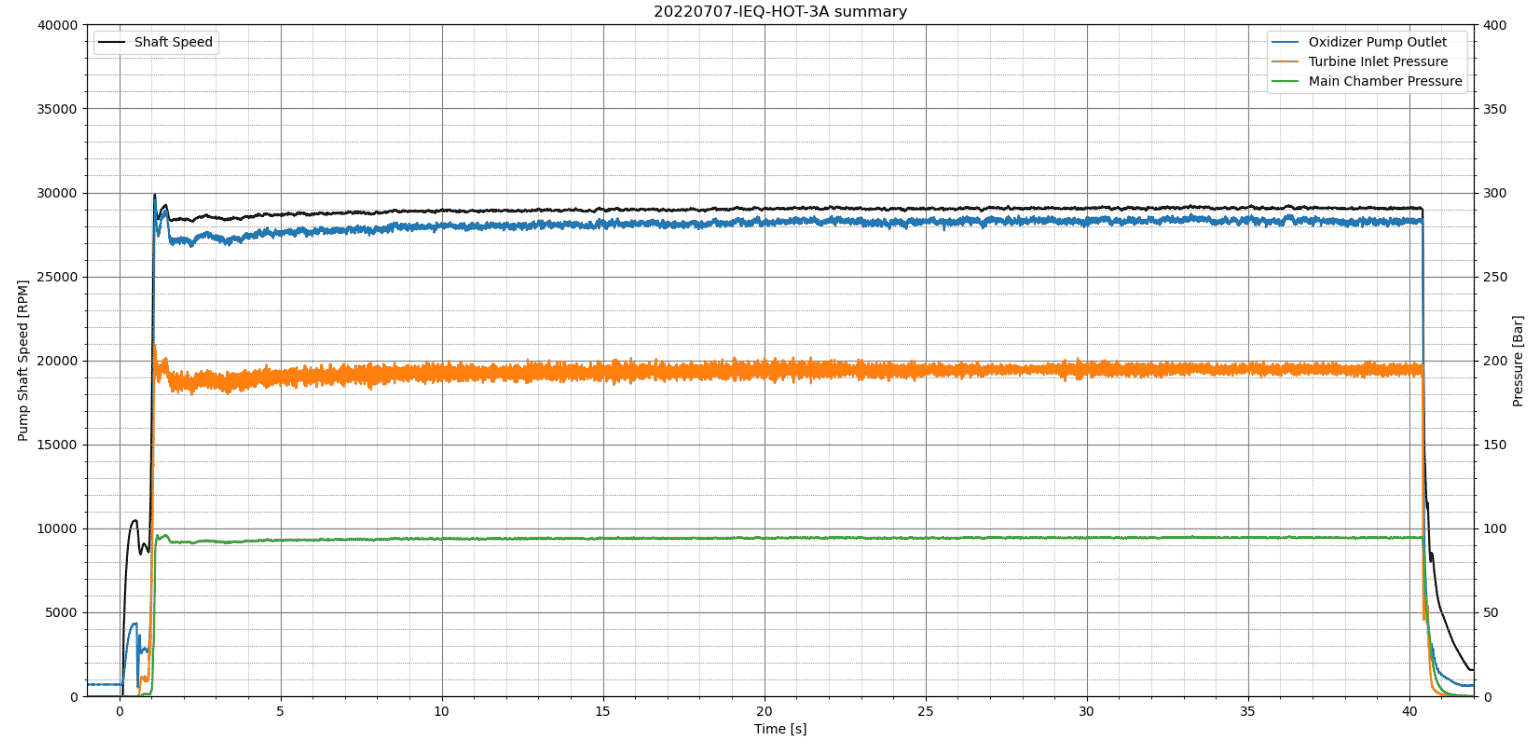

dataplot of pump shaft speed and pressuer in bar related to time in seconds

About staged combustion:

Back in July 2021, RFA became the first company in the European Union to successfully develop and test a staged combustion engine with a successful eight-second hot fire test. This made RFA the third commercial company in the world to successfully test a staged combustion rocket engine on a large scale.


The staged combustion technology is characterized by higher efficiency and performance compared to conventional open-cycle rocket engines. The partially unburned exhaust gases from the turbopump are fed into the main combustion chamber, avoiding the release of unburned fuel. Recycling the exhaust significantly increases the efficiency of the launch vehicle while reducing launch costs and minimizing CO2 emissions during rocket launches.

About Rocket Factory

Rocket Factory Augsburg was founded in 2018 with the vision to enable data generating business models in space to better monitor, protect and connect our planet Earth. Against this background, the company’s goal is to offer launch services into low Earth orbits and beyond on a weekly basis at unmatched prices. With this, RFA wants to democratize access to space and reduce the launch costs in the space industry. The RFA ONE launch service combines three key competitive advantages: A customer focused service with precise in-orbit delivery and a high degree of mission flexibility through its orbital stage; at a highly competitive price; made possible by superior staged combustion technology, low-cost structures and usage of industrial components.

Press Contact:

Mr. Jonas Kellner

Telefon +49 821 999576-21

Email: jonas.kellner@rfa.space


Rocket Factory Augsburg AG

Berliner Allee 65

86153 Augsburg

Germany

Chairman of the Supervisory Board: Jean-Jacques Dordain

Board of Directors: Stefan Tweraser, Stefan Brieschenk, Jörn Spurmann

Seat of the company: Augsburg

Registry Court: AG Augsburg, HRB 34251

USt-ID/Tax-ID: DE319402838

Interested in featuring us?

Sustainable Space Flight: More than loud noises and flashy lights

In November 2022, the next UN World Climate Conference will take place in Egypt. It will reconfirm what we have known for years: We have to be more sustainable. And we can be more sustainable – from space. Data from satellites in low-earth orbit allow us to conduct comprehensive real-time research on the climate, make informed decisions and take action. Small launch vehicles from Europe make it possible to transport these satellites and thus form the foundation of a sustainable space travel, called Green New Space.

Earth Green Energy Infographics Half Orb Night White Icons Place

Spaceflight plays an important, if not crucial, role in creating a global climate data model. Satellite constellations for Earth observation can create a huge data model, a digital twin, of the Earth. Researchers can use this data to observe, research, understand, and act. Transporting the satellites needed to do this into space must also be sustainable and ecological. This must be done in two dimensions in particular: The strategic dimension as well as the technical dimension.

With foresight into orbit

In the case of space travel, it is important to keep reminding ourselves of the enormous benefits it brings: satellites provide data that can not only optimize logistics routes by emission or prevent forest fires, but also actively contribute to climate research and environmental protection. Atmospheric and ecosystem research, e-mobility, determination of fertilizer concentrations, sustainable water management – all these are just a few of the numerous application examples where it is best to work with an overview, from above, from space. In conclusion, rockets, the means to an end, are extremely sustainable on a completely different level: they enable us to better understand and protect our Earth with data from space.

In the long term and from a strategic point of view, one might object that it is getting more and more crowded up there and that space debris has already reached worrying proportions. That’s true. Russia shot down an old Russian satellite in November 2021, causing vast amounts of small, yet highly energetic debris due to its enormous velocity, and thus dangerous to existing and future satellites. Therefore, it is imperative to deal with the prevention and disposal of the same. Orbital stages are being developed that can automatically burn up after some time and even selectively collect space debris beforehand. Services offered by these orbital stages in orbit include refueling, battery replacement or repair work. They work to make satellite constellations decisively more durable and thus more sustainable. Because what can be operated longer does not have to be newly produced and replaced.

Sustainable space flight

heat map of earth
Data on average CO2 Levels provided by NASA’s Orbiting Carbon Observatory-2 satellite. Credit: NASA/JPL

Rockets and sustainability are not mutually exclusive. On the contrary: Economy and ecology are not contradictory here, but go hand in hand and have been part of the business idea from the very beginning: climate and environmental protection is one of the main customers of space travel. We are convinced that in the medium term, every industry can and will benefit from data from space. Consciously sustainably designed rockets, with their simultaneously inexpensive, flexible and precise transport into orbit, are a key element of space-based climate and environmental protection. And thus far more than just (very loud) noises and flashy lights. Let´s get into details.

Sustainable space flight

heat map of earth
Data on average CO2 Levels provided by NASA’s Orbiting Carbon Observatory-2 satellite. Credit: NASA/JPL

Rockets and sustainability are not mutually exclusive. On the contrary: Economy and ecology are not contradictory here, but go hand in hand and have been part of the business idea from the very beginning: climate and environmental protection is one of the main customers of space travel. We are convinced that in the medium term, every industry can and will benefit from data from space. Consciously sustainably designed rockets, with their simultaneously inexpensive, flexible and precise transport into orbit, are a key element of space-based climate and environmental protection. And thus far more than just (very loud) noises and flashy lights. Let´s get into details.

Sustainable rocket technology

On the technical side, much has happened in recent years, and a sustainable Green New Space has developed. Reusing stages, for example, not only saves a large part of the total production cost of a rocket, it also saves resources and labor time and reduces the CO2 emissions of production – those who reuse do not have to produce anew. And it works: SpaceX and Blue Origin have been landing and reusing their first stages fully automatically for years.

Tank structures are made of stainless steel. This is available at lower cost, can be processed quickly and with low energy consumption, and also allows corrections to be made: Where composite structures become very expensive and only storable, non-recyclable waste in the event of even the smallest production defects or test damage, stainless steel with its properties is ideally suited for series production. Tank structures made of stainless steel can be simply rolled and welded, and isolated production errors or test losses are of little consequence either ecologically or in terms of time and cost because they can be reused.

graphic of staged combustion rocket cycle
Oxidzer Rich Staged Combustion Cycle Visualisation. Credit: RFA

At the same time, modern engines with staged combustion are being developed. In these, the exhaust gases from the turbopump are fed into the main combustion chamber. The fuel is burned more completely and thus not only more efficiently but also in a more environmentally friendly way: Thanks to this so-called “closed cycle,” the engine does not eject highly sooty exhaust gases from the turbopump into the atmosphere, as is the case with engines with an open combustion cycle, for example. Additionally, research is being done on other sustainable options like hybrid-rocket propulsion using e.g. wax as a fuel. These are just a few examples of technologies that show that the industry is aware of its responsibilities and is working to incorporate the ecological dimension into its development and business ideas.
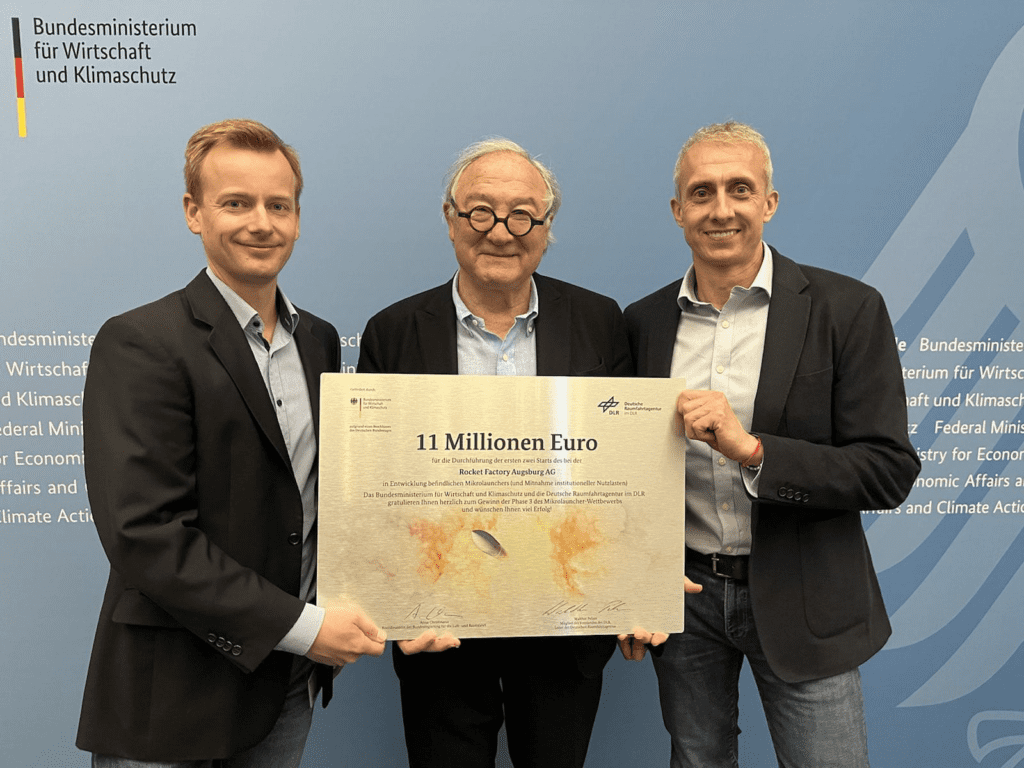
Sustainable rocket technology

On the technical side, much has happened in recent years, and a sustainable Green New Space has developed. Reusing stages, for example, not only saves a large part of the total production cost of a rocket, it also saves resources and labor time and reduces the CO2 emissions of production – those who reuse do not have to produce anew. And it works: SpaceX and Blue Origin have been landing and reusing their first stages fully automatically for years.

Tank structures are made of stainless steel. This is available at lower cost, can be processed quickly and with low energy consumption, and also allows corrections to be made:

Oxidizer Rich Staged Combustion Cycle Visualisation. Credit: RFA

Where composite structures become very expensive and only storable, non-recyclable waste in the event of even the smallest production defects or test damage, stainless steel with its properties is ideally suited for series production. Tank structures made of stainless steel can be simply rolled and welded, and isolated production errors or test losses are of little consequence either ecologically or in terms of time and cost because they can be reused.

At the same time, modern engines with staged combustion are being developed. In these, the exhaust gases from the turbopump are fed into the main combustion chamber. The fuel is burned more completely and thus not only more efficiently but also in a more environmentally friendly way: Thanks to this so-called “closed cycle,” the engine does not eject highly sooty exhaust gases from the turbopump into the atmosphere, as is the case with engines with an open combustion cycle, for example. Additionally, research is being done on other sustainable options like hybrid-rocket propulsion using e.g. wax as a fuel. These are just a few examples of technologies that show that the industry is aware of its responsibilities and is working to incorporate the ecological dimension into its development and business ideas.
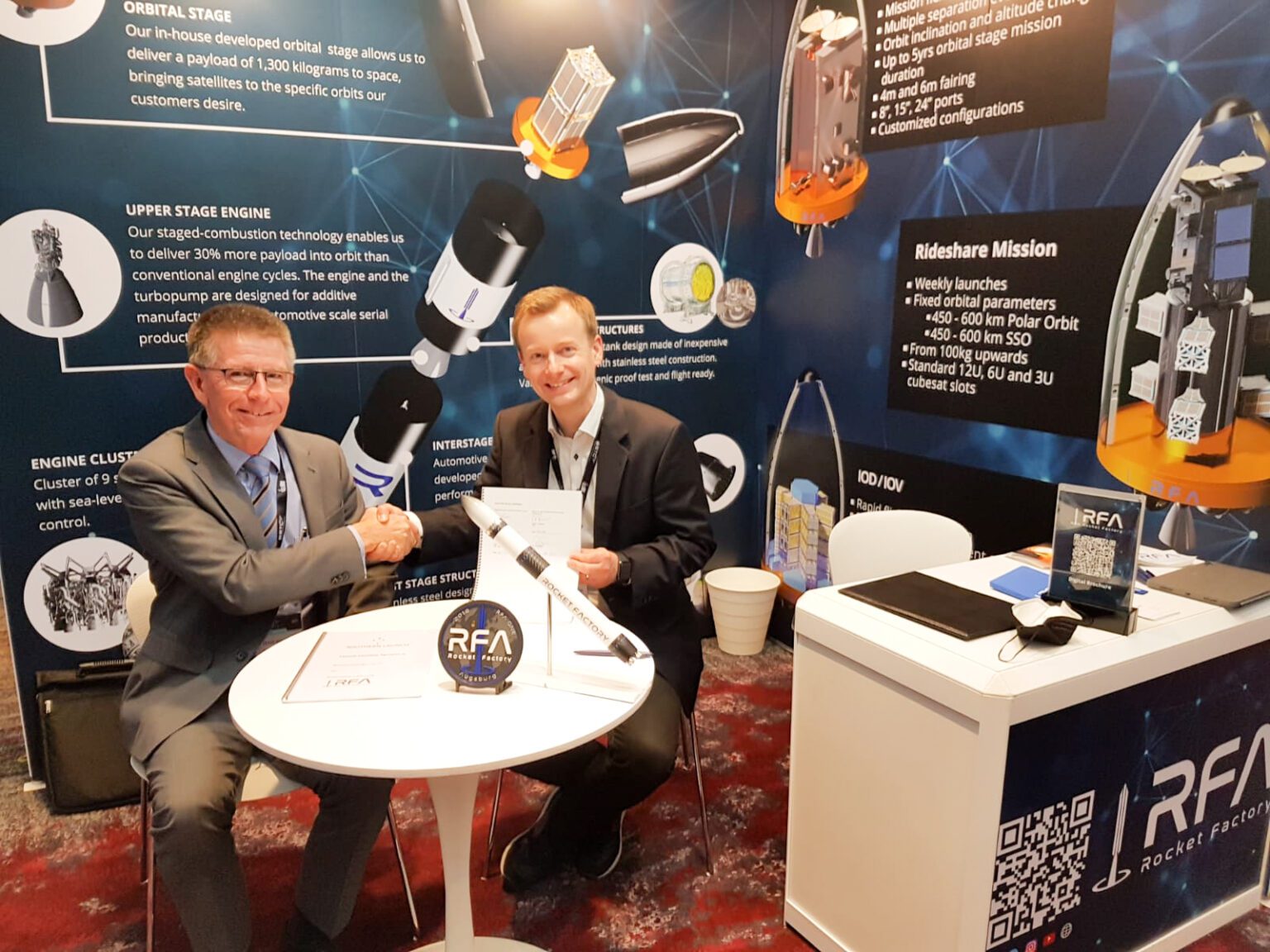
Quo vadis? Ad astra!

The coalition agreement of the German Government signed in the end of 2021 in Germany describes space travel and especially the field of  NewSpace as a central technology of the future  and wants, among other things, to strengthen the national space programme. It demonstrates the importance the coalition and especially the green party, which is part of the coalition, puts on New Space to help achieve a CO2 neutral Germany. Climate protection efforts need solid and continuously updated data as a basis for decision-making, which can only be gathered by satellites.

With its three rocket-building start-ups, Germany has already taken a leading role in European New Space. Building on this, New Space is a crucial piece in the institutional fight against climate change. With its setup of new launchers, Germany has the option to lead in the production of green launch vehicles, which enable the gathering of data that can in turn be used to coordinate climate protection efforts all over the world and allow sustainable services in orbit. What is needed, however, is practical political initiative in the form of institutional launch agreements, economic and structural support for commercial competition and clear regulations. We have everything to lose, so let’s address the problem head-on – based on and with the help of sustainable space travel.

SUBSCRIBE

Stay up to date with The Preburner blog and all of our latest posts by signing up.

RFA wins 11 million Euros in the DLR microlauncher competition

image of CEOs of RFA and DLR holding signed deal over 11 million euros for the first two flights of RFA ONE

Berlin, Germany, April 25, 2022 – Rocket Factory Augsburg (RFA) wins the 2022 round of the German Aerospace Center (DLR) microlauncher competition. The prize values 11 million Euros. As a result, the German government will be an anchor customer of RFA ONE. Payload of up to 150kg shall be placed on the first two flights of the RFA ONE.

“We are very pleased to have won DLR as an anchor customer and are honored by the confidence the German government is placing in us. We believe that buying services from newly emerging and commercially acting Space Transportation companies is the right direction for European spaceflight”, says Jörn Spurmann, Chief Commercial Officer at RFA. “Launching with us as in the frame of this DLR competition is a unique opportunity for many institutions and new space companies in Germany and we are working full throttle to offer a variety of innovative, reliable and affordable services – on the ground, to-orbit and on-orbit”.


RFA is developing its three-stage rocket RFA ONE, which can deliver up to 1,350 kg to a low polar Earth orbit. The rocket is 30 meters high and 2 meters wide and has reached important milestones in its development over the past year: RFA hot fired its highly efficient staged combustion engine “Helix” multiple times, is now producing the first batch of flight configuration engines and conducted a successful pressure test with its extensively reusable core stage. The RFA ONE is expected to launch up to fifty times a year in the future, delivering satellites into near-Earth orbit quickly and reliably at a highly competitive price point.


RFA has already signed a launch contract with Lunar Research Service (LRS) for its first launch and signed launch contracts with nine other customers for future launches.

About the competition:

The DLR microlauncher competition has two main objectives: It aims to strengthen commercial and cost-effective transport into orbit in Germany and to provide new impetus for German founders to develop business models that are viable in the long term. The decision for RFA was made by a jury chaired by Dr. Anna Christmann, Federal Government Coordinator of German Aerospace Policy. Technical, economic and operational evaluation criteria were decisive for the selection in all competition phases. The competition is part of the Commercial Space Transportation Services and Support (C-STS) program by the European Space Agency. It was initiated and funded by the German Ministry for Economic Affairs and Climate Protection (BMWK) and conducted by the DLR.

About Rocket Factory

Rocket Factory Augsburg was founded in 2018 with the vision to enable data from space to better understand and protect our Earth. With this in mind, RFA wants to democratize access to space and reduce the launch costs in the space industry. The company’s goal is to launch satellites into low Earth orbits on a weekly basis at unmatched prices. The RFA ONE launch service combines three key competitive advantages: A customer focused service with precise in-orbit delivery and a high degree of mission flexibility through its orbital stage, at a highly competitive price, made possible by superior staged combustion technology, industrial automation and low-cost structures.

Press Contact:

Mr. Jonas Kellner

Telefon +49 821 999576-21

Email: jonas.kellner@rfa.space


Rocket Factory Augsburg AG

Berliner Allee 65

86153 Augsburg

Germany

Chairman of the Supervisory Board: Jean-Jacques Dordain

Board of Directors: Stefan Tweraser, Stefan Brieschenk, Jörn Spurmann

Seat of the company: Augsburg

Registry Court: AG Augsburg, HRB 34251

USt-ID/Tax-ID: DE319402838

Interested in featuring us?

"Helix" - public names RFA engine

The public could propose names for the RFA engine and vote in two rounds

report to the community that the final name for the rocket eninge will be HELIX with rocket engine test image in the background

Augsburg, Germany, March 10, 2022 – The staged combustion engine of Rocket Factory Augsburg (RFA) is given the name “Helix”. This name was suggested by two fans from the USA as part of RFA´s #NameOurEngine campaign. Over 3,800 names were submitted, from which RFA selected its TOP 10 and put it to two public votes. “Helix” emerged as the winner of the final round with “Tycho”, “Fernweh” and “Daedalus”. A total of over 17,000 votes from all around the world were cast in both rounds.


This makes RFA the first company in the world to have its engine named by the public. The submitters were also able to provide a reason. In the case of Helix, the reason is that DNA has the shape of a helix. The DNA of the rocket is its engine, the entire rocket depends on it. It is what breathes life into the machine. Moreover, this gives new meaning to the phrase “Space is for everyone” because everyone is made of DNA.

About the Helix engine

Helix is a staged combustion engine, one of the most advanced engine types in the world. Unlike engines with an open combustion cycle, in RFA´s Helix engine the exhaust gases from an oxygen-rich preburner are fed into the main combustion chamber after driving the turbopump. The fuel is thus burned more completely, increasing Helix´s efficiency by 7%, which translates into 30% more payload capacity of the RFA ONE micro launcher. Staged combustion is also more environmentally friendly, as significantly fewer highly sooty exhaust gases are released into the atmosphere.


The Helix engine is operated with RP-1 as propellant and liquid oxygen as oxidizer, has a thrust of 100kN and an Isp of 325s (SL) / 350s (Vac). Nine Helix engines are used in the first stage, and one vacuum-optimized Helix engine in the second stage.
Dr.

Dr. Stefan Tweraser, Chief Executive Officer of RFA, said: “We were overwhelmed by the many great submissions and appreciative feedback. Many people have really put a lot of thought and love into creative, beautiful, unusual and profound names and reasons. Helix is a beautiful name with a fitting meaning. We are proud to say that our Helix engine has been named by the public and will continue on this path of participation and open communication. “Space is for everyone” is not a phrase for us, we are tackling this adventure together as humanity”.

About Rocket Factory
Rocket Factory Augsburg was founded in 2018 with the mission to significantly reduce launch costs in the space industry. The company’s goal is to launch satellites into low Earth orbits on a weekly basis at unmatched prices. The launch system prototype under development shall be completed by the end of 2022. The RFA ONE launch service combines three key competitive advantages: A customer focused service with precise in-orbit delivery and a high degree of mission flexibility through its orbital stage, at a highly competitive price, made possible by superior staged combustion technology, industrial automation and low-cost structures.

Press Contact for RFA:

Mr. Jonas Kellner

Phone +49 821 999576-21

Email: jonas.kellner@rfa.space


Rocket Factory Augsburg AG

Berliner Allee 65

D-86153 Augsburg


Chairman of Supervisory Board: Jean-Jacques Dordain

Executive Board: Stefan Tweraser, Stefan Brieschenk, Jörn Spurmann

Headquarter: Augsburg

Place of jurisdiction: AG Augsburg, HRB 34251

Tax-ID: DE319402838


Interested in featuring us?

RFA and Southern Launch sign agreement for launch facilities

RFA and SOuthern LAunch sign agreement

Singapore, 10. February 2022 – Rocket Factory Augsburg AG (RFA), Europe’s leading launch service provider, has partnered with Southern Launch, a South Australian rocket launch facility provider. The partnership allows for the German launcher RFA ONE to be launched from Southern Launch’s Whalers Way Orbital Launch Complex in South Australia. Southern Launch’s orbital complex provides direct ascent into sun-synchronous and polar orbits.

The agreement will enable RFA to provide flexible, low-cost, and precise launch services with its RFA ONE from a regional spaceport in the Asia-Pacific region. This three-stage small rocket, with its highly efficient staged combustion engine and orbital stage, can deliver up to 1,350 kg to a 300-km polar orbit. The rocket is 30 meters high and 2 meters wide and has reached important milestones in its development over the past year. The RFA ONE is expected to launch up to fifty times a year in the future, delivering satellites into near-Earth orbit quickly and reliably at a highly competitive price point

The first engagement between RFA and Southern Launch was at the International Astronautical Congress, Washington in 2019, and the parties are now very pleased to have finalized and to be signing a launch services agreement at the Global Space and Technology Convention in Singapore.

Jörn Spurmann, Chief Commercial Officer at RFA, says: “Launching from South Australia allows us to offer our launch services in a highly customer-oriented way from a regional spaceport in the Asia-Pacific region. It marks a central milestone in our strategy for a globally distributed launch capability. With various launch sites around the world, we minimize our customers’ logistics and time constraints and lay the infrastructural foundation for a weekly launch cadence. Southern Launch offers a comprehensive and competitive service to launch our rockets. We could not have wished for a better partner.”

Lloyd Damp,

Chief Executive Officer of Southern Launch, said: “We are excited to announce this partnership with Rocket Factory Augsburg AG, which will see their launcher RFA ONE launched into space from Southern Launch’s sites in South Australia. This partnership further demonstrates Australia’s world-class space launch capabilities to the international space industry.”

About Rocket Factory

Rocket Factory Augsburg was founded in 2018 with the mission to significantly reduce launch costs in the space industry. The company’s goal is to develop a launch vehicle prototype by the end of 2022 which can launch satellites into low Earth orbits on a weekly basis at unmatched prices. The RFA ONE launch vehicle combines three key competitive advantages: An extremely customer focused service through our orbital stage with precise in-orbit delivery, at a highly competitive price, made possible by our superior staged combustion technology, industrial automation and low-cost structure.

About Southern Launch

Southern Launch is an innovative space company providing launch services, launch sites and bespoke rocket subsystems and designs to customers. The company operates the Whalers Way Orbital Launch Complex located at the tip of the Eyre Peninsula to support orbital launches into the highly sought after polar and sun-synchronous orbits. In addition to the Whalers Way Orbital Launch Complex, Southern Launch operates the suborbital Koonibba Test Range, the southern hemisphere’s largest overland suborbital rocket testing facility. The Range extends out 145 kilometers and covers over 10,000km2, making it the perfect location to launch and recover rocket and satellite technologies in the uninhabited national parks to the north. The Range provides a critical steppingstone for companies to validate their technology’s performance before launching their rockets and satellites into orbit.

Southern Launch is committed to providing Australia with a world-class orbital launch complex, whilst simultaneously contributing to material habitat improvement, consequent biodiversity improvement and the long-term survival of local fauna and flora species. The Australian company is privately owned and headquartered in Adelaide, South Australia.

Press Contact for RFA:

Mr. Jonas Kellner

Phone +49 821 999576-21

Email: jonas.kellner@rfa.space


Rocket Factory Augsburg AG

Berliner Allee 65

D-86153 Augsburg


Chairman of Supervisory Board: Jean-Jacques Dordain

Executive Board: Stefan Tweraser, Stefan Brieschenk, Jörn Spurmann

Headquarter: Augsburg

Place of jurisdiction: AG Augsburg, HRB 34251

Tax-ID: DE319402838


Interested in featuring us?

RFA launches campaign #NameOurEngine

Augsburg, Germany, 1. February 2022 – Rocket Factory Augsburg (RFA) is the first aerospace company in the world to put the naming of its rocket engine in the hands of the public. Starting today, anyone can submit their name suggestions online at www.rfa.space/nameourengine as part of the #NameOurEngine campaign. After an internal vote, RFA will put the top ten suggestions to a public vote on Twitter and Linkedin, where the final name will be determined. RFA hopes to receive numerous suggestions from individuals, but also from school classes, institutions, companies or other groups.

Submitting a name can be done online at www.rfa.space/nameourengine without registration. The submission is secret and, if desired, anonymous. There are no limits to the imagination, the name just has to be serious, free of copyrights, and be able to be briefly explained and justified. All submitted names will be presented to RFA and the top ten will then be put to a public vote on Twitter and Linkedin. Two rounds will be held to determine the final name: From the initial ten names, the top three are chosen and put to a public vote again, where the final name is chosen. The votes on both platforms are added together to determine the three finalists and the winning name.

The campaign will run for four weeks. Deadline for submitting names is February 20, the first round of voting will take place on February 23, the second and final round on February 28. The final name will be officially announced on March 3. The engine’s name giver will receive an official RFA certificate, engine hardware and a package of gifts from RFA.

About the engine

The RFA engine with staged combustion is one of the most advanced engine types in the world. Unlike engines with an open combustion cycle, in RFA´s staged combustion engine the exhaust gases from an oxygen-rich preburner are fed into the main combustion chamber after driving the turbopump. The fuel is thus burned more completely, increasing the engine’s efficiency by 7%, which translates into 30% more payload capacity of the RFA ONE micro launcher. Staged combustion is also more environmentally friendly, as significantly fewer highly sooty exhaust gases are released into the atmosphere.

The RFA engine is operated with RP-1 as propellant and liquid oxygen as oxidizer, has a thrust of 100kN and an Isp of 325s (SL) / 350s (Vac). Nine engines are used in the first stage, and one vacuum-optimized engine in the second stage.

Dr. Stefan Tweraser, Chief Executive Officer of RFA, says: “Part of our vision at RFA is to democratize access to space. However, this does not only refer to payloads. We want to be as transparent and open as possible and let everyone participate in our journey and development. Today, we want to go one step further and let the public play an active role in shaping it. The final name, perhaps suggested by a young boy or girl, will shape European spaceflight for years to come. And everyone who voted for that name will know they had a hand in it.”

Dr. Stefan Brieschenk, Chief Operating Officer at RFA, adds: “The RFA staged combustion engine is leading-edge technology combining performance and efficiency with modern, cost-effective manufacturing. Our staged combustion engine is the first of its kind in the European Union and will launch numerous satellites into low Earth orbit, as well as into higher orbits and even to the Moon, to better understand and protect our Earth. We are eagerly looking forward to a name that carries and reflects that spirit. Naming this engine is a truly unique opportunity and the name will become part of many articles, stories and conversations.”

About Rocket Factory

Rocket Factory Augsburg was founded in 2018 with the mission to significantly reduce launch costs in the space industry. The company’s goal is to develop a launch vehicle prototype by the end of 2022 which can launch satellites into low Earth orbits on a weekly basis at unmatched prices. The RFA ONE launch vehicle combines three key competitive advantages: a highly cost-efficient architecture using industrial automation and lowest-possible development costs, precise in-orbit delivery by its orbital stage, and superior propulsion systems using staged-combustion.

Press Contact for RFA:

Mr. Jonas Kellner

Phone +49 821 999576-21

Email: jonas.kellner@rfa.space


Rocket Factory Augsburg AG

Berliner Allee 65

D-86153 Augsburg


Chairman of Supervisory Board: Jean-Jacques Dordain

Executive Board: Stefan Tweraser, Stefan Brieschenk, Jörn Spurmann

Headquarter: Augsburg

Place of jurisdiction: AG Augsburg, HRB 34251

Tax-ID: DE319402838


Interested in featuring us?

Maiden flight of RFA ONE to launch LRS´s mission

RFA ONE maiden flight to launch LRS

Bremen, Germany, 18.11.2021 Lunar Research Service (LRS) and Rocket Factory Augsburg AG (RFA) have agreed on a launch service contract. According to this, RFA will fly a research mission of Ukraine-based LRS with its RFA ONE micro launcher into low-Earth orbit. The flight, which will take place end of 2022 from Andøya, Norway, will be the maiden flight of the German-developed launch vehicle.

Lunar Research Service will use the results of the mission to improve its ground-orbit communications and test a solar concentrator that will be used in the upcoming lunar mission. Among the features of the mission are proprietary satellite design and a developed in-house deployment system.

“Ride-sharing opportunities let new space companies quickly prove their technologies to customers as well as to investors. At the same time, our customers can significantly reduce their time-to-market. By helping startups, research labs and scientists at the earliest stages of their development, we form a solid foundation for long-term partnership during their technology testing”, says Dmytro Khmara, CEO of Lunar Research Service.

“We are very happy to sign with LRS as a customer on our first launch. The contract is a demonstration of our attractive rideshare service pricing. We are honored by the trust from LRS to embark on our maiden launch and are looking forward to its joint preparation. We can hardly wait and are eager to fly customers into orbit,” says Jörn Spurmann, Chief Commercial Officer of RFA,” says Jörn Spurmann, Chief Commercial Officer of RFA.

About Rocket Factory

Rocket Factory Augsburg was founded in 2018 with the mission to significantly reduce launch costs in the space industry. The company’s goal is to develop a launch vehicle prototype by the end of 2022 which can launch satellites into low Earth orbits on a weekly basis at unmatched prices. The RFA ONE launch vehicle combines three key competitive advantages: a highly cost-efficient architecture using industrial automation and lowest-possible development costs, precise in-orbit delivery by its orbital stage, and superior propulsion systems using staged-combustion.

About Lunar Research Service

Lunar Research Service is a nano-satellite manufacturer, hardware testing lab, and space mission integrator. The company’s efforts are focused on developing solutions for Earth orbit and lunar missions, enabling hardware and software ranging from single nano-satellites to constellations and lunar rovers.

Press Contact for RFA:

Mr. Jonas Kellner

Phone +49 821 999576-21

Email: jonas.kellner@rfa.space


Rocket Factory Augsburg AG

Berliner Allee 65

D-86153 Augsburg


Chairman of Supervisory Board: Jean-Jacques Dordain

Executive Board: Stefan Tweraser, Stefan Brieschenk, Jörn Spurmann

Headquarter: Augsburg

Place of jurisdiction: AG Augsburg, HRB 34251

Tax-ID: DE319402838


Interested in featuring us?

Morpheus and RFA sign Memorandum of Understanding

Morpheus and RFA sign Memorandum

Bremen, Germany, Nov. 16, 2021 – Morpheus Space, the world’s most scalable and efficient propulsion systems supplier enabling autonomous mobility in space, and Rocket Factory Augsburg AG (RFA) Europe’s leading launch service provider, have jointly signed a memorandum of understanding for cooperation. The two companies will work closely together in the field of propulsion technology in the future.

RFA intends to integrate Morpheus propulsion systems into the orbital stage of its RFA ONE launch vehicle system to improve its overall performance and sustainability. The RFA ONE is expected to launch up to fifty times a year in the future, delivering satellites into near-Earth orbit quickly and reliably at a highly competitive price point.
Dr. Stefan Brieschenk, Chief Operating Officer: “For launch vehicles, engines with staged combustion are the best choice: high efficiency allows significantly higher payloads and the best possible energy, CO2 and cost balance of the overall system. For the satellites launched in orbit, Morpheus’ electric propulsion systems are leading the way: in-space propulsion systems with an unprecedented price/performance ratio will set new standards. The combination of both propulsion technologies will ultimately enable our customers to access space in the most efficient and cost-effective way – from the ground to many years of service-in-orbit.”
“The Morpheus team is thrilled to be signing a memorandum of understanding with RFA for its RFA ONE launch vehicle system and to support more sustainable practices in the space industry,” said Daniel Bock, co-founder and CEO at Morpheus Space. “Through integrating our electric propulsion systems, we are able to provide a network of small, highly efficient thrusters that are also cost effective. As we approach a defining era of space, access to space mobility technologies has to be a necessary part of every exhibition. RFA and its customers are getting ahead of what will likely become a catastrophic issue should other NewSpace companies continue to not take the threat of space debris seriously.”
About Rocket Factory

Rocket Factory Augsburg was founded in 2018 with the mission to significantly reduce launch costs in the space industry. The company’s goal is to develop a launch vehicle prototype by the end of 2022 which can launch satellites into low Earth orbits on a weekly basis at unmatched prices. The RFA ONE launch vehicle combines three key competitive advantages: a highly cost-efficient architecture using industrial automation and lowest-possible development costs, precise in-orbit delivery by its orbital stage, and superior propulsion systems using staged-combustion.

About Morpheus

Morpheus Space is introducing a fully integrated ecosystem for satellite mobility that enables truly dynamic satellite constellations, the future of the New Space economy; a fusion between cutting edge electric propulsion and artificial intelligence. Its solution package enables satellite service providers to operate entire constellations as one entity by utilizing the world’s smallest and most efficient space qualified (TRL-9) propulsion system servicing satellites. For more information, visit www.morpheus-space.com.  

Press Contact for RFA:

Mr. Jonas Kellner

Phone +49 821 999576-21

Email: jonas.kellner@rfa.space


Rocket Factory Augsburg AG

Berliner Allee 65

D-86153 Augsburg


Chairman of Supervisory Board: Jean-Jacques Dordain

Executive Board: Stefan Tweraser, Stefan Brieschenk, Jörn Spurmann

Headquarter: Augsburg

Place of jurisdiction: AG Augsburg, HRB 34251

Tax-ID: DE319402838


Interested in featuring us?

Lúnasa and RFA sign Memorandum of Understanding

RFA joins forces with Lúnasa to provide flexible and cost-effective in-orbit services

Lúnasa and RFA sign Memorandum

Augsburg, Germany, 16.11.2021 – Lúnasa Ltd. and Rocket Factory Augsburg AG (RFA) have jointly signed a memorandum of understanding. The two companies are thus consolidating their partnership in the field of space logistics to offer small satellite customers flexible and cost-effective launch services. They mutually benefit from each other’s experience, methods and networks.

The common goal of both companies is to provide small satellite operators with flexible and cost-effective access to space. The MoU reflects a mutual desire to work closely together to facilitate the launch of small satellites into their final operational orbit. The RFA ONE launch vehicle, developed by RFA, will be used to deliver the reusable orbital transfer vehicle (OTV) “VIA” to near-earth orbit as well as provide resupply flights.

The agreement was finalized back in early October, now to be announced at the Space Tech Expo Europe in Bremen, Germany.

“From the beginning, we designed our RFA ONE to be compatible with other transfer vehicles. Lúnasa’s reusable “VIA” are optimal complements to our own launch vehicle technology and allow us to offer our launch services in an even more diversified and tailored way,” says Dr. Stefan Tweraser, Chief Executive Officer of RFA.

Jörn Spurmann, Chief Commercial Officer of RFA, adds, “The compatibility of our rocket with a wide range of OTV’s is a key element of our business case and goes hand in hand with our vision of making space accessible to everyone – easily, quickly and with low cost.” 

“Lúnasa and RFA’s objectives are well aligned in the desire to enable SMEs, universities and other entities to innovate and provide services and technologies otherwise dominated by larger companies due to prohibitive cost of access to space. We believe this will remove some of the barriers to entry and stimulate the space market with even more competitive and cutting edge products whilst creating more jobs,” says Amin Chabi, Founder and Chief Executive Officer of Lúnasa.

About Rocket Factory

Rocket Factory Augsburg was founded in 2018 with the mission to significantly reduce launch costs in the space industry. The company’s goal is to develop a launch vehicle prototype by the end of 2022 which can launch satellites into low Earth orbits on a weekly basis at unmatched prices. The RFA ONE launch vehicle combines three key competitive advantages: a highly cost-efficient architecture using industrial automation and lowest-possible development costs, precise in-orbit delivery by its orbital stage, and superior propulsion systems using staged-combustion.

About Lúnasa

Lúnasa Space is a Space-Tech start-up based in London and founded in early 2021 by Amin Chabi, CEO. The company brings together a team of highly skilled space engineers to realize the company’s vision: With its reusable OTV, Lúnasa Space aims to accelerate the world’s transition to affordable, reliable and sustainable access to space. The platform “VIA” uses modern space technology to be transformed into a reusable vehicle where it can deploy several rideshare missions over its lifetime and make access to space very affordable and frequent for the small satellite industry.

Press Contact for RFA:

Mr. Jonas Kellner

Phone +49 821 999576-21

Email: jonas.kellner@rfa.space


Rocket Factory Augsburg AG

Berliner Allee 65

D-86153 Augsburg


Chairman of Supervisory Board: Jean-Jacques Dordain

Executive Board: Stefan Tweraser, Stefan Brieschenk, Jörn Spurmann

Headquarter: Augsburg

Place of jurisdiction: AG Augsburg, HRB 34251

Tax-ID: DE319402838


Interested in featuring us?

Plus Ultra Space Outpost and RFA sign agreement for GTO launch

First lunar constellation satellite to travel to the Moon in 2023

image of RFA signing contracts

Dubai, United Arab Emirates, 28 October 2021 – Plus Ultra Space Outpost (Plus Ultra) and Rocket Factory Augsburg AG (RFA) have jointly signed an agreement for launching a demonstrator mission to the Moon.

RFA will launch Plus Ultra’s demonstrator mission towards the end of 2023 on the RFA ONE launch system. Plus Ultra’s first satellite will launch into a geosynchronous transfer orbit (GTO), from where it will use its own propulsion to reach lunar orbit and become the first satellite to initialize Plus Ultra’s cislunar constellation “Harmony”. The satellite will also be the first private orbiter with electric propulsion going to and orbiting the Moon.

Through Harmony’s commercial communications and navigation services for upcoming lunar missions, Plus Ultra will change the paradigm of lunar operations. It’ll turn communications and navigation from a carefully managed resource into an on-demand, dependable service that enables new capabilities on the Moon, like continuous remote operations, pinpoint landings, precise surface navigation, and polar and far side access.

The satellite will reach its operational orbit in 2024, providing the first 24/7 high-speed broadband communications of up to 100 Mbps per user between the Moon, including cislunar orbit, and anywhere on Earth.

Jörn Spurmann, Chief Commercial Officer from RFA: “It is very encouraging to see new business models emerge for commercial services in the cis-lunar orbit. We are particularly proud that Plus Ultra has chosen our launch system RFA ONE confirming our traction in the launch service market.”

Carlos Manuel Entrena Utrilla, founder and CEO of Plus Ultra, said: “We are aiming to become the backbone of the cis-lunar industry. With more than 140 lunar missions planned for this decade, more than all Moon missions in history combined, the upcoming lunar market is prime for disruption.”

Sebastian Ströhl, founder and Chief Commercial Officer of Plus Ultra said: “RFA’s launch vehicle fits our needs perfectly in performance and price, and will allow us to get an early start in the race for the lunar economy.”

About Rocket Factory

Rocket Factory Augsburg was founded in 2018 with the mission to significantly reduce launch costs in the space industry. The company’s goal is to develop a launch vehicle prototype by the end of 2022 which can launch satellites into low Earth orbits on a weekly basis at unmatched prices. The RFA ONE launch vehicle combines three key competitive advantages: a highly cost-efficient architecture using industrial automation and lowest-possible development costs, precise in-orbit delivery by its orbital stage, and superior propulsion systems using staged-combustion.

About Plus Ultra Space Outpost

Plus Ultra is a new European company based in Spain, Germany and Luxembourg aiming to deploy and operate a satellite constellation for the Moon, required for the accelerated development and sustainability of the fast-growing lunar economy. With this game changing communication and navigation infrastructure, offering global highspeed broadband connectivity and precise navigation on the Moon and cislunar orbit, Plus Ultra aims to become the backbone of the lunar economy. For clients this means commercial and scientific ROI maximisation, maximum access to the Moon and to cislunar orbit, substantial risk minimisation as well as significant cost reduction.

Plus Ultra’s constellation “Harmony” is projected to begin its initial operations in 2024.

Press Contact Plus Ultra:

Harry Pirrwitz

Email: harry@ciceroandfriends.com  

Mobile: +44 (0)73 9252 5980

Press Contact for RFA:

Mr. Jonas Kellner

Phone +49 821 999576-21

Email: jonas.kellner@rfa.space


Rocket Factory Augsburg AG

Berliner Allee 65

D-86153 Augsburg

Chairman of Supervisory Board: Jean-Jacques Dordain

Executive Board: Stefan Tweraser, Stefan Brieschenk, Jörn Spurmann

Headquarter: Augsburg

Place of jurisdiction: AG Augsburg, HRB 34251

Tax-ID: DE319402838


Interested in featuring us?

Neutron Star Systems and RFA sign agreement for demonstrator mission

image of RFA signing contracts

Dubai, United Arab Emirates, Oct. 27, 2021 – Neutron Star Systems UG (NSS) and Rocket Factory Augsburg AG (RFA) have jointly signed an agreement for launching a demonstrator mission into low Earth orbit.

RFA will launch Neutron Star Systems demonstrator mission in Q3 2023 on the RFA ONE launch system. This mission will demonstrate a key subsystem for Neutron Star Systems disruptive electric propulsion system called SUPREME (SUperconductor-based Readiness Enhanced Magnetoplasmadynamic Electric propulsion). The mission will focus on advancing technology readiness level on one of the most important subsystems of SUPREME thruster technology.

Jörn Spurmann, Chief Commercial Officer of RFA: “We are happy to support Neutron Star Systems in-orbit demonstration mission with our rideshare program on the RFA ONE launch systems. Their propulsion system has the potential to disrupt satellite propulsion, and we are proud to enable this endeavor.”

Manuel La Rosa Betancourt, Chief Executive Officer of NSS: “Neutron Star Systems is committed to secure the development of this technology in Europe and to the strengthening of the vibrant German space ecosystem. By demonstrating this capability we do not only advance the TRL of SUPREME but also make a contribution towards Europe’s non dependence and leadership in enabling technologies objectives.”

About Rocket Factory

Rocket Factory Augsburg was founded in 2018 with the mission to significantly reduce launch costs in the space industry. The company’s goal is to develop a launch vehicle prototype by the end of 2022 which can launch satellites into low Earth orbits on a weekly basis at unmatched prices. The RFA ONE launch vehicle combines three key competitive advantages: a highly cost-efficient architecture using industrial automation and lowest-possible development costs, precise in-orbit delivery by its orbital stage, and superior propulsion systems using staged-combustion.

About Neutron Star Systems

Neutron Star Systems is a new-space start-up headquartered in Cologne, Germany, focused on the development of superconductor-based spacecraft systems. NSS core product is an Electric Propulsion system combining High-Temperature Superconductors with Applied-Field Magnetoplasmadynamic Thrusters, providing greater scalability, efficiency, and operational flexibility, and enabling more powerful and more capable spacecraft while cutting costs by up to billions of dollars. Alongside the German headquarters, NSS runs operations in London, UK, and Colorado Springs, USA.

Press Contact:

Mr. Jonas Kellner

Phone +49 821 999576-21

Email: jonas.kellner@rfa.space


Rocket Factory Augsburg AG

Berliner Allee 65

D-86153 Augsburg

Chairman of Supervisory Board: Jean-Jacques Dordain

Executive Board: Stefan Tweraser, Stefan Brieschenk, Jörn Spurmann

Headquarter: Augsburg

Place of jurisdiction: AG Augsburg, HRB 34251

Tax-ID: DE319402838


Interested in featuring us?

Rocket Factory Augsburg and SENER Aeroespacial sign launch service agreement

image of RFA singing contracts

Dubai, United Arab Emirates, Oct. 26, 2021 – SENER Aeroespacial and Rocket Factory Augsburg AG (RFA) have agreed on a launch service contract. As a result, SENER Aeroespacial will launch its E.T.PACK technology demonstrator with the RFA ONE micro launcher.


SENER Aeroespacial will launch its small satellite, called E.T.PACK, into near-Earth orbit at mid-inclination. E.T.PACK is a deorbit device that will demonstrate a novel electrodynamic tether technology for deorbiting satellites and launcher upper stages without chemical or electrical propulsion. The flight is of high interest for RFA since the potential adoption of SENER Aeroespacial technology in the future can be an asset for the RFA ONE launch system.


The signing of the agreement took place on October 26 during the IAC 2021 exhibition in Dubai, between the Chief Commercial Officer of RFA, Jörn Spurmann, and the Director of Institutional Space Department of SENER Aeroespacial, Augusto Caramagno.


“We are very pleased to have won SENER Aeroespacial as a customer. After very trusting discussions, we were able to offer a customized launch service tailored precisely to their requirements. We benefited from the fact that we were able to convince SENER Aeroespacial not only with our price, but above all with our service. This speaks for the competitiveness of RFA ONE,” says Jörn Spurmann, Chief Commercial Officer of RFA.


“The launch of E.T.PACK with RFA is a wonderful opportunity not only of receiving a high quality service, but also to forge a very profitable cooperation between the two companies. RFA is a perfect partner for our E.T.PACK technology demonstration since the deorbiting of launcher upper stages is a key application for our system” says Augusto Caramagno, Director of Institutional Space Department of SENER Aeroespacial.

E.T.PACK, an autonomous deorbiting kit

E.T.PACK is a FET-OPEN project funded with €3million by the European Commission, developed by SENER Aeroespacial and UC3M together with other partners of the E.T.PACK’s consortium. This deorbit device is a small “kit” that will be mounted on launcher upper stages and satellites in the future and will allow those spacecrafts to be eliminated at the end-of-life, instead of the actual trend of leaving them in orbit. The drag force on the electrodynamic tether causes the re-entry of the satellite and its elimination at the upper layers of the atmosphere. Unlike conventional technologies, it does not need a propellant and works passively. 


E.T.PACK aims to provide a light, low-cost and highly effective system that will be able to communicate with the ground, stabilize a satellite of mass up to 1,000 kg and control the deorbiting maneuver to prevent collisions with other objects.


Therefore, the launch of SENER Aerospacial’s satellite with the E.T.PACK technology demonstrator will be a decisive step in validating this innovative technology.

About Rocket Factory

Rocket Factory Augsburg was founded in 2018 with the mission to significantly reduce launch costs in the space industry. The company’s goal is to develop a launch vehicle prototype by the end of 2022 which can launch satellites into low Earth orbits on a weekly basis at unmatched prices. The RFA ONE launch vehicle combines three key competitive advantages: a highly cost-efficient architecture using industrial automation and lowest-possible development costs, precise in-orbit delivery by its orbital stage, and superior propulsion systems using staged-combustion.

About SENER Aeroespacial 

SENER Aeroespacial has been a leading supplier of high performance aerospace systems for Space, Defense and Science for more than 50 years, with high added value technological developments. In Space, it supplies electromechanical components and systems, navigation systems (GNC/AOCS), communications, astronomy and optics systems to satellites and space vehicles for NASA, ESA, JAXA and Roscosmos. Institutes and companies such as CNES, Airbus Space & Defense, Thales Space, OHB, RUAG, SELEX and CSIC also number among its clients. SENER Aeroespacial is part of the SENER engineering and technology group, founded in 1956. The SENER Group has 2,350 professionals in offices in five continents.

For more information, please visit: www.aeroespacial.sener/en

Press Contact:

Mr. Jonas Kellner

Phone +49 821 999576-21

Email: jonas.kellner@rfa.space


Rocket Factory Augsburg AG

Berliner Allee 65

D-86153 Augsburg

Chairman of Supervisory Board: Jean-Jacques Dordain

Executive Board: Stefan Tweraser, Stefan Brieschenk, Jörn Spurmann

Headquarter: Augsburg

Place of jurisdiction: AG Augsburg, HRB 34251

Tax-ID: DE319402838


Interested in featuring us?

CST and RFA to offer unique orbits with new partnership

image of RFa singing contract with CST

Dubai, United Arab Emirates, Oct. 25, 2021German-based launch service provider Rocket Factory Augsburg (RFA) and UK-based launch broker Commercial Space Technologies (CST) have solidified their partnership with an MoU. Both CST, the world’s longest-standing launch broker, and RFA, Europe’s technology leader for launch vehicles, profit from this cooperation as well as customers worldwide, which get tailored launch services to unique orbits at the most competitive prices. 


The partnership will offer launch opportunities that are currently undersupplied to the market. Larger rideshare missions are often confined to orbits driven by popular demand, while smaller launch vehicles below the 1 ton performance threshold have limitations in the orbits they can offer. The performance of the RFA vehicle of 1300 kg to LEO offers the benefits of a dedicated launch with greater flexibility to get your spacecraft to where it needs to go. While CST’s experienced management team can capture and implement unique logistical, contractual and supply chain requirements that are often unavailable for larger rideshare launches. This combination of unique technology and skills can support customers on range-unique missions, such as:


  • Tundra and Molniya Orbits – There is increased urgency to monitor the environments of the Earth’s poles, as well as to supply communications to researchers, local inhabitants and shipping routes. These highly elliptical orbits are challenging to access and rideshare opportunities are limited to infrequent Russian and US federal missions. RFA can launch up to 1.000 kg to either of these orbits.
  • Escape Trajectories – Some customers may require release from Earth’s orbit, such as: interplanetary probes, commercial ‘off-planet’ mining operations, science missions targeting Lagrange points, etc. Traditional launch opportunities are often limited to infrequent government launches that are prone to delays. On-demand, dedicated launch, through CST and RFA could offer a timely and dependable alternative in these instances.
  • Lunar – The emerging lunar economy brings exciting commercial and research prospects. Launches supporting lunar orbit or landing missions can be discussed and solutions adapted to the requirements of the customer.
  • Short lead times – For any final tweaks you may need before launch, timelines between signing of interface control documentation and integration will be 6 weeks, compared to typical lead times of three months for most rideshare launches. This timeline may be further improved on a case-by-case basis.
  • Late access – There are benefits to having late access to your payload, for example biomedical payloads with living cultures that are sensitive to powering down for long durations. On request, RFA and CST can support access to payloads 12 hours before launch.


Dr. Stefan Tweraser, Chief Executive Officer of RFA, says: “The demand for simple polar, but also highly elliptical polar orbits is steadily increasing. RFA can offer its customers not only precise delivery in these orbits, but also a comprehensive package of end-to-end services in cooperation with CST. Our customers can thus be assured that their flight into the near-Earth orbit will be custom-tailored, reliable, fast and affordable.” 


Alan Webb, Managing Director of CST, says: “We have been approached several times in the past by customers looking for ‘exotic’ launches to orbits like Molniya. It has been disappointing to have to turn such customers away because the launch options simply aren’t available. We are therefore delighted to partner with RFA and broaden the portfolio of launch options we can offer our customers. Furthermore, market trends and our own experience indicates demand for these launches will only increase,  thus adding immense value to this partnership and the bespoke solutions it can offer.”


About Rocket Factory

Rocket Factory Augsburg was founded in 2018 with the mission to significantly reduce launch costs in the space industry. The company’s goal is to develop a launch vehicle prototype by the end of 2022 which can launch satellites into low Earth orbits on a weekly basis at unmatched prices. The RFA ONE launch vehicle combines three key competitive advantages: a highly cost-efficient architecture using industrial automation and lowest-possible development costs, precise in-orbit delivery by its orbital stage, and superior propulsion systems using staged-combustion.

About Commercial Space Technologies  

Commercial Space Technologies Ltd. has been consulting to public and private organisations on emerging technologies and markets in the space industry since its foundation in 1983. Averaging 20 consultancy projects a year, CST has a repository of over 750 studies that allows it to accurately predict trends and opportunities for its customers. It has also been identifying and brokering bespoke launch solutions for the small satellite community for 30 years – with over 100 years of combined experience in the field, CST is one of the longest lasting and experienced launch brokers in the world. With this experience, CST is well placed to support small satellite customers with unique and challenging launch requirements. 

Press Contact:

Mr. Jonas Kellner

Phone +49 821 999576-21

Email: jonas.kellner@rfa.space


Rocket Factory Augsburg AG

Berliner Allee 65

D-86153 Augsburg

Chairman of Supervisory Board: Jean-Jacques Dordain

Executive Board: Stefan Tweraser, Stefan Brieschenk, Jörn Spurmann

Headquarter: Augsburg

Place of jurisdiction: AG Augsburg, HRB 34251

Tax-ID: DE319402838


Interested in featuring us?

Dr. Stefan Tweraser becomes new CEO of Rocket Factory Augsburg

image of RFA CEO Stefan Tweeraser

Augsburg, 22.10.2021 – Dr. Stefan Tweraser is the new Chief Executive Officer (CEO) of Rocket Factory Augsburg AG (RFA) as of October 1st 2021. The 51-year-old Austrian will support RFA in further driving the company’s growth.


Previously, Stefan Tweraser was responsible for the DACH region at Google, and worked at the music streaming service Deezer, at the startup Snapshot and at the renowned consulting firm McKinsey & Company. With a doctorate in economics, he thus brings with him a wealth of experience from various industries, in which he drove innovative and future-oriented developments in management positions.


Given the rapid technological advances, increased success in the market and strong growth in personnel, the Executive and Supervisory Board of RFA believe that now is the right time to complement and broaden the Executive Board.


Dr. Stefan Tweraser on his new role: “The commercial use of space will change fundamentally in the coming decade. New space-based business models are emerging and innovative launch vehicles – with a strong focus on cost and customer orientation – are a cornerstone of this positive dynamic. RFA has made great strides by combining cutting-edge technology with innovative manufacturing processes. The team has also already succeeded in developing a promising commercial pipeline. I am very excited to lead RFA – together with the Executive Board and the Supervisory Board – to the next stage of our exciting journey.”


Jean-Jacques Dordain, Chairman of the Supervisory Board: “We deliberately looked for someone with extensive experience in managing enterprises outside the space sector to bring new expertise and additional impetus to the next steps of RFA’s development. After a very intensive process, we asked Stefan to join RFA’s Executive Board and add to the great expertise and space experience already there. We now have the complete board we need to lead RFA – together with a great team – to a successful development and operation.”


Marco Fuchs, Supervisory Board member: “We are very pleased with RFA’s progress to date. Stefan’s background and leadership will be instrumental in helping RFA achieve sustainable growth.”


Hans Steininger, Supervisory Board member: “European and global competition in the micro launcher vehicle segment will be intense, but we plan to be a leader in this competition. Based on his experience in a wide range of industries, Stefan will lead the RFA team to exploit this potential.”


Jörn Spurmann, Chief Commercial Officer: “RFA is one of the fastest growing start-ups in the New Space scene. Stefan’s experience in leading large organizations is very valuable for our further development. He has great ideas and approaches on how we will maintain our rapid pace as a growing company and convince more investors of our vision.”


Dr. Stefan Brieschenk, Chief Operating Officer: “We are very excited that Stefan has decided to take on the position as CEO of RFA. Under his leadership, we will further professionalize RFA’s processes and structures. This will help us to transform our rapid technological progress into a sustainable business model.”

About Rocket Factory

Rocket Factory Augsburg was founded in 2018 with the mission to significantly reduce launch costs in the space industry. The company’s goal is to develop a launch vehicle prototype by the end of 2022 which can launch satellites into low Earth orbits on a weekly basis at unmatched prices. The RFA ONE launch vehicle combines three key competitive advantages: a highly cost-efficient architecture using industrial automation and lowest-possible development costs, precise in-orbit delivery by its orbital stage, and superior propulsion systems using staged-combustion.

Press Contact:

Mr. Jonas Kellner

Phone +49 821 999576-21

Email: jonas.kellner@rfa.space


Rocket Factory Augsburg AG

Berliner Allee 65

D-86153 Augsburg

Chairman of Supervisory Board: Jean-Jacques Dordain

Executive Board: Stefan Tweraser, Stefan Brieschenk, Jörn Spurmann

Headquarter: Augsburg

Place of jurisdiction: AG Augsburg, HRB 34251

Tax-ID: DE319402838


Interested in featuring us?

RFA hosts panel of space industry experts discussing staged combustion.

Thumbnail PR Stage combustion event
Augsburg, 15.09.2021 –

Last Monday the Rocket Factory Augsburg hosted an event on the importance of rocket engines with staged combustion for European space travel. After a short introduction movie and keynotes by the two co-founders Jörn Spurmann and Dr. Stefan Brieschenk, the highlight of the event was a top-class panel followed by a Q&A round, among others with Thomas Jarzombek, Federal Government Coordinator of German Aerospace, who said: “What you are creating here is not only a test, but a role model for a lot of deep tech fields. You have done it differently compared to the way it has been done before in Europe. This opens the market more. RFA is one of the rising startups and very attractive to the market.”


Besides Thomas Jarzombek, the panel consisted of Jeanne Medvedeva (Vice President of Launch at Exolaunch), Rüdeger Albat (Head of Future Preparation and Ariane 5 at the European Space Agency) and Frank Thelen (series-founder and New Space Investor). They discussed the commercialization of European spaceflight and what role micro launchers and staged combustion engines play in it.


With staged combustion technology, Rocket Factory Augsburg is developing an engine that will be more powerful, efficient and cleaner than most launch vehicles currently on the market. Stefan Brieschenk, Chief Operating Officer of Rocket Factory, explained: “The most fascinating thing is certainly the fuel efficiency. At the end of the day, staged combustion is about 6-8% more fuel efficient and this relates into a 30% increase in payload capacity and in less environmental pollution”.


RFA´s goal is to provide easy, fast and affordable access to space, also for a commercialized European space economy. Jörn Spurmann, Chief Commercial Officer of Rocket Factory, sees commercial development and free competition as desirable: „Data from space will open up entirely new business opportunities, and these will require a cost-effective, reliable transport into orbit. European tax payers should not pay for the development of launch systems, while commercial companies are stepping in. Europe should evolve and act as a customer procuring the transportation service.”


The panelists agreed that customers are becoming more demanding and have more precise ideas. The demand for affordable, reliable and flexible dedicated mission would increase.  “Micro launchers and their fast and agile development are something which is crucial to keep the speed of innovation in Europe. Staged combustion engines allow to shrink rockets and use much less resources. The smaller launchers will provide more performance at much less costs. We are building up a new ecosystem which surrounds the earth and is becoming the 8th continent.” added Rüdeger Albat, giving a great insight into what to expect from New Space.

 

Staged combustion technology is characterized by higher efficiency and performance compared to conventional open-cycle rocket engines. The partially unburned exhaust gases from the turbopump are fed back to the main combustion chamber, avoiding the release of unburned propellant. Recycling the exhaust gases significantly increases launch vehicle efficiency while reducing launch costs and minimizing CO2 emissions from rocket launches. These special features enable RFA to offer unmatched prices and thus lead the global competition for low-cost launchers.


Rocket Factory Augsburg was founded in 2018 with the mission to significantly reduce launch costs in the space industry. The company’s goal is to develop a launch vehicle prototype by the end of 2022 which can launch satellites into low Earth orbits on a weekly basis at unmatched prices. The RFA ONE launch vehicle combines three key competitive advantages: a highly cost-efficient architecture out of stainless steel using industrial automation and lowest-possible development costs, precise in-orbit delivery by our orbital stage, and superior propulsion systems using staged-combustion.

Press Contact:

Mr. Jonas Kellner

Phone +49 821 999576-21

Email: jonas.kellner@rfa.space


Rocket Factory Augsburg AG

Berliner Allee 65

D-86153 Augsburg

Chairman of Supervisory Board: Jean-Jacques Dordain

Executive Board: Stefan Brieschenk, Jörn Spurmann

Headquarter: Augsburg

Place of jurisdiction: AG Augsburg, HRB 34251

Tax-ID: DE319402838


Interested in featuring us?

RFA engine reaches next milestone.

Hot Fire Engine Test picture
Launch service provider RFA tests its staged combustion engine for the first time for eight seconds, confirming its technology leadership in new-space launch vehicles

Augsburg, Germany – 23th July 2021 – Launch service provider Rocket Factory Augsburg AG has successfully tested its entire engine with staged combustion over eight seconds. The test, which was conducted in Kiruna, Sweden, represents another important milestone in the development process: The eight-second burn time with a stable combustion is regarded in the industry as proof that an engine is fully functional, reaching a thermal steady-state across all engine components.


“The engine ran for over eight seconds, meeting all the parameters we wanted. All systems worked perfectly. We are thus continuing our successful test series and feel confirmed in our decision to develop engines with staged combustion technology in Europe as well,” said Dr. Stefan Brieschenk, the company’s Chief Operating Officer


“Our advanced engine – along with our low-cost industrial production and our orbital stage – is one of our three key advantages. It allows us not only to reduce costs for our customers, but also to transport up to 30 percent more payload to the desired orbit,” adds Jörn Spurmann, RFA’s Chief Commercial Officer.


Back in June, RFA became the first Western European company to commission a staged combustion engine with a successful two-second hot fire test. At the same time, RFA is the ninth company worldwide to have successfully tested a rocket engine with staged combustion in full scale. Staged combustion is the technological backbone of some of the world’s most successful space companies and has been limited to the United States, Russia, China, India, Japan and Ukraine. The U.S. companies SpaceX and Blue Origin were the last private companies to develop this sophisticated technology with the “Raptor” and the “BE-4” engine.


Staged combustion technology is characterized by higher efficiency and performance compared to conventional open-cycle rocket engines. The partially unburned exhaust gases from the turbopump are fed back to the main combustion chamber, avoiding the release of unburned propellant. Recycling the exhaust gases significantly increases launch vehicle efficiency while reducing launch costs and minimizing CO2 emissions from rocket launches. These special features enable RFA to offer unmatched prices and thus lead the global competition for low-cost launchers.


About RFA

Rocket Factory Augsburg was founded in 2018 with the mission to significantly reduce launch costs in the space industry. The company’s goal is to develop a launch vehicle prototype by the end of 2022 which can launch satellites into low Earth orbits on a weekly basis at unmatched prices. The RFA ONE launch service combines three key competitive advantages: a highly cost-efficient architecture using industrial automation and lowest-possible development costs, precise in-orbit delivery and superior propulsion systems using staged-combustion. 


For more information, visit: www.rfa.space


Press Contact:

Dr. Ibrahim Ata

Tel.: +49 821 999576-21

Email: ibrahim.ata@rfa.space


Rocket Factory Augsburg AG

Berliner Allee 65

D-86153 Augsburg

Chairman of Supervisory Board: Jean-Jacques Dordain

Executive Board: Stefan Brieschenk, Jörn Spurmann

Headquarter: Augsburg

Place of jurisdiction: AG Augsburg, HRB 34251

Tax-ID: DE319402838


Interested in featuring us?

RFA expands to Portugal to press ahead launcher development.

RFA ONE Payload Bay with fairing and satellite rendering

Inauguration of RFA Portugal offices in Matosinhos and signature of agreement with AICEP with Jorge Cabral (CEiiA), Francisca Guedes de Oliveira (AICEP), and Jörn Spurmann (RFA)

Augsburg, Germany – June 30  , 2021 – RFA Portugal Unipessoal LDA, a subsidiary of Rocket Factory Augsburg AG (RFA), officially opens their offices in Matosinhos, Portugal. This newly formed product engineering and manufacturing partnership with Portugal will provide a competitive edge to RFA’s business case and catalyze the launch vehicle development. Through the expansion of the development team to Portugal, RFA increases its European footprint leverage the broad talent pool as well as development capabilities in Europe. RFA already operates a site in Sweden for engine test and qualification activities and recently baselined the Norwegian Andoya Space Port for launch.


During the inauguration, a multi-million Euro agreement was signed with AICEP, the Portuguese Trade & Investment Agency. The agreement targets the development and qualification of RFA ONE’s launch system composite structures in close collaboration with Portugal’s Centre of Engineering and Product Development in Matosinhos (CEiiA). The hardware will be designed and manufactured using advanced composite materials that allow for higher launch-vehicle performances and lower production costs. RFA Portugal, together with CEiiA, will invest 9 million Euros over three years and lead the subsequent industrialization efforts.


Manuel Heitor, Minister for Science, Technology and Higher Education explained: “The development of micro-launchers in Europe is a critically relevant step to foster European autonomy and resilience in space. This will help to promote skilled employment, along with new markets, to foster the green transition of our societies in conjunction with emerging opportunities in the European digital transition.”


“It is a great pleasure to welcome RFA to Portugal. The signature of this investment contract is an important step to put Portugal at the forefront of innovation in such a pioneering sector as the “rocket” industry, proving talent is the key success factor. In fact, this partnership with CEiiA proves once again the enormous capability of our engineering talent. A decade ago, Portugal was doing its first steps in the aeronautical sector. Now we are entering a new era, planting the seeds of the Space Industry in our country!”, said Luís Castro Henriques, Chairman & CEO of AICEP. 


“Opening our facilities in Matosinhos and signing the agreement with AICEP Portugal covers two big milestones for the development of Europe’s most competitive launch service”, says Jörn Spurmann, Chief Commercial Officer at RFA. “Portugal is home to some fine engineering and the composite structures produced there will be very difficult to compete with”, adds Stefan Brieschenk, Chief Operating Officer at RFA.


“The establishment of this partnership with RFA is a good example of CEiiA’s unique role in attracting complete development programs in high-tech sectors, from concept to industrialization of advanced products, that allow not only to generate value, but also to fix it in our country, while competitively positioning Portugal on the space industry map”, said Tiago Rebelo, technical director at CEiiA.


About AICEP:

Portuguese Trade & Investment Agency is a government entity focused on attracting productive investment, increasing exports, and internationalizing Portuguese businesses to boost the country’s economy. AICEP is a “one-stop shop” agency and the ideal business partner for those looking to invest in Portugal or to purchase Portuguese products and services. With offices in Portugal and abroad, AICEP supports international companies investing in Portugal through project analysis and by helping select installation sites and human resources. Its current president is Luís Castro Henriques. For further information, please visit: www.portugalglobal.pt


About RFA

Rocket Factory Augsburg was founded in 2018 with the mission to significantly reduce launch costs in the space industry. The company’s goal is to develop a launch vehicle prototype by the end of 2022 which can launch satellites into low Earth orbits on a weekly basis at unmatched prices. The RFA ONE launch service combines three key competitive advantages: a highly cost-efficient architecture using industrial automation and lowest-possible development costs, precise in-orbit delivery and superior propulsion systems using staged-combustion. 

For more information, visit: www.rfa.space


About CEiiA

CEiiA is a Centre of Engineering and Product Development focused on fostering sustainability and quality of life, while addressing complex challenges across the board and working in high-tech sectors such as, automotive and mobility, aeronautics, ocean and space. CEiiA’s vision is to establish Portugal as a reference within these high-tech industries, contributing to a more sustainable society, and developing technologies, products and systems conceived, industrialized and operated from Portugal. CEiiA operates in the global market, having a subsidiary in Brazil and engineering teams deployed in the United Kingdom, Switzerland, France and Italy. Currently, CEiiA has a team of +300 Researchers and Engineers presently involved in Development & Engineering activities with integrated product and process development methodologies, based upon full capabilities for product development including concept, design, research, engineering, prototyping and testing of materials and full-scale structures. www.ceiia.com

compete 2020 logo


Press Contact:

Dr. Ibrahim Ata

Tel.: +49 821 999576-21

Email: ibrahim.ata@rfa.space


Rocket Factory Augsburg AG

Berliner Allee 65

D-86153 Augsburg

Chairman of Supervisory Board: Jean-Jacques Dordain

Executive Board: Stefan Brieschenk, Jörn Spurmann

Headquarter: Augsburg

Place of jurisdiction: AG Augsburg, HRB 34251

Tax-ID: DE319402838


Interested in featuring us?

RFA successfully tests full-scale staged combustion engine.

RFA hot fire test

Launch service provider RFA fires full-scale staged combustion engine for first time in Europe and secures its position as technological leader in the new space launch vehicle domain.

Augsburg, Germany, 21.06.2021 Launch service provider Rocket Factory Augsburg has demonstrated its technological leadership with its successful firing tests of its full-scale staged combustion engine. During the 2-second test, which was carried out in Kiruna (Sweden), RFA successfully commissioned the first staged combustion engine in Western Europe. Staged combustion technology is characterized by higher efficiencies and performances compared to traditional rocket engine designs. The partially unburnt exhaust gases from the turbopump are fed back to the main combustion chamber, thereby avoiding the release of unburned fuel. The recycling of the exhaust gases significantly increases the overall efficiency of the launch vehicle while reducing launch costs and also minimizing CO2-footprints of the launch activity. This ground-breaking achievement allows RFA to offer unmatched prices, putting them ahead in the global race for low-cost space launch.

“The successful test of our full-scale staged combustion engine reinforces our claim for market leadership,” said Dr. Stefan Brieschenk, the company’s Chief Operating Officer. “Our technology allows us to carry 30 percent more payload into space at the same cost to the customer”, adds Jörn Spurmann, RFA’s Chief Commercial Officer.

Two planned milestones were already reached at the beginning of May of this year. In the so-called “power-pack test”, the turbopump and pre-burner were started and operated in a stable, steady-state thermo-mechanical condition for a total burn-time of 8 seconds. In the next development step, the first ignitions of the main combustion chamber were conducted, after which the test team connected the “power pack” to all systems of the full-scale engine and performed the complete system-level test.

RFA stands-out as the ninth company worldwide to have successfully tested a full-scale rocket engine using staged combustion. Staged combustion is the technological backbone of some of the world’s most successfully space companies and to this point, was limited to the United States, Russia, China, India, Japan and Ukraine. The US companies SpaceX and Blue Origin were the latest private companies to have developed this sophisticated technology with the “Raptor” full-flow staged combustion engine and “BE-4” staged combustion engine.

About RFA

Rocket Factory Augsburg was founded in 2018 with the mission to significantly reduce launch costs in the space industry. The company’s goal is to develop a launch vehicle prototype by the end of 2022 which can launch satellites into low Earth orbits on a weekly basis at unmatched prices. The RFA ONE launch vehicle combines three key competitive advantages: a highly cost-efficient architecture using industrial automation, lowest-possible development costs, precise in-orbit delivery and superior propulsion systems using staged combustion.

For more information, visit: www.rfa.space


Press Contact:

Dr. Ibrahim Ata

Tel.: +49 821 999576-21


Press Release

Email: ibrahim.ata@rfa.space

Tel.: +49 821 999576-21


Rocket Factory Augsburg AG

Berliner Allee 65

D-86153 Augsburg


Chairman of Supervisory Board: Jean-Jacques Dordain

Executive Board: Stefan Brieschenk, Jörn Spurmann

Headquarter: Augsburg

Place of jurisdiction: AG Augsburg, HRB 34251

Tax-ID: DE319402838


Interested in featuring us?

Rocket Factory Augsburg secures launch site in Andøya, Norway.

RFA One lifts-off from Andøya

Next to RFA ONE’s maiden flight, the site will host more missions beyond 2023

Augsburg, 28.04.2021 Rocket Factory Augsburg (RFA) has signed a contract with Norway’s Andøya Space, securing one of the most coveted launch sites in Europe.


“This agreement secures launch capacity to cover the first years of operation for us. We are very happy that Europe’s most advanced rocket launch complex is partnering with us. We have everything in place now from launch site, over customers to traction on the development program to get the first launch campaign going”, says Jörn Spurmann, Chief Commercial Officer of RFA. “Flexible access to space from continental Europe aids RFA in offering its customers the best and most cost-effective launch service for their payloads.”


“A partnership with Rocket Factory is another big milestone for the European New Space Industry”, says Odd Roger Enoksen, CEO and President of Andøya Space. “We look forward to supporting their ambitious launch cadence from our spaceport. Our relationship with RFA has grown strong through the past years and we are particularly proud that RFA continues to be part of our vision to create a competitive European New Space industry.”


“Andøya’s unique location allows us to offer a flexible, ultra-competitive launch service for orbital inclinations ranging from 87 to 108 degrees. The launch site is easily accessible within Europe and can help to strengthen our space launch industry”, Stefan Brieschenk, Chief Operational Officer of RFA added.


RFA is at the forefront of worldwide launch vehicle development for NewSpace with its state-of-the-art staged combustion engine technology. This high-performance engine design, coupled with the most cost-effective production techniques possible, is essentially new to Europe. With OHB’s support, RFA has succeeded in acquiring key technologies and key talent that will drive the RFA ONE launch vehicle business case to global market dominance. Recent fire tests have shown that RFA is on a successful path to establishing Europe’s most efficient and powerful rocket motor technology.


Andøya Space got their zonal area approval September 2020 and have permit for 30 launches per year from their new spaceport 35 km south of the existing launch site. The spaceport’s location, 69 degrees north and above the Arctic circle on the coastline of Andøya in Nordland county with a flightpath that ensures a trajectory whose ground track does not cross populated areas. Andøya Space, provides launch pads, payload integration facilities as well as the technical infrastructure on site.

 

About Andøya Space

Andøya Space has provided launch services for sounding rockets since 1962. The company is also involved in scientific ground-based instrumentation, unmanned aircraft, space education and testing/verification of new technologies. Andøya Space is from 2022 expanding its portfolio to include a launch site for small satellites to polar and sun-synchronous orbit. Andøya Space AS is 90 % owned by The Norwegian Ministry of Trade and Fisheries.


 

For more information: https://www.andoyaspace.no


About RFA

Rocket Factory was founded in 2018 by Jörn Spurmann and Stefan Brieschenk, investor Hans Steininger and German satellite company OHB SE. The goal of the start-up is to develop a launch vehicle prototype by the end of 2022, which will lift satellites into low-Earth orbit on a weekly basis at unrivalled prices. Rocket Factory aims for exponential growth in the booming New Space market. The start-up’s goal is to combine highest system performances with ultra-low-cost manufacturing and design principles. Rocket Factory will deliver satellites precisely into orbit with a unique orbital transfer vehicle, thinking space transportation from the satellite and customer point of view. The launcher will offer an end-to-end solution with its last mile delivery service. The launch vehicle combines three key competitive advantages: ultra-low-cost architecture, precise in-orbit delivery and superior propulsion technology. The start-up has established itself in Augsburg and currently has a team of 85 (as of February 2021) New Space veterans from 25 different nationalities, with a demonstrated track-record established in international launch vehicle development projects.


For more information, visit: www.rfa.space


Press Contact:

Dr. Ibrahim Ata

Email: ibrahim.ata@rfa.space

Tel.: +49 821 999576-21


Rocket Factory Augsburg AG

Berliner Allee 65

D-86153 Augsburg

Chairman of Supervisory Board: Jean-Jacques Dordain

Executive Board: Stefan Brieschenk, Jörn Spurmann

Headquarter: Augsburg

Place of jurisdiction: AG Augsburg, HRB 34251

Tax-ID: DE319402838


Press Contact Andøya Space Orbital:

Audhild Dahlstrøm

Head of Marketing and Communications

Email: audhild.dahlstroem@andoyaspace.no

Tel.: +47 907 98 610


Interested in featuring us?

Rocket Factory Augsburg signs further launch contracts.

3D render of RFA One launch with clouds
OHB Cosmos and LuxSpace select RFA ONE for dedicated launches in 2024 and 2025.


Augsburg, Germany – April 27, 2021 – OHB Cosmos International Launch Services GmbH, a company of OHB SE’s newly established business segment OHB DIGITAL, as well as LuxSpace, the group’s Luxembourg-based satellite manufacturer, both signed a contract for a dedicated launch with German-based launch service provider, Rocket Factory Augsburg AG (RFA), for upcoming missions scheduled for mid-2024 and 2025.


“OHB Cosmos and Rocket Factory share a common philosophy to provide the most customer-centric service at the lowest possible prices. OHB Cosmos with its extensive experience in launching satellites manufactured by the OHB group for its commercial and institutional customers, has now found its perfect match with RFA and its RFA ONE launch vehicle.” says Lutz Bertling, Chief Strategy & Development Officer at OHB. “Launching with a German-based launch provider simplifies and speeds up the whole process of launching payloads into orbit. We want to offer the most reliable and fastest launch service to our customers and are convinced that RFA will play a key role in improving the launch experience for our customers.”


“Signing with OHB Cosmos and LuxSpace demonstrates the competitiveness of RFA ONE”, says Jörn Spurmann, Chief Commercial Officer at RFA. “We are particularly proud that both companies picked RFA ONE over the numerous launch service providers they have previously been working with. Launching European-built spacecraft with a launch vehicle developed in Germany marks a significant milestone for Europe in its way to achieve independent access to space that secures prosperity for the next generations by fostering innovation and technological progress.”


OHB Cosmos is the launch service provider of the OHB group. The company features a proven track record of organizing and conducting launches for institutional and commercial customers. OHB Cosmos is trusted by governments and institutions around the world and has launched all of the German Bundeswehr’s SAR-Lupe satellites. Recently, OHB Cosmos demonstrated its capabilities to conduct responsive launches. In January 2021, the company launched a customer’s spacecraft within a seven-month timeline. This marked a novelty on the commercial satellite launch market.


LuxSpace is the small satellite platforms expert of the OHB group and a provider of integrated applications and services. The company boosts a heritage in delivering microsatellite solutions for both global institutional and commercial customers, including the recently launched ESAIL satellite, powered by LuxSpace’s Triton-2 platform and developed in collaboration with the European Space Agency and exactEarth. ESAIL broke records in February 2021 by capturing two million AIS messages from ships at sea in a single day.


Rocket Factory, a start-up backed by the German satellite maker OHB as a strategic investor and Venture Capital firm Apollo Capital Partners, is currently developing a launcher system called RFA One for small satellites with a payload performance of up to 1300kg to low earth orbit (LEO). The first launch is scheduled for the end of 2022. The company recently qualified the upper stage tank system during cryogenic tests and currently is running a test campaign to hot-fire the main engine in Esrange, Sweden.


“Through its one-of-a-kind orbital stage, RFA ONE offers unrivalled in-orbit flexibility and injection accuracy, which is exactly what our customers demand for their very specific and critical missions.”, states Prof. Dr. Indulis Kalnins, Managing Director at OHB Cosmos. “Our intention with this contract is to secure a launch opportunity for one of our customers’ planned launches in 2024. This launch agreement allows us to cater to all our customers’ requirements at the best possible price point.”


Dr. Stefan Brieschenk, Chief Operating Officer at RFA, adds: “We are super excited to see RFA ONE entering into service with OHB Cosmos and LuxSpace. The RFA ONE launch system combines the most competitive payload capacity within its class with a disruptively low launch price. This is possible only by employing the most efficient propulsion technology available today: staged combustion. In addition to that, RFA ONE features a unique orbital stage to precisely position our customers’ payloads in their target orbits through additional on-orbit maneuvers, including inclination- and RAAN changes.”


“LuxSpace enables the space ambitions of business leaders and institutions requiring reliable platforms and integrated services to successfully fulfil their mission’s objectives. RFA ONE, through its one-of-a-kind orbital stage offers us the injection accuracy we are looking for to serve our customers. We are convinced that this launch service will set the bar for all missions to follow and are excited to partner with them”, says Edgar Milic, Chief Executive Officer at LuxSpace.


RFA is at the forefront of the global new-space launch vehicle development, with its state-of-the-art staged-combustion engine technology. This high-performance engine technology, coupled to lowest-possible-cost production techniques, is essentially new to Europe, and through the support of OHB, RFA managed to acquire key technologies and key talent that will propel the business case of the RFA One launch vehicle to allow it to compete on a global scale. Recent firing tests have demonstrated that RFA is on a winning path to resolve Europe’s most efficient and most powerful rocket engine technology. Recently, RFA won the first round of the German micro-launcher competition of the German Space Agency DLR, which granted RFA with a letter of support to receive 500.000 € of funding within ESA’s Boost! programme. In the next round of the competition, DLR and ESA will award a launch contract worth 11.000.000 € for institutional payloads.


About OHB Cosmos

OHB Cosmos is the launch service provider of the OHB group with more than 20 years of international experience in bringing satellites into their intended orbits. We are responsible for launching the spacecraft built by the group’s satellite manufacturers based in Germany, Italy, Luxembourg and Sweden. Usually the capacity of the launch vehicle is not fully utilized by the main payloads. This further capacity is offered by OHB COSMOS to satellite operators and manufacturers around the world as Rideshare Launch Service at a very attractive price and in excellent quality. Our portfolio also includes a wide range of well-founded technical support such as the integration of various satellites on a launcher or custom-made adapter, deployer and dispenser or even fairing modifications.

For more information, visit: www.ohb-cosmos.de


About LuxSpace:

Founded in 2004 as a daughter company of OHB SE and with headquarters in Betzdorf, Luxembourg, LuxSpace is provider of the innovative and reliable Triton microsatellites product line, which includes the recently launched record-setting ESAIL AIS satellite, powered by LuxSpace’s Triton-2 platform, and the new highly scalable Triton-X platform. LuxSpace further complements its portfolio with integrated application and data services, successfully enabling the missions of institutional and commercial customers.

For more information, visit: http://www.luxspace.lu


About Rocket Factory:

Rocket Factory was founded in 2018 by Jörn Spurmann and Stefan Brieschenk, investor Hans Steininger and German aerospace company OHB SE. The start-up’s goal is to develop a launch vehicle prototype by the end of 2022 that can transport satellites to low-Earth orbits on a weekly basis at unrivalled prices. Rocket Factory is aiming for exponential growth in the booming New Space market. The start-up’s goal is to combine maximum performance with extremely cost-effective manufacturing processes and design principles. The experts plan the concept of the rocket from the perspective of the satellites and the customers: Rocket Factory will precisely launch satellites into the desired orbits using a unique orbital stage. The launcher will thus provide an end-to-end delivery service for the last mile. The launcher combines three key competitive advantages: a highly cost-effective architecture, precise in-orbit delivery and superior propulsion technology. The startup employs a team of 85 (as of April 2021) New Space experts from 25 different countries in Augsburg, Germany, who have previous experience in other launcher projects.

For further information, please visit: www.rfa.space


Press Contact:

Dr. Ibrahim Ata

Email: ibrahim.ata@rfa.space

Tel.: +49 821 999576-21


Rocket Factory Augsburg AG

Berliner Allee 65

D-86153 Augsburg


Chairman of Supervisory Board: Jean-Jacques Dordain

Executive Board: Stefan Brieschenk, Jörn Spurmann

Headquarter: Augsburg

Place of jurisdiction: AG Augsburg, HRB 34251

Tax-ID: DE319402838


Interested in featuring us?

RFA Portugal is awarded a contract to develop and qualify launcher structures with CEiiA aiming for series production

RFA Portugal is awarded a contract for launcher structures

Marco Fuchs announces agreement with Pedro Siza Vieira, Minister for the Economy and Prof. Heitor, Minister for Science, Technology and Higher Education in Lisbon

Lisbon, Portugal – April 23, 2021 – Rocket Factory Portugal LDA Unipessoal, a subsidiary of German launch service provider Rocket Factory Augsburg AG (RFA) successfully concluded the contractual negotiations to develop composite structures of its launch vehicle RFA ONE together with CEiiA, a Portuguese Engineering and Development Center based in Matosinhos, North of Portugal. The announcement took place during the event “Space in the Recovery of Portugal and Europe” in Lisbon, to be followed by a visit to the island of Santa Maria, Azores.


Manuel Heitor, Minister for Science, Technology and Higher Education that the installation of RFA Portugal opens a new phase of the Portuguese strategy for space and a new moment towards the effective use of Space systems in the recovery of Portugal and Europe. Developing micro launchers in Europe is a critically relevant step to foster European autonomy and resilience in space and to help promoting skilled employment, together with new markets to foster the green transition of our societies in articulation with the emerging opportunities of digital transition. It is a step forward in the “European New space for people”.


“We are currently experiencing very exciting times in European space. New markets are forming that new, young companies want to conquer commercially. A number of startups are currently developing microlaunchers around the world. I am convinced that this market of low-cost and industrially manufactured launchers will be highly lucrative. That is why I am very pleased that we are entering into a joint venture with Rocket Factory Augsburg and CEiiA for the design and industrialization of microlaunchers in Portugal. Portugal is an emerging country in European space and especially in the field of microlaunchers. I am very much looking forward to the collaboration.”, said Marco Fuchs, Board Member of RFA and the CEO of OHB SE the major space integrator in Europe.


“It is a great pleasure to welcome RFA to Portugal. This investment project is an important step to put Portugal at the forefront of innovation in such a pioneering sector as the rocket industry, proving talent is key. In fact, this partnership with CEIIA proves once again the enormous capability of our engineering talent. A decade ago, Portugal was starting the aeronautical sector. Now, we are entering a new era, planting the seeds of the Space Industry in our country. We are launching the Space Era!”, said Luís Castro Henriques, Chairman & CEO of AICEP.


The project scope comprises the development and qualification of the orbital stage and payload fairing structures made from advanced CFRP materials aiming for serial production. RFA Portugal will invest 9 million euros over a duration of three years with the clear goal of the subsequent industrialization in Portugal. The investment will be supported by AICEP.


“We are honored to play such a vital role in the Portuguese space industry. PT Space is doing a fantastic job with their space strategy. The partnership supported by AICEP will enable launcher development in Portugal, leveraging the highly-skilled talent pool in Portugal combined with the industrialization know-how from Germany,” said Jörn Spurmann, Chief Commercial Officer at RFA and Managing Director at RFA Portugal.


Stefan Brieschenk, Chief Operating Officer at RFA, added, “The orbital stage and the payload fairing developed in this project play a critical role with respect to launcher capabilities. The concept of serial production is new to the launcher industry and we are excited to go this path with our Portuguese development partner CEiiA leveraging their unrivalled track-record with respect to developing ultra-competitive composite products.”


“We are currently starting the prototyping phase of the orbital stage demonstrator together with RFA Portugal under ESA’s C-STS program based on the great support from the Portuguese Space Agency, PT Space. Kicking off this contract with the development of these complex space components towards the series production and qualification of composite launcher structures is the next logical step. We are happy to contribute to RFA’s vision and humbled to have been selected to undertake this extraordinary challenge.” said Tiago Rebelo, technical director at CEiiA.


About AICEP:

Portuguese Trade & Investment Agency is a government entity focused on attracting productive investment, increasing exports, and internationalizing Portuguese businesses to boost the country’s economy. AICEP is a “one-stop shop” agency and the ideal business partner for those looking to invest in Portugal or to purchase Portuguese products and services. With offices in Portugal and abroad, AICEP supports international companies investing in Portugal through project analysis and by helping select installation sites and human resources. Its current president is Luís Castro Henriques. For further information, please visit: www.portugalglobal.pt


About RFA:

Rocket Factory was founded in 2018 by Jörn Spurmann and Stefan Brieschenk, investor Hans Steininger and German aerospace company OHB SE. The start-up’s goal is to develop a launch vehicle prototype by the end of 2022 that can transport satellites to low-Earth orbits on a weekly basis at unrivalled prices. Rocket Factory is aiming for exponential growth in the booming New Space market. The start-up’s goal is to combine maximum performance with extremely cost-effective manufacturing processes and design principles. The experts plan the concept of the rocket from the perspective of the satellites and the customers: Rocket Factory will precisely launch satellites into the desired orbits using a unique orbital stage. The launcher will thus provide an end-to-end delivery service for the last mile. The launcher combines three key competitive advantages: a highly cost-effective architecture, precise in-orbit delivery and superior propulsion technology. The startup employs a team of 85 (as of April 2021) New Space experts from 25 different countries in Augsburg, Germany, who have previous experience in other launcher projects. For further information, please visit: https://www.rfa.space


About CEiiA

CEiiA is a Centre of Engineering and Product Development focused on fostering sustainability and quality of life, while addressing complex challenges across the board and working in high-tech sectors such as, automotive and mobility, aeronautics, ocean and space. CEiiA’s vision is to establish Portugal as a reference within these high-tech industries, contributing to a more sustainable society, and developing technologies, products and systems conceived, industrialized and operated from Portugal. CEiiA operates in the global market, having a subsidiary in Brazil and engineering teams deployed in the United Kingdom, Switzerland, France and Italy. Currently, CEiiA has a team of +300 Researchers and Engineers presently involved in Development & Engineering activities with integrated product and process development methodologies, based upon full capabilities for product development including concept, design, research, engineering, prototyping and testing of materials and full-scale structures.


Media Contact RFA:

Mr. Jonas Kellner

Telefon +49 821 999576-21

Email: jonas.kellner@rfa.space

Rocket Factory Augsburg AG

Berliner Allee 65

86153 Augsburg

Germany

Chairman of the Supervisory Board: Jean-Jacques Dordain

Board of Directors: Stefan Tweraser, Stefan Brieschenk, Jörn Spurmann

Seat of the company: Augsburg

Registry Court: AG Augsburg, HRB 34251

USt-ID/Tax-ID: DE319402838

Interested in featuring us?

OHB Sweden Signs Launch Service Agreement with Rocket Factory Augsburg

Launch Site Agreement OHB RFA Signing

Rocket Factory selected for the dedicated launch of a commercial mission

Augsburg, Germany – March 31st, 2021 – OHB Sweden AB, subsidiary of space and technology group OHB SE, signed a contract for a dedicated launch with Germany-based launch service provider, Rocket Factory Augsburg AG (RFA), for an upcoming mission scheduled for mid-2024.


“OHB Sweden and Rocket Factory share a common philosophy to provide the highest quality and reliability at the lowest possible prices. OHB Sweden with its extensive experience of over three decades in the design, development and testing of low-cost small satellite missions has found its counterpart in the launch service market.”, said Benoit Mathieu, Managing Director at OHB Sweden. “We are closely following the development activities of RFA from the very beginning. The team has shown an impressive track record over the last two years and we are confident that RFA will keep this pace for the upcoming milestones. Our intention with this contract is to secure a launch slot for one of our commercial customers. This agreement allows us to be able to offer a highly integrated and cost-effective solution to our customers.”


OHB Sweden is a Swedish provider of space systems and develops, builds, tests and operates satellites for different kinds of space missions within communications, earth observation, space research and exploration. From low-orbiting satellites via geostationary ones and all the way up to interplanetary missions. The company recently sealed the Arctic Weather Satellite (AWS) with ESA as the prime contractor, marking the beginning of OHB Sweden’s future towards small satellite constellations.


Rocket Factory, a start-up backed by the German satellite maker OHB as a strategic investor and Venture Capital firm Apollo Capital Partners, is currently developing a launcher system called RFA One for small satellites with a payload performance of up to 1300kg to low earth orbit (LEO). The first launch is scheduled for the end of 2022. The company recently qualified the upper stage tank system during cryogenic tests and currently is running a test campaign to hot-fire the main engine in Esrange, Sweden.


“Signing on with your first commercial customer is always something special,” said Jörn Spurmann, Chief Commercial Officer at RFA. “We are particularly proud that OHB Sweden selected our highly competitive launch service, which is a great demonstration that we achieve traction in the commercial market. Specifically, since OHB Sweden is at the forefront of NewSpace, with the quick turnaround time on the GMS-T mission launched in January, we believe that this will be the starting point of a great partnership.”


Dr Stefan Brieschenk, Chief Operating Officer at RFA, added, “We are truly excited to provide the outstanding capabilities of the RFA ONE launch service to OHB Sweden. This marks a major milestone for future European access to space in a new environment that allows for commercial solutions that are highly cost-effective with a strong customer focus. The orbital stage of the RFA ONE vehicle can position the payloads precisely where the customer wants them to go, while providing a new dimension of flexibility that traditional launch services and solutions do not cover.”


RFA is at the forefront of the global new-space launch vehicle development, with its state-of-the-art staged-combustion engine technology. This high-performance engine technology, coupled to lowest-possible-cost production techniques, is essentially new to Europe, and through the support of OHB, RFA managed to acquire key technologies and key talent that will propel the business case of the RFA One launch vehicle to allow it to compete on a global scale. Recent firing tests have demonstrated that RFA is on a winning path to resolve Europe’s most efficient and most powerful rocket engine technology. Recently, RFA won the first round of the German micro-launcher competition of the German Space Agency DLR, which granted RFA with a letter of support to receive 500.000 € of funding within ESA’s Boost! programme. In the next round of the competition, DLR and ESA will award a launch contract worth 11.000.000 € for institutional payloads.


About OHB Sweden

OHB Sweden is a Swedish provider of space systems and develops, builds, tests and operates satellites for different kinds of space missions within communications, earth observation, space research and exploration. From low-orbiting satellites via geostationary ones and all the way up to interplanetary missions. OHB Sweden is a member of the OHB SE Group (ISIN: DE0005936124, Prime Standard) which currently employs over 2.900 people in its business units Space Systems, Aerospace and Digital. Within this array, OHB Sweden AB belongs to Space Systems. For more information, visit: www.ohb-sweden.se


About Rocket Factory:

Rocket Factory was founded in 2018 by Jörn Spurmann and Stefan Brieschenk, investor Hans Steininger and German aerospace company OHB SE. The start-up’s goal is to develop a launch vehicle prototype by the end of 2022 that can transport satellites to low-Earth orbits on a weekly basis at unrivalled prices. Rocket Factory is aiming for exponential growth in the booming New Space market. The start-up’s goal is to combine maximum performance with extremely cost-effective manufacturing processes and design principles. The experts plan the concept of the rocket from the perspective of the satellites and the customers: Rocket Factory will precisely launch satellites into the desired orbits using a unique orbital stage. The launcher will thus provide an end-to-end delivery service for the last mile. The launcher combines three key competitive advantages: a highly cost-effective architecture, precise in-orbit delivery and superior propulsion technology. The startup employs a team of 85 (as of March 2021) New Space experts from 25 different countries in Augsburg, Germany, who have previous experience in other launcher projects. For further information, please visit: www.rfa.space


Press Contact:

Dr. Ibrahim Ata

Email: ibrahim.ata@rfa.space

Tel.: +49 821 999576-21


Rocket Factory Augsburg AG

Berliner Allee 65

D-86153 Augsburg

Chairman of Supervisory Board: Jean-Jacques Dordain

Executive Board: Stefan Brieschenk, Jörn Spurmann

Headquarter: Augsburg

Place of jurisdiction: AG Augsburg, HRB 34251

Tax-ID: DE319402838


Interested in featuring us?

ESA-Generaldirektor Aschbacher kündigt neue Leuchtturm-Programme für die europäische Raumfahrt an

RFA ONE Event

Der neue ESA-Chef Josef Aschbacher wird in Kürze seine Agenda 2025 vorstellen / Bayerns Ministerpräsident Söder wirft Kritikern der bayerischen Raumfahrtinitiative „Bavaria One“ Ahnungslosigkeit vor / Online-Veranstaltung der Rocket Factory zur Eröffnung der neuen Produktionsanlagen in Augsburg

Augsburg, 30.03.2021 – Bei einer im Internet übertragenen Onlineveranstaltung der Rocket Factory Augsburg AG zur Eröffnung der neuen Produktionsanlagen in den ehemaligen Augsburger Osram-Werken kündigte Josef Aschbacher, der am 1. März sein Amt als ESA-Generaldirektor angetreten hat, neue Leuchtturm-Programme an. Aschbacher sagte: „Wir sollten an neuen Leuchtturmprojekten arbeiten. Wir haben heute Copernicus und Galileo als die wichtigsten Programme, die einige der besten Technologien der Welt hervorbringen. Aber wir brauchen neue Programme, die Hand in Hand gehen mit Investitionen in neue Satelliten und Konstellationen auf der einen Seite und in Technologien, die zu neuen Trägerraketen führen, auf der anderen Seite. Dabei ist es durchaus vorstellbar, dass die ESA künftig auch als Anker-Investor für Startups auftritt, um neue Technologien zu fördern. Das ist etwas, womit wir uns künftig zusätzlich zu unserer klassischen Rolle als ESA beschäftigen müssen.“


Der bayerische Ministerpräsident Dr. Markus Söder bezeichnete in einer Videobotschaft den Produktionstsart bei der Rocket Factory als einen „weiteren wichtigen Schritt für die Raumfahrt in Bayern.“ Die Rocket Factory würde im New Space „mit neuen Trägerraketen neue Möglichkeiten schaffen“. Zu seinem Amtsantritt hatte Söder das Raumfahrt-Programm „Bavaria One“ angekündigt, mit einem Volumen von 700 Millionen Euro. Söder sagte heute in seiner Videobotschaft: “Mit unserem Raumfahrtkonzept haben wir am Anfang noch ein bisschen Spott erfahren, vor allem von denjenigen, die null Ahnung haben von der Bedeutung. Heute geht es ja nicht nur darum, in die Tiefen des Alls zu blicken, sondern alles was wir im Orbit planen, machen und denken, hat immer auch mit uns selbst zu tun. Wenn es um Klimaschutz geht, Wasserplanung oder landwirtschaftliche Prozesse, dann lässt sich das aus der Atmosphäre am besten beobachten und planen.”


Auch für das Startup steht die Erdbeobachtung im Mittelpunkt der Unternehmensstrategie. Jörn Spurmann, Chief Commercial Officer der Rocket Factory, sagte auf der Onlineveranstaltung seines Unternehmens: „Für die Beobachtung unseres Planeten und unseres Klimas werden viele kleine Satelliten benötigt, die in erdnahe Umlaufbahnen transportiert werden müssen. Und unsere Rakete aus Augsburg wird in naher Zukunft hunderte dieser Satelliten in den Weltraum bringen. Damit können wir von Augsburg aus einen Beitrag zur Verbesserung der Welt leisten. Nur wenn wir die Kosten des Raumtransports deutlich senken, werden private Anbieter im Weltraum Geld verdienen. Hunderte von Startups – auch aus Bayern – stehen bereits mit ihren Geschäftsideen in den Startlöchern.“


Stefan Brieschenk, Chief Operating Officer der Rocket Factory ergänzt: “In dieser historischen Halle arbeiten über 85 Mitarbeiter aus 25 Nationen an unserer gemeinsamen Vision: Den Weltraum mit unschlagbar günstigen Trägerraketen zu erobern. Die Geschichte der Raumfahrt hat gezeigt: Es geht nicht darum, Erster zu sein. Es geht darum der Beste zu sein. Und wenn wir unser ambitioniertes Triebwerks-Konzept verwirklichen, werden wir auch die Kostenvorteile unserer Trägerraketen realisieren können.“ Mit der gestuften Verbrennungstechnologie entwickelt die Rocket Factory ein Triebwerk, dass leistungsfähiger, effizienter und sauberer sein wird als bei den meisten Trägerraketen, die derzeit auf dem Markt kommen.


An der Panel Diskussion nahmen neben Josef Aschbacher auch Professor Ulrich Walter von der Technischen Universität München (TUM), Matthias Wachter, Head of Department Cooperation, Security, Raw Materials and Space des BDI und Christoph Keese, CEO der hy – The Axel Springer Consulting Group teil.


Rocket Factory will in den neuen Produktionshallen in Augsburg Raketen wie Autos bauen. Das Startup kombiniert dabei höchste Leistungsfähigkeit mit äußerst kostengünstigen Herstellungsverfahren und Designprinzipien. In einem ersten Schritt werden in den neuen Hallen Prototypen der Triebwerke und Raketen hergestellt. Dabei sollen die erfolgreichen Fertigungsstrategien der Automobilindustrie auf die Produktion von Raketen übertragen werden. So ist geplant, Plattformen zu entwickeln, auf deren Grundlage jederzeit unterschiedliche Varianten gebaut werden können. Dadurch können möglichst viele baugleiche Teile verwendet werden. Darüber hinaus will das Startup konsequent industrielle Komponenten verwenden und sie auf die besonders harten Bedingungen im Weltraum anpassen. Dabei werden auch konsequent 3D-Drucktechnologien anwenden.


Für die Entwicklung der seriellen Fertigung hat der Standort Augsburg eine große Bedeutung für das junge Unternehmen. Jörn Spurmann: „Diese Stadt ist ein sehr attraktives Umfeld für innovative Existenzgründer. Viele Beispiele von erfolgreichen Startups zeigen, dass die Stadt Augsburg ein großartiger Inkubator für starke Zukunftsideen ist. Wir konnten das selbst zweieinhalb Jahre im Technologiezentrum in Augsburg erleben.“


Die Augsburger Oberbürgermeisterin Eva Weber sagte in ihrer „Videobotschaft: „Es freut mich sehr, dass Rocket Factory in Augsburg bleibt. Augsburg ist seit vielen, vielen Jahren eine Luft- und Raumfahrt-Stadt. Ich bin mir ganz sicher, dass auch die Rocket Factory im Herzen der Fuggerstadt Weltraum-Geschichte schreiben wird.“


Über Rocket Factory

Rocket Factory wurde 2018 gegründet. Ziel des Start-ups ist es, bis Ende 2022 einen Trägerraketen-Prototypen zu entwickeln, mit dem Satelliten wöchentlich zu konkurrenzlos günstigen Preisen in erdnahe Umlaufbahnen transportiert werden können. Rocket Factory strebt ein exponentielles Wachstum im boomenden New Space-Markt an. Ziel des Start-ups ist es, höchste Leistungsfähigkeit mit äußerst kostengünstigen Herstellungsverfahren und Designprinzipien zu kombinieren. Die Experten planen das Konzept der Rakete aus der Perspektive der Satelliten und der Kunden: Rocket Factory wird Satelliten mit einer einzigartigen Orbitalstufe präzise in die gewünschten Umlaufbahnen bringen. Der Launcher bietet damit einen End-to-End-Lieferservice für die letzte Meile. Die Trägerrakete vereinigt drei wichtige Wettbewerbsvorteile: eine äußerst kostengünstige Architektur, eine präzise Lieferung im Orbit und eine überlegene Antriebstechnologie. Das Start-up beschäftigt in Augsburg ein Team von 85 (Stand März 2021) New Space-Veteranen aus 25 verschiedenen Ländern, die bereits in anderen Launcher-Projekten Erfahrungen gesammelt haben. Weitere Informationen finden Sie unter: www.rfa.space

Media Contact RFA:

Mr. Jonas Kellner

Telefon +49 821 999576-21

Email: jonas.kellner@rfa.space

Rocket Factory Augsburg AG

Berliner Allee 65

86153 Augsburg

Germany

Chairman of the Supervisory Board: Jean-Jacques Dordain

Board of Directors: Stefan Tweraser, Stefan Brieschenk, Jörn Spurmann

Seat of the company: Augsburg

Registry Court: AG Augsburg, HRB 34251

USt-ID/Tax-ID: DE319402838

Interested in featuring us?

ESA commissions RFA-lead OHB consortium with study on the future of European space transportation

3D render of spaceplane in future conzept

Start-up Rocket Factory Augsburg playing a leading role

Augsburg, Bremen, March 11, 2021 – Rocket Factory Augsburg AG, a subsidiary of space and high-tech group OHB SE, has been commissioned by the European Space Agency ESA to conduct a study on the future of the European space transportation sector. The microlauncher manufacturer is heading a consortium which also includes OHB companies MT Aerospace AG and OHB System AG. The objective of the study is to investigate New European Space Transportation Solutions (NESTS) for the period beyond 2030.

The study aims to estimate the future demand for space transportation systems in Europe for the period from 2030 to 2050. To this end, different approaches will be designed and evaluated. These include a generation of launchers geared to future needs as well as all relevant and required services, technologies, infrastructures and organizational concepts. The study is scheduled to last four months. In addition to the OHB consortium, two other consortia have been commissioned in parallel.

“ESA, through its New European Space Transportation Solutions initiative, lays the foundations that enable us to prepare the future beyond Ariane 6 and Vega-C. These system concept studies will include services that prioritise the future needs of Europe’s space programmes but also allow us to address global market needs,” commented Daniel Neuenschwander, ESA Director of Space Transportation.

“The study is about what course Europe needs to set and when, in order to be future-proof in the commercialization of European spaceflight,” says Marco Fuchs, CEO of OHB SE. “The task now is to investigate the different space transportation systems and solutions which private initiatives can propose to make Europe a globally sought-after partner for the future of space transportation as well.”

The study partners complement each other in their skills


The OHB consortium combines the strengths of start-up Rocket Factory Augsburg (RFA), space systems company OHB System AG and launcher supplier and manufacturing expert MT Aerospace AG. RFA brings creative and innovative perspectives and focuses on cost-efficient and competitive solutions. It is flanked and supported in all areas by the broad-based expertise and decades of experience of its two consortium partners. “With this study, ESA has selected us in the circle of relevant industrial suppliers who are to propose New Space from a European perspective,” says Jörn Spurmann, Chief Commercial Officer at Rocket Factory Augsburg, who wants to prove that consistent serial production can drastically reduce the costs of commercial space transportation. “This also opens up attractive forms of collaboration for government space programs based on commercially developed service offerings.”

“We have proven that we can develop and serially manufacture first-class, high-precision launcher structures and tank components, with around ten percent manufacturing shares in each Ariane 5 rocket. This would not have been possible without comprehensive systems expertise,” adds Hans Steininger, CEO of MT Aerospace AG in Augsburg, which also has a presence at Europe’s Spaceport in French Guiana and offers a wide range of services. “We are pleased to be able to contribute our wealth of experience from more than 50 years of business activity in launcher development, production and testing to the study and to think ‘out of the box’!”


About NESTS/ESA:

ESA NESTS Study

https://www.esa.int/Enabling_Support/Space_Transportation/ESA_defines_elements_of_future_European_space_transportation_solutions#.YEnRZhwbTD8.link


About Rocket Factory

Rocket Factory was founded in 2018 by Jörn Spurmann and Stefan Brieschenk, investor Hans Steininger and German aerospace company OHB SE. The start-up’s goal is to develop a launch vehicle prototype by the end of 2022 that can transport satellites to low-Earth orbits on a weekly basis at unrivalled prices. Rocket Factory is aiming for exponential growth in the booming New Space market. The start-up’s goal is to combine maximum performance with extremely cost-effective manufacturing processes and design principles. The experts plan the concept of the rocket from the perspective of the satellites and the customers: Rocket Factory will precisely launch satellites into the desired orbits using a unique orbital stage. The launcher will thus provide an end-to-end delivery service for the last mile. The launcher combines three key competitive advantages: a highly cost-effective architecture, precise in-orbit delivery and superior propulsion technology. The startup employs a team of 85 (as of February 2021) New Space experts from 25 different countries in Augsburg, Germany, who have previous experience in other launcher projects. For further information, please visit: www.rfa.space

Interested in featuring us?

Rocket Factory receives Portuguese support to extend ESA Boost! contract.

3D render of redshift satellite in orbit
Rocket Factory solidifies leadership position in European launcher industry with great support from the Portuguese Space Agency

Augsburg, Germany, 12.02.2021 – Rocket Factory Augsburg AG, a Germany-based commercial launch service provider, is extending its contract in Boost! – ESA’s Commercial Space Transportation Services and Support program signed in November 2020. Rocket Factory activated a contract option with ESA for production and testing of the orbital stage demonstrator of its launch vehicle RFA ONE based on the great support of the Portuguese Space Agency, Portugal Space. Partners on the project are CEiiA, a Portuguese Engineering and Development Center, and RFA Portugal, a subsidiary of Rocket Factory. Back in November, Rocket Factory had already received support from ESA for the development of the first stage demonstrator.


“Extending our ESA Boost! Contract underlines our position at the forefront of commercialization of European space transportation,” said Jörn Spurmann, Chief Commercial Officer at RFA. “We are very happy that the Portuguese Space Agency enables this program and we are very proud to be a substantial part of the emerging Portuguese Space Industry.”


Within the scope of the contract option, Rocket Factory will be qualifying the orbital stage demonstrator for its launch vehicle. The activities under the scope of this project cover engineering analysis, manufacturing as well as testing of the orbital stage manufacturing demonstrator for a successful proof-of-concept and final qualification towards its respective industrialization roadmap milestones throughout 2021.


Stefan Brieschenk, Chief Operating Officer at RFA, added, “The orbital stage developed here will allow us to provide unmatched flexibility with respect to mission capabilities. We are excited to engage with our Portuguese development partner CEiiA on this project, to leverage their unrivalled track-record with respect to developing ultra-competitive composite products.”


“The Portuguese Space Agency welcomes and actively support the joint effort of RFA Portugal and CEiiA, to develop structural components of a new generation micro-launcher in Portugal. This marks an important next step in the effort to move Portugal up the added-value chain in the space sector. Through its activities, RFA Portugal and CEiiA will contribute to one of the key objectives advocated by Portugal Space: the democratisation of access and use of Space for the benefit of society and economy in the country and worldwide.


All these activitiescontribute to the creation of highly qualified jobs in an ultra-innovative sector, helping create critical mass, that will be fundamental to the economic recovery plan design for the country.”, stated Ricardo Conde, President of the Portuguese Space Agency, Portugal Space.


“The establishment of a strong partnership with RFA towards the development of a breakthrough orbital-stage for Europe’s most innovative micro-launcher is not only an outstanding opportunity for Portugal to be at the forefront on the development of complex space systems, but also a great challenge for CEiiA’s engineering team. We are excited to start the activities and certain that this collaboration will be of great success for all parties on-board.”, said Tiago Rebelo, Chief Technology Officer at CEiiA.


About ESA Boost

The “Boost! – ESA’s Commercial Space Transportation Services and Support” program co-funds and assists the pre-commercial development of new European space transportation services, providing flexible and tailored support to the needs of European operators pursuing privately-led developments for commercially viable new space transportation services. https://www.esa.int/boost


About RFA

Rocket Factory was founded in 2018 by Jörn Spurmann and Stefan Brieschenk, investor Hans Steininger and German satellite company OHB SE. The goal of the start-up is to develop a launch vehicle prototype by the end of 2022, which will lift satellites into low-Earth orbit on a weekly basis at unrivalled prices. Rocket Factory aims for exponential growth in the booming New Space market. The start-up’s goal is to combine highest system performances with ultra-low cost manufacturing and design principles. Rocket Factory will deliver satellites precisely into orbit with a unique orbital transfer vehicle, thinking space transportation from the satellite and customer point of view. The launcher will offer an end-to-end solution with its last mile delivery service. The launch vehicle combines three key competitive advantages: ultra-low-cost architecture, precise in-orbit delivery and superior propulsion technology. The start-up has established itself in Augsburg and currently has a team of 85 (as of February 2021) New Space veterans from 25 different nationalities, with a demonstrated track-record established in international launch vehicle development projects. www.rfa.space


About CEiiA

CEiiA is a Centre of Engineering and Product Development focused on fostering sustainability and quality of life, while addressing complex challenges across the board and working in high-tech sectors such as, automotive and mobility, aeronautics, ocean and space. CEiiA’s vision is to establish Portugal as a reference within these high-tech industries, contributing to a more sustainable society, and developing technologies, products and systems conceived, industrialized and operated from Portugal. CEiiA operates in the global market, having a subsidiary in Brazil and engineering teams deployed in the United Kingdom, Switzerland, France and Italy. Currently, CEiiA has a team of +300 Researchers and Engineers presently involved in Development & Engineering activities with integrated product and process development methodologies, based upon full capabilities for product development including concept, design, research, engineering, prototyping and testing of materials and full-scale structures. www.ceiia.com


Press Contact:

Dr. Ibrahim Ata

Email: ibrahim.ata@rfa.space

Tel.: +49 821 999576-21


Rocket Factory Augsburg AG

Berliner Allee 65 D-86153 Augsburg


Chairman of Supervisory Board: Jean-Jacques Dordain Executive Board: Stefan Brieschenk, Jörn Spurmann

Headquarter: Augsburg Place of jurisdiction: AG Augsburg, HRB 34251 Tax-ID: DE319402838

Interested in featuring us?

German Microlauncher start-up Rocket Factory announces unrivalled low price of EUR 3 million per rocket launch

3D render of redshift satellite in orbit

Serial production enables cost leadership / Financing round to raise EUR 25 million

Bremen, Augsburg, Germany – February 12, 2021 –

At the Capital Market Day of space technology group OHB SE (Prime Standard, ISIN DE0005936124), Augsburg-based start-up Rocket Factory announced that it will boost the growth of the microlauncher company with a financing round. The current shareholders of Rocket Factory are OHB SE, Apollo Capital Partners, other founders as well as the company’s management, the employees and private investors. The aim of the financing round is to raise EUR 25 million in fresh capital.


Rocket Factory develops microlaunchers for the cost-effective transport of small satellites into low-Earth orbits. The start-up is determined to grow strongly in the next few years and quickly conquer market shares: “We want to build the best and cheapest rockets and microlaunchers. With freight costs of EUR 3 million per launch, we will be able to offer by far the cheapest launch service in the world,” said Hans Steininger, Deputy Chairman of the Supervisory Board and founding investor of Rocket Factory and owner of Apollo Capital Partners, Munich.


In the meantime, the start-up has begun building prototypes of its engine. Small and inexpensive launch vehicles play a key role in the commercial use of space by private service providers. “New Space” is opening up a billion-dollar market that is attracting more and more investors. Venture capital funds worldwide invested a record $15.7 billion in 252 space companies in 2020, of which $9.4 billion went to US companies*.


Marco Fuchs, CEO of OHB SE, said: “We do not want to leave this lucrative market to US companies. That is why we have set up the Rocket Factory with two young space enthusiasts and given the new company a major boost in the form of expertise and capital. We will be able to maximise the cost advantages of series production because we will be building rockets just like cars. Due to the very high demand for investment opportunities in this promising market, we are now opening up the possibility for further selected investors to participate in the growth of the Rocket Factory.”


Rocket Factory’s launcher combines three significant competitive advantages: Unbeatable pricing, precise in-orbit delivery through a novel orbital stage and superior engine technology.


“With the staged combustion technology, we are a technological trendsetter because it is more powerful, more efficient and cleaner than most launch vehicles currently on the market,” said Dr. Stefan Brieschenk, Board Member and Chief Operations Officer at Rocket Factory.


Jörn Spurmann, Board Member and Chief Commercial Officer at Rocket Factory, added: “We offer a delivery service for the last mile. Unlike many others, we deliver satellites to different orbits with pinpoint accuracy using our unique orbital stage. This creates cost advantages. And because we also produce at the lowest cost, we create unrivalled value for money.”

*Source: Space Investment Quarterly Q4/2020 by Space Capital


About RFA

Rocket Factory was founded in 2018 by Jörn Spurmann and Stefan Brieschenk, investor Hans Steininger
and German satellite company OHB SE. The goal of the start-up is to develop a launch vehicle prototype
by the end of 2022, which will lift satellites into low-Earth orbit on a weekly basis at unrivalled prices.
Rocket Factory aims for exponential growth in the booming New Space market. The start-up’s goal is
to combine highest system performances with ultra-low cost manufacturing and design principles.
Rocket Factory will deliver satellites precisely into orbit with a unique orbital transfer vehicle, thinking
space transportation from the satellite and customer point of view. The launcher will offer an end-toend
solution with its last mile delivery service. The launch vehicle combines three key competitive
advantages: ultra-low-cost architecture, precise in-orbit delivery and superior propulsion technology.
The start-up has established itself in Augsburg and currently has a team of 85 (as of February 2021)
New Space veterans from 25 different nationalities, with a demonstrated track-record established in
international launch vehicle development projects.


For more information, visit: www.rfa.space


Interested in featuring us?

Rocket Factory receives Portuguese support to extend ESA Boost! contract.

3D render of RFA ONE in space

Contract signature solidifies RFA`s leadership position in European small launcher industry


Rocket Factory Augsburg AG (RFA), a Germany-based commercial launch service provider, is the first company to sign a contract for Boost! – ESA’s Commercial Space Transportation Services and Support program. RFA is receiving ESA support for a project volume of 500.000 € for the development of the first stage demonstrator of its RFA ONE launch vehicle.


„Being the first company to sign a contract within ESA Boost underlines our position at the forefront of commercialization of space transportation in Europe.” said Jörn Spurmann, Chief Commercial Officer at RFA. “We are very happy that the DLR Microlauncher competition enables this program and we are very much looking forward to the next phase.”

Within the scope of the C-STS program, Rocket Factory Augsburg will be testing its first stage demonstrator for the RFA ONE launch vehicle. The activities under the scope of this project cover detailed design, manufacturing as well as testing of the first stage demonstrator for a successful proof-of-concept and final qualification towards its respective development roadmap milestones throughout 2021.

Stefan Brieschenk, Chief Operating Officer at RFA, added, “The signing of the ESA contract puts RFA at the forefront of the global new-space launch vehicle development, with its state-of-the-art orbital stage and staged-combustion engine technology. RFA’s orbital stage can conduct inclination and RAAN changes enabling the deployment of full smallsat constellations within hours. The core stage design and the high-performance staged-combustion engine, coupled with the lowest-possible-cost production techniques, are essentially new to Europe.”


About RFA

Rocket Factory Augsburg AG (RFA), a start-up backed by the German satellite manufacturer OHB as a strategic investor and Munich-based venture capital firm Apollo Capital Partners, is currently developing a launcher system called RFA ONE for small satellites with a payload performance of up to 1.350 kg to low earth orbit (LEO). Since its foundation in August 2018, RFA established a team of 80 (as of October 2020) New Space veterans from 20 different nationalities having a demonstrated track record from previous small launcher projects. RFA is developing state-of-the-art staged-combustion engine technology. The company recently qualified the upper stage tank system during cryogenic tests and is currently preparing hot-fire tests of the main engine in Esrange, Sweden. RFA ONE’s first launch is scheduled for 2022.


About ESA Boost

The “Boost! – ESA’s Commercial Space Transportation Services and Support” program co-funds and assists the pre-commercial development of new European space transportation services, providing flexible and tailored support to the needs of European operators pursuing privately-led developments for commercially viable new space transportation services


Media Contact RFA:

Mr. Jonas Kellner

Telefon +49 821 999576-21

Email: jonas.kellner@rfa.space

Rocket Factory Augsburg AG

Berliner Allee 65

86153 Augsburg

Germany

Chairman of the Supervisory Board: Jean-Jacques Dordain

Board of Directors: Stefan Tweraser, Stefan Brieschenk, Jörn Spurmann

Seat of the company: Augsburg

Registry Court: AG Augsburg, HRB 34251

USt-ID/Tax-ID: DE319402838

Interested in featuring us?

Rocket Factory Augsburg inaugurated Swedish test site

Aerial shot of RFA engine test site at Esrange in Kiruna, Sweden.

RFA inaugurated engine test in Esrange, Sweden


Rocket Factory Augsburg, a start-up backed by the German satellite manufacturer OHB as a strategic investor, inaugurated its test site in Esrange, Sweden to conduct the first hot fire tests for RFA ONE staged combustion main engine later this year. This marks a significant milestone in the development of RFA ONE launch vehicle.


“We are proud of this new milestone which brings new capability for European space companies to test new technologies, such as reusable, multi-stage rockets and new sustainable fuels. RFA is a very appreciated customer and we are looking forward to many years of ground-breaking co-operation to develop next generation European space technology together,” says Lennart Poromaa, site manager at Esrange.


With a payload capacity of up to 1350 kg into polar orbit, the two-staged micro launcher plus orbital stage is the first commercial vehicle equipped with engines using the staged combustion. This highperformance engine design, coupled to lowest-possible-cost production techniques, is essentially new to Europe and demonstrates that RFA is on a winning path to establishing Europe’s most efficient and most powerful rocket engine technology. This is leads to significant improvements in payload performance along with the capability to deploy whole constellations at once.


“Together we are writing European history in the field of commercial aerospace.”, said Stefan Brieschenk, Chief Operations Officer at RFA. “While the Esrange test site offers the perfect facilities and infrastructure for us, they also share the same hands-on spirit as RFA. To work together for a common goal is the essence of our operations, and we are all very passionate about what we do.”, stated Jörn Spurmann, Chief Commercial Officer at RFA.


The test site was inaugurated together with two Swedish Ministers on October 14th. In addition to this, the North European Test Range (NEAT), where also Esrange Space Center is located, is a co-operation of the Swedish Space Corporation as well as the Swedish Defense Material Administration. RFA is thankful for Swedish space co-operation and for its partners to be able to complete this vital step on the journey for its maiden flight in 2022.


RFA is at the forefront of the global new-space launch vehicle development, with its state-of-the-art staged combustion engine technology. Recently, the company won the first round of the German micro-launcher competition of the German Space Agency DLR, which granted RFA with a letter of support to receive 500.000 € of funding within ESA’s C-STS program. In the next round of the competition, DLR and ESA will award a launch contract worth 11.000.000 € for institutional payloads.

Interested in featuring us?

Rocket Factory Augsburg Signs Agreement with Andøya Space for Maiden Launch.

Further Partnership establishes RFAs Leadership in providing launch services out of Europe

Rocket Factory Augsburg AG (RFA), the leading launch service provider based in Germany, signed a ground breaking MoU with Norway based Andøya Space, to implement a launch site for the RFA ONE launch system to provide end-to-end launch services for small satellites.


“This partnership is pivotal, it allows RFA and Andøya to launch the first satellite into orbit from continental Europe with an European launcher” said Dr. Stefan Brieschenk, Chief Operation Officer of RFA.

Jörn Spurmann, Chief Commercial Officer of RFA, added, “Andøya Space is the most advanced micro launcher spaceport project in Europe. We believe to have found the best partner to start with the delivery of our end to end launch service to our customers in 2022.”


Andøya Space is developing the new launch complex on Andøya island, 35 km south of their existing sub-orbital launch site. This new site will provide operators of vehicles in the 1.5t payload class with independent integration facilities and access to two launch pads with necessary support infrastructure.

Rocket Factory, a start-up backed by the German satellite manufacturer OHB as a strategic investor and Munich-based venture capital firm Apollo Capital Partners, currently is developing a launcher system called RFA ONE for small satellites with a payload performance of up to 1.500kg to low earth orbit (LEO). The first launch is scheduled for 2022. The company recently qualified the upper stage tank system during cryogenic tests and is currently preparing hot-fire tests of the main engine in Esrange, Sweden.


“We are convinced that Rocket Factory is one of the most progressive SSLV companies in Europe. Having them commit to Andøya Space as a partner is of great significance to us. We are developing an efficient multi-user launch site in Norway, and Rocket Factory has the technical capabilities, the same innovative culture, and the enthusiastic team we need in a partner to help us take the spaceport initiative forward. We look forward to supporting them in their missions to polar- and sun synchronous orbits.”, said Odd Roger Enoksen, CEO and President of Andøya Space.


RFA is at the forefront of the global new-space launch vehicle development, with its state-of-the-art staged-combustion engine technology. This high-performance engine design, coupled to lowest-possible-cost production techniques, is essentially new to Europe, and through the support of OHB, RFA has managed to acquire key technologies and key talent that will propel the business case of the RFA One launch vehicle to dominate the market on a global scale. Recent firing tests have demonstrated that RFA is on a winning path to establish Europe’s most efficient and powerful rocket engine technology. Recently, RFA won the first round of the micro-launcher competition of the German Space Agency DLR, which granted RFA a letter of support to receive 500.000 € of funding within ESA’s C-STS programme. In the next round of the competition, DLR and ESA will award a launch contract worth 11.000.000 € for institutional payloads.

Media Contact RFA:

Mr. Jonas Kellner

Telefon +49 821 999576-21

Email: jonas.kellner@rfa.space

Rocket Factory Augsburg AG

Berliner Allee 65

86153 Augsburg

Germany

Chairman of the Supervisory Board: Jean-Jacques Dordain

Board of Directors: Stefan Tweraser, Stefan Brieschenk, Jörn Spurmann

Seat of the company: Augsburg

Registry Court: AG Augsburg, HRB 34251

USt-ID/Tax-ID: DE319402838

Interested in featuring us?

Rocket Factory Augsburg selects Kourou for Launch Site Implementation with CNES

aerial picture of Kourou_ESA's launch site

Implementation project based on MoU signed in 2019 concludes major part of phase 0/A.

Rocket Factory Augsburg AG (RFA), a Germany-based launch service provider, concludes the major part of phase 0/A project with CNES/CSG European Spaceport towards implementing a launch site for the RFA ONE launch system on the historic Diamant launch complex in Kourou, French Guiana.


The agreement between our companies not only expands RFA‘s launch service portfolio to the customer, being able to launch from European territory to all inclinations offered by the unique French launch location, but also enforces a unrivalled position in the New Space industry in Europe and beyond.” said Jörn Spurmann, Chief Commercial Officer at RFA.


Dr. Stefan Brieschenk, Chief Operations Officer at RFA, added, “This marks the beginning of a new era, where a team of NewSpace veterans combines the unmatched experience from launching all European orbital vehicles since 1968 for a true best-of-both-worlds setup.


Rocket Factory, a start-up backed by the German satellite manufacturer OHB as a strategic investor and Munich-based venture capital firm Apollo Capital Partners, currently is developing a launcher system called RFA ONE for small satellites with a payload performance of up to 1.500kg to low earth orbit (LEO). The first launch is scheduled for 2022. The company recently qualified the upper stage tank system during cryogenic tests and is currently preparing hot-fire tests of the main engine in Esrange, Sweden.


Covering an area of 700 sq.km and with three operational launch complexes, the Guiana Space Centre (CSG) is the cradle of Europe’s launchers and, since 2011, a base for the Russian Soyuz. CNES is in the process of building the ELA4 complex for Ariane 6 and investing to accommodate future launchers, notably reusable ones and micro launchers. It is also preparing the CSG New Generation programme designed to modernize the launch base, topped by a new Operations Centre where all the information required by its teams will converge. Assuring independent access to space is a strategic, political and economic choice. Europe is preparing its future launchers to keep pace in the fiercely competitive commercial space launch services market. The excellence of the Guiana Space Centre, renowned as the most effective space launch base in the world, are key assets in this respect.


For more information visit:  www.cnes-csg.fr

Media Contact RFA:

Mr. Jonas Kellner

Telefon +49 821 999576-21

Email: jonas.kellner@rfa.space

Rocket Factory Augsburg AG

Berliner Allee 65

86153 Augsburg

Germany

Chairman of the Supervisory Board: Jean-Jacques Dordain

Board of Directors: Stefan Tweraser, Stefan Brieschenk, Jörn Spurmann

Seat of the company: Augsburg

Registry Court: AG Augsburg, HRB 34251

USt-ID/Tax-ID: DE319402838

Interested in featuring us?

Exolaunch Signs Agreement with Rocket Factory Augsburg to Supply Commercial Launch Services

Further partnership establishes Germany´s leadership position in the space industry

Exolaunch, a Berlin-based rideshare launch and deployment solutions provider, signed a wide-ranging MOU with Germany-based launch vehicle provider, Rocket Factory Augsburg AG (RFA), to provide end-to-end launch services for small satellites, with Exolaunch procuring launch capacities from RFA.


“Exolaunch and Rocket Factory share a common mission that places the customer at the center of every launch service experience,” said Jeanne Medvedeva, Commercial Director at Exolaunch. “The agreement between our companies not only expands access to commercial space opportunities, but also reinforces Germany’s leadership position in the space industry in Europe and beyond.”


Exolaunch is the European leader in providing launch services, mission management, and small satellite deployment systems whose customers include startups, universities, scientific institutions, and space agencies from around the world. Since 2017, Exolaunch has helped launch nearly 100 small satellites into orbit, with 50 more small satellites to be launched before the end of 2020.


Rocket Factory, a start-up backed by the German satellite maker OHB as strategic investor and Venture Capital firm Apollo Capital Partners, currently is developing a launcher system called RFA One for small satellites with a payload performance of up to 300kg to low earth orbit (LEO). The first launch is scheduled for 2022. The company recently qualified the upper stage tank system during cryogenic tests and currently is preparing hot-fire tests of the main engine in Esrange, Sweden.

“RFA is looking forward to launching the first RFA One vehicle, using separation and payload deployment systems supplied by Exolaunch. We are optimistic that this partnership will generate a win-win situation for all parties involved, in particular our customers.” said Dr Stefan Brieschenk, Chief Operations Officer at RFA. “This marks the beginning of a new era, where the space domain is transformed into a commercial market in Europe”.


Jörn Spurmann, Chief Commercial Officer at RFA, added, “I am excited about joint missions together with Exolaunch. They lead the market in our target segment and share the same spirit: providing firstclass launch services at most affordable prices and an outstanding quality, in-time without delays..”


RFA is at the forefront of the global new-space launch vehicle development, with it’s state-of-the-art staged-combustion engine technology. This high-performance engine technology, coupled to lowestpossible-cost production techniques, is essentially new to Europe, and through the support of OHB, RFA managed to acquire key technologies and key talent that will propel the business case of the RFA One launch vehicle to allow it to compete on a global scale. Recent firing tests have demonstrated that RFA is on a winning path to resolve Europe’s most efficient and most powerful rocket engine technology. Recently, RFA won the first round of the German micro-launcher competition of the German Space Agency DLR, which granted RFA with a letter of support to receive 500.000 € of funding within ESA’s C-STS programme. In the next round of the competition DLR and ESA will award a launch contract worth 11.000.00 € for institutional payloads.

Media Contact RFA:

Mr. Jonas Kellner

Telefon +49 821 999576-21

Email: jonas.kellner@rfa.space

Rocket Factory Augsburg AG

Berliner Allee 65

86153 Augsburg

Germany

Chairman of the Supervisory Board: Jean-Jacques Dordain

Board of Directors: Stefan Tweraser, Stefan Brieschenk, Jörn Spurmann

Seat of the company: Augsburg

Registry Court: AG Augsburg, HRB 34251

USt-ID/Tax-ID: DE319402838

Interested in featuring us?

REQUEST PRESS KIT

If you’re interested in receiving our press kit, please enter your details below. We’ll review your request and get back to you ASAP.

Payload User's Guide

If you’re interested in receiving access to our Payload Users Guide for our RFA ONE, please enter your details below.

BOOK YOUR LAUNCH

Interested in launching with us? Enter your details and specifications to explore tailored solutions.

Payload User's Guide

If you’re interested in receiving access to our Payload Users Guide for our Redshift OTV, please enter your details below.