


























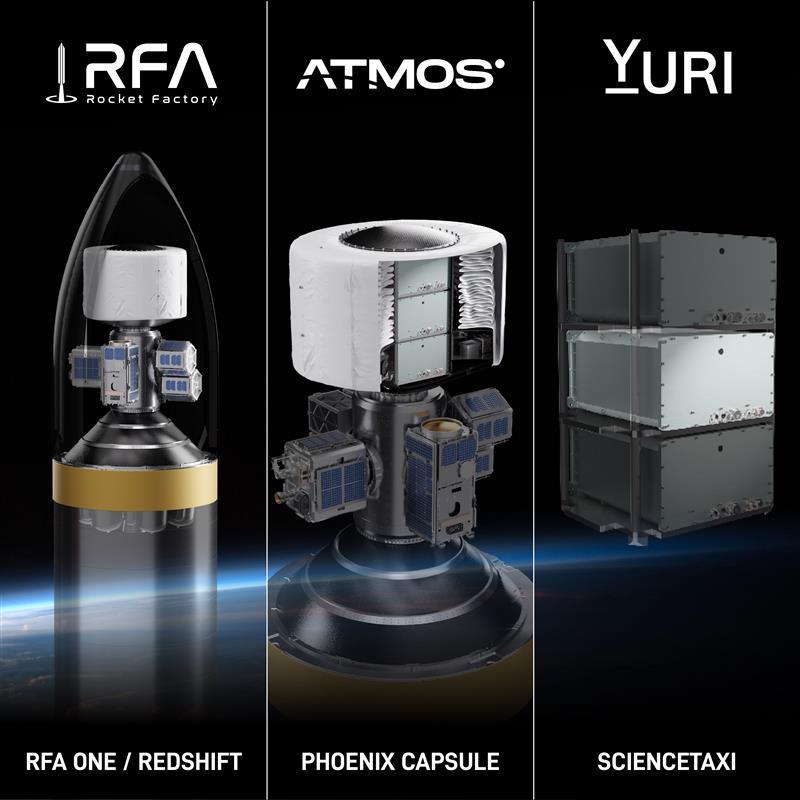
Strengthening Europe’s Defense: The Role of Space Technology

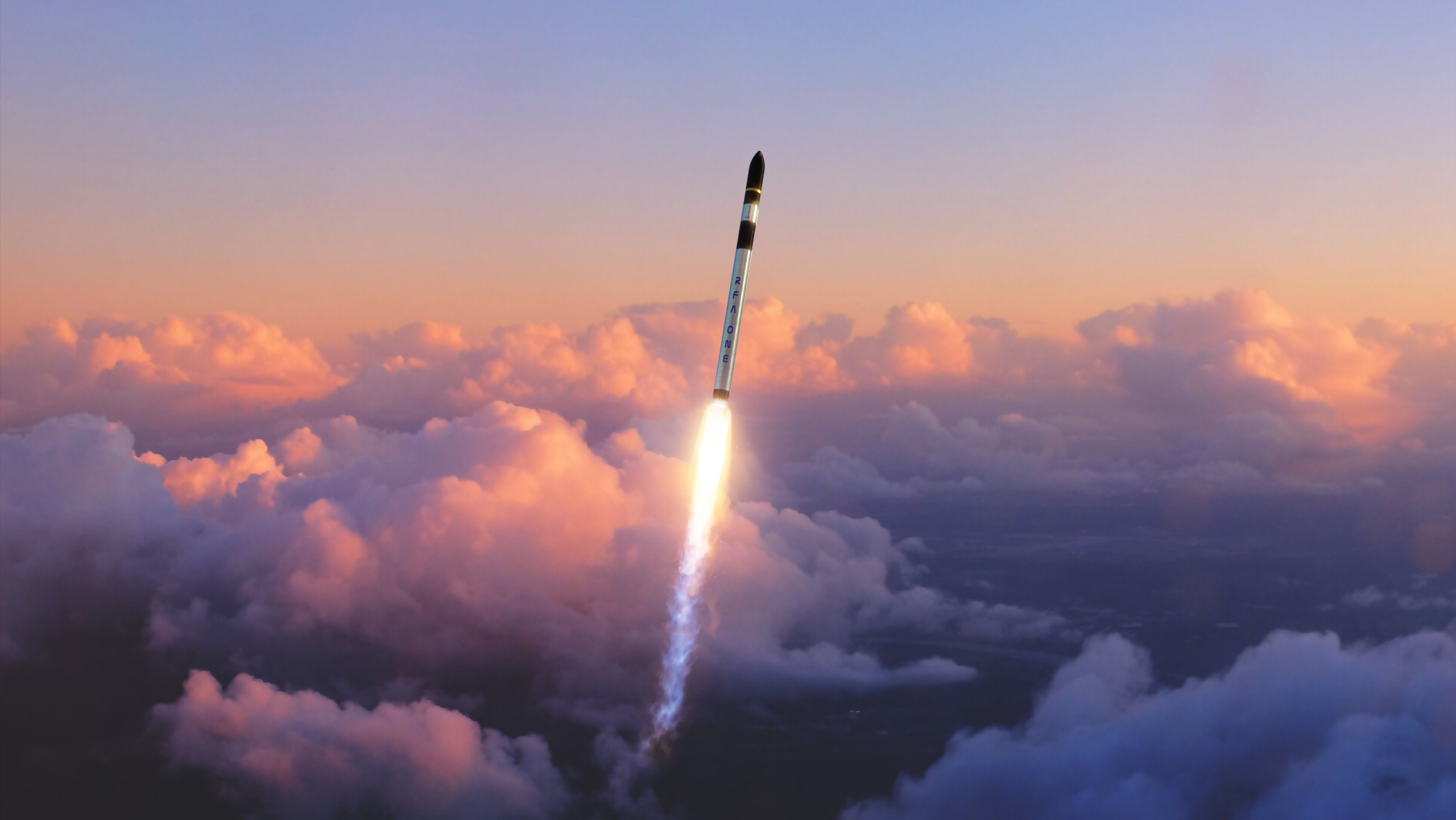
Graphic showing a stylized map of Europe with the European flag over it. RFA ONE is launching to the right picture edge.

In an era of rapidly evolving global security challenges, Europe´s defense is on the rise as the continent recognizes the urgent need to strengthen its capabilities. From the shadowy realm of cyber threats to the palpable tensions of geopolitical rivalries, the continent must swiftly adapt to a new reality where traditional defense strategies are no longer sufficient. Amidst this transformative journey, one of the most critical yet often overlooked domains is space, a frontier that holds the key to strategic sovereignty and future security.   

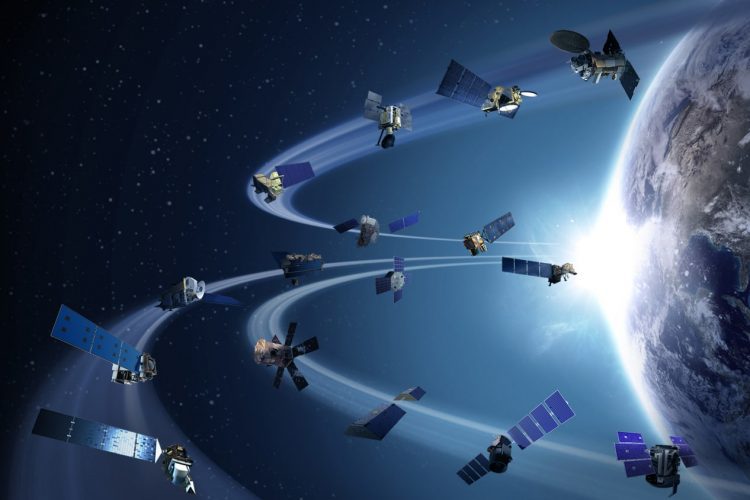
Space technology has undeniably become the backbone of modern defense and security strategies. From real-time intelligence and secure communication to navigation and early warning systems, space-based infrastructure is essential for maintaining Europe’s security and strategic autonomy. However, none of these capabilities are possible without one critical component: reliable and flexible access to space. Let’s take a closer look at the importance of space infrastructure in the security and defense context. 

Space Technology: Enhancing Defense and civil capabilities

The Ukraine conflict underscored the critical role of satellite imagery and real-time intelligence in monitoring threats and guiding strategic decisions. Similarly, cyberattacks on satellite networks, such as the KA-SAT incident, highlighted the fragility of space-based infrastructure and the urgent need for robust counter measures. Without technology, structures and processes to rapidly deploy or replace satellites, Europe risks significant gaps in its ability to act in space, undermining its defense planning and operational effectiveness on the ground. Consider the risks of delayed satellite deployment: gaps in reconnaissance data could leave military operations blind, disrupted communications could cripple joint force coordination, and failures in monitoring critical infrastructure, such as energy networks, could expose Europe to cascading vulnerabilities.  

In the same context, deeper military cooperation is essential to ensure collective security, reduce redundancies, and maximize the impact of defense investments. While the EU has taken significant steps to foster defense integration through initiatives like the Common Security and Defense Policy (CSDP), Permanent Structured Cooperation (PESCO), or the European Defence Fund (EDF), the NATO remains the cornerstone of Euro-Atlantic security. In 2024, it has set up its own space programme, STARLIFT, with which the NATO members want to jointly establish and ensure rapid and independent access to orbit. 

Pictures from orbit – a lifeline for civil protection

What applies to military applications also applies to civil protection and disaster assistance. Natural disasters, such as the 2021 floods in Germany and wildfires in Southern Europe, further illustrate the importance of rapid satellite deployment for effective crisis management. Earth observation satellites provide critical real-time data for coordinating emergency responses, assessing damage, and allocating resources efficiently. Viewed the other way around, delays in launching or replacing these satellites could slow response times, exacerbating the impact of disasters and leading to greater loss of life and property. 

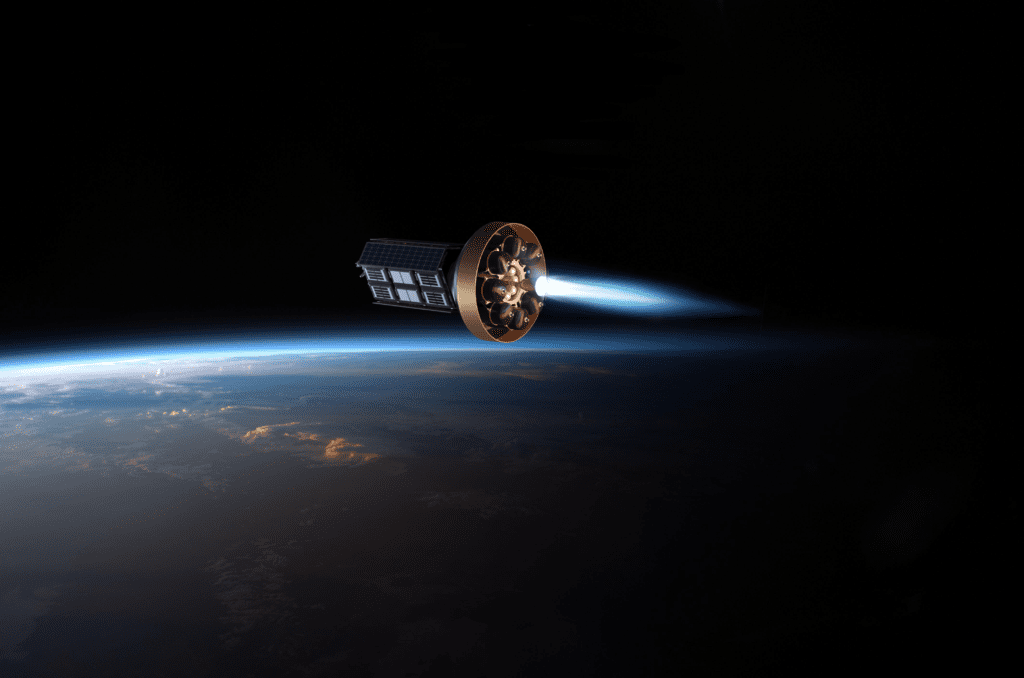
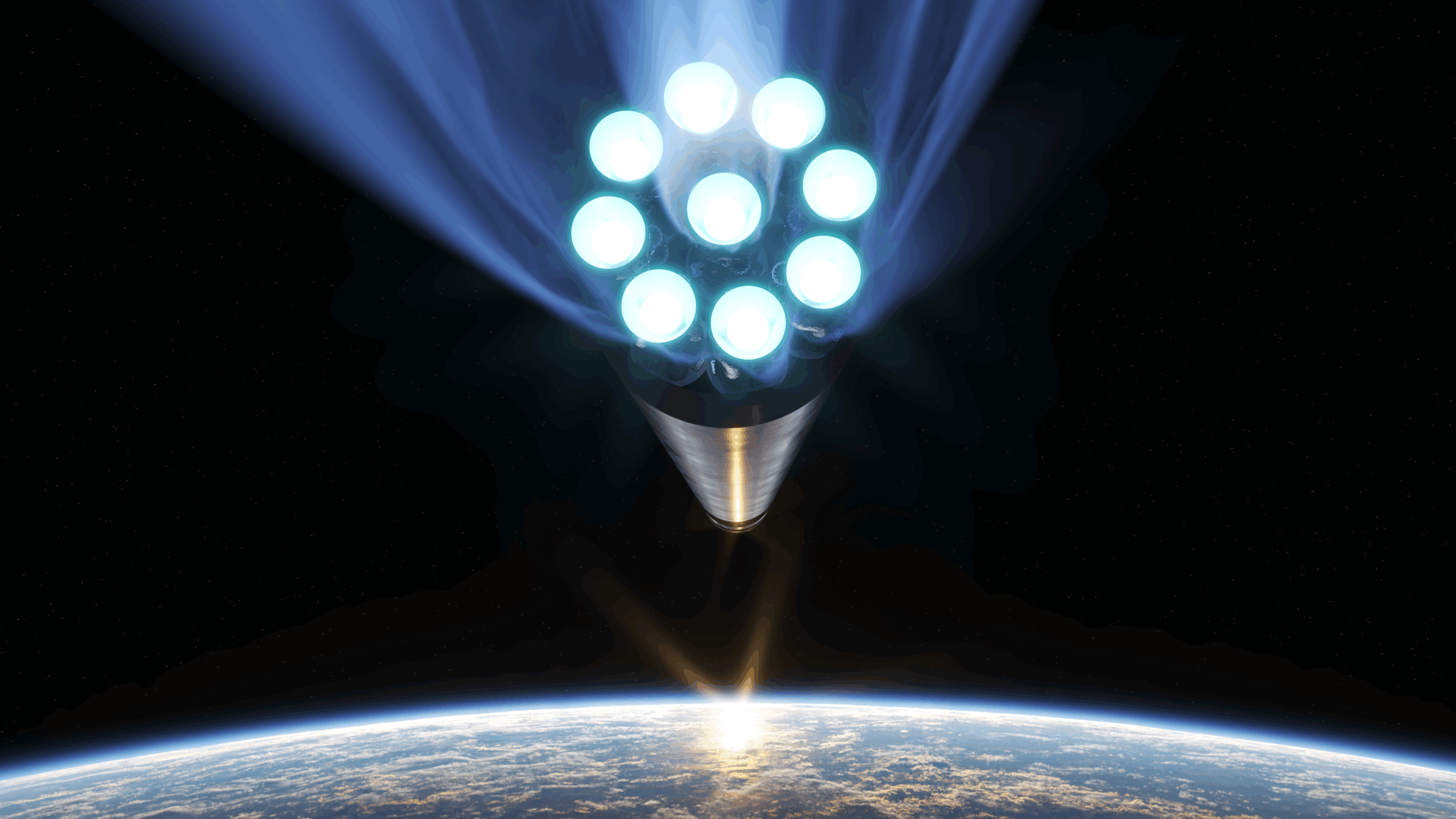
Redshift OTV in low earth orbit

So what lies at the root of all satellite-based countermeasures – whether civilian or military – is independent, reliable and flexible access to orbit. Speaking about… 

Sovereign and Flexible Access to Space

In the modern realm of defense and security, access to space is non-negotiable. However, Europe’s current dependence on non-European companies for satellite launches introduces vulnerabilities, as access, delays or prioritization conflicts could compromise its ability to respond swiftly to emerging threats. So Europe must prioritize sovereign and flexible access to space, ensuring it can act decisively without relying on external partners. Yes, Europe has an institutional launch system that guarantees independent launch capabilities. At the same time, this rocket has commercial obligations and is a large, expensive and quite inflexible system, launching from the other side of the Atlantic. It is therefore less suitable for short-notice defense and security missions.

To address these challenges, Europe’s defense strategy must prioritize investments in flexible and cost-effective launch solutions like the RFA ONE. With its modular design, serial production capabilities, and competitive pricing, the RFA ONE offers Europe a pathway to strategic autonomy in space. By supporting initiatives like RFA, Europe can enhance its military and civilian space capabilities, strengthen its military resilience, and improve its ability to respond to natural disasters and humanitarian crises. 

RFA ONE – enabling Europe´s ability to act

RFA ONE is purpose-built to deliver fast, flexible, and reliable launches – exactly what’s needed for responsive access to space. Thanks to our efficient production methods, scalable design, and remote and secure launch site at SaxaVord Spaceport, Scotland, we can react quickly to launch demands and get satellites where they need to be, when they need to be there. Whether it’s for crisis response, reconnaissance, or rapid tech demonstration, RFA ONE is the right tool for the job. Especially in the defense sector, where timing and availability are critical, that kind of responsiveness makes all the difference.

RFA is at the forefront of this mission, providing Europe with the launch solutions it needs to strengthen its defense capabilities and ensure strategic autonomy. By offering sovereign and flexible access to space, RFA ONE eliminates Europe’s dependence on external partners, safeguarding its ability to deploy critical assets quickly and act in space without geopolitical constraints.

As a leading European launch service provider, RFA is uniquely positioned to support Europe’s defense and security initiatives. With RFA, Europe is not just reaching for the stars – it’s securing its future on Earth.  

RFA ONE: The Most Comprehensive Guide to Our Launch Vehicle

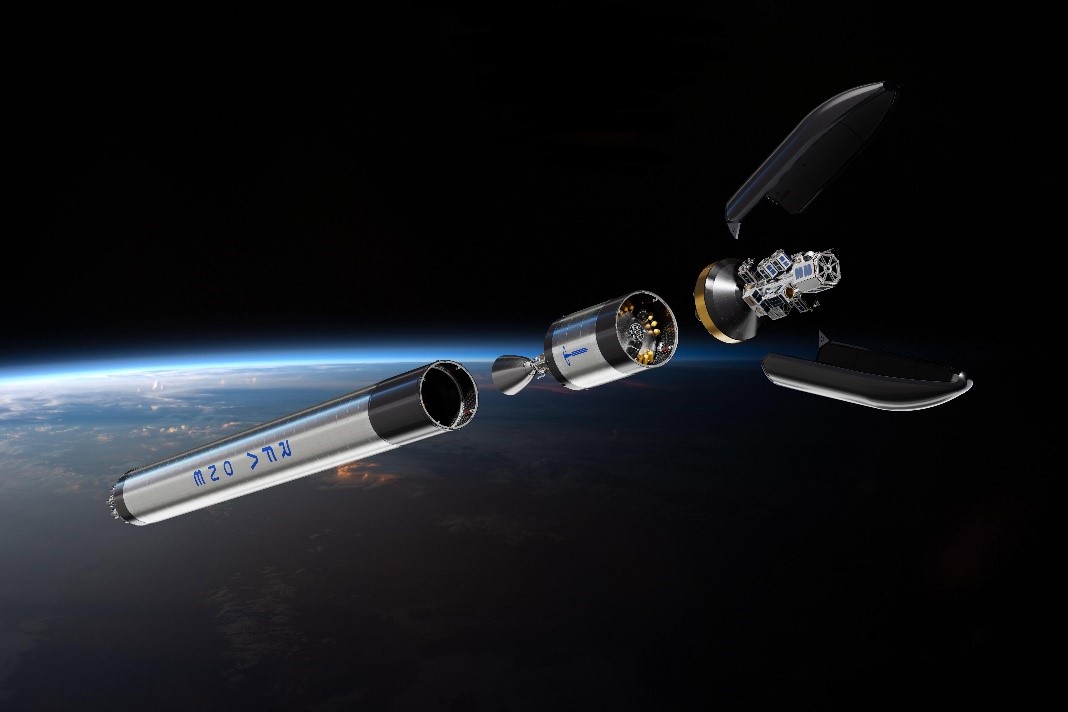
3D render of an exploded RFA ONE vehicle to show all 3 stages and elements.

We’ve got one mission at Rocket Factory Augsburg: to provide cost-effective, flexible, and frequent access to space.

At the heart of this mission is our RFA ONE launch vehicle. With three stages, innovative engine designs and a – for this rocket class – above-average payload capacity, it is built for maximum efficiency and performance.

Our previous blog post about our stage zero launch pad was a huge success so we thought we would share a deep dive look into the vehicle itself.

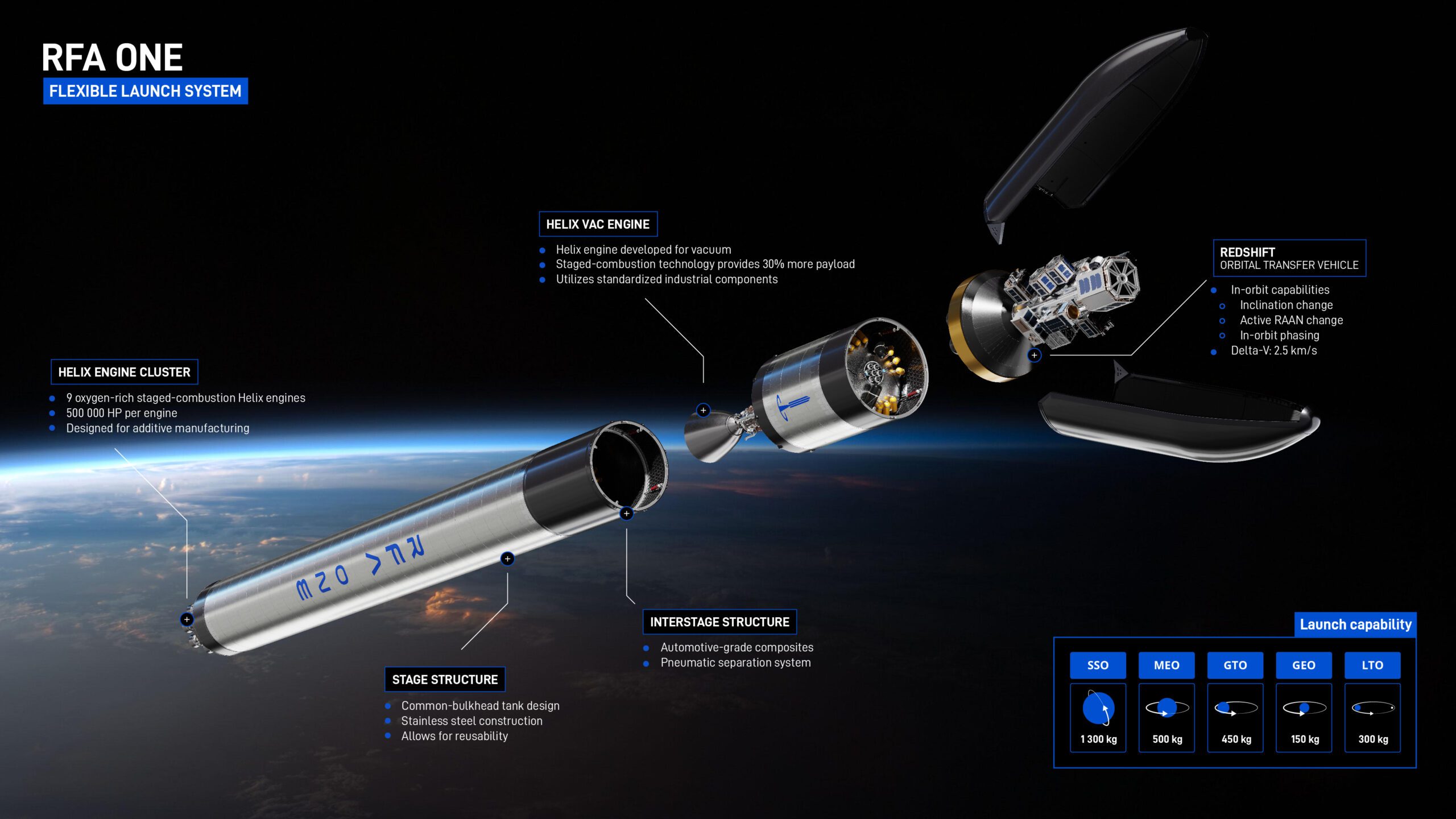
Diagram of RFA ONE vehicle with text information on each stage and major system.

RFA ONE – Stage 1

The first stage of RFA ONE is designed with the sole purpose of getting the rocket off the ground and propelling our payloads through the thicker atmosphere with maximum efficiency. It’s the main workhorse of the rocket.

Stage Structure and Durability

RFA ONE’s first stage is a common-bulkhead tank design made from stainless steel, making it durable, reusable and able to withstand the intense forces of liftoff and atmospheric pressure.


Stainless steel might seem like an odd choice when the standard material for rocket structures are aerospace-grade carbon fiber or aluminum. But we don’t do things the standard way, do we? 😉


Our goal when sourcing materials was to learn what would work best in term of costs, simplicity and reusability. The solution? Beer tanks. We leverage the high-quality manufacturing skills and extensive experience of the beverage industry and order pre-welded storage tanks. Then we conduct all necessary testing and qualification in-house.


Additionally, we use a specific alloy that gains increased stiffness when filled with cryogenic fuels. This allows us to make the tank walls thinner (currently 1mm), saving valuable mass without compromising on strength. Stainless steel beer tanks are also super cheap, lending them to our low-cost approach. Furthermore, they already have the structural strength required for rocketry and are suited for serial production and reusability. What’s more, we can easily pop out any dents in minutes (literally).

Helix Engine Cluster – Why 9 Engines?

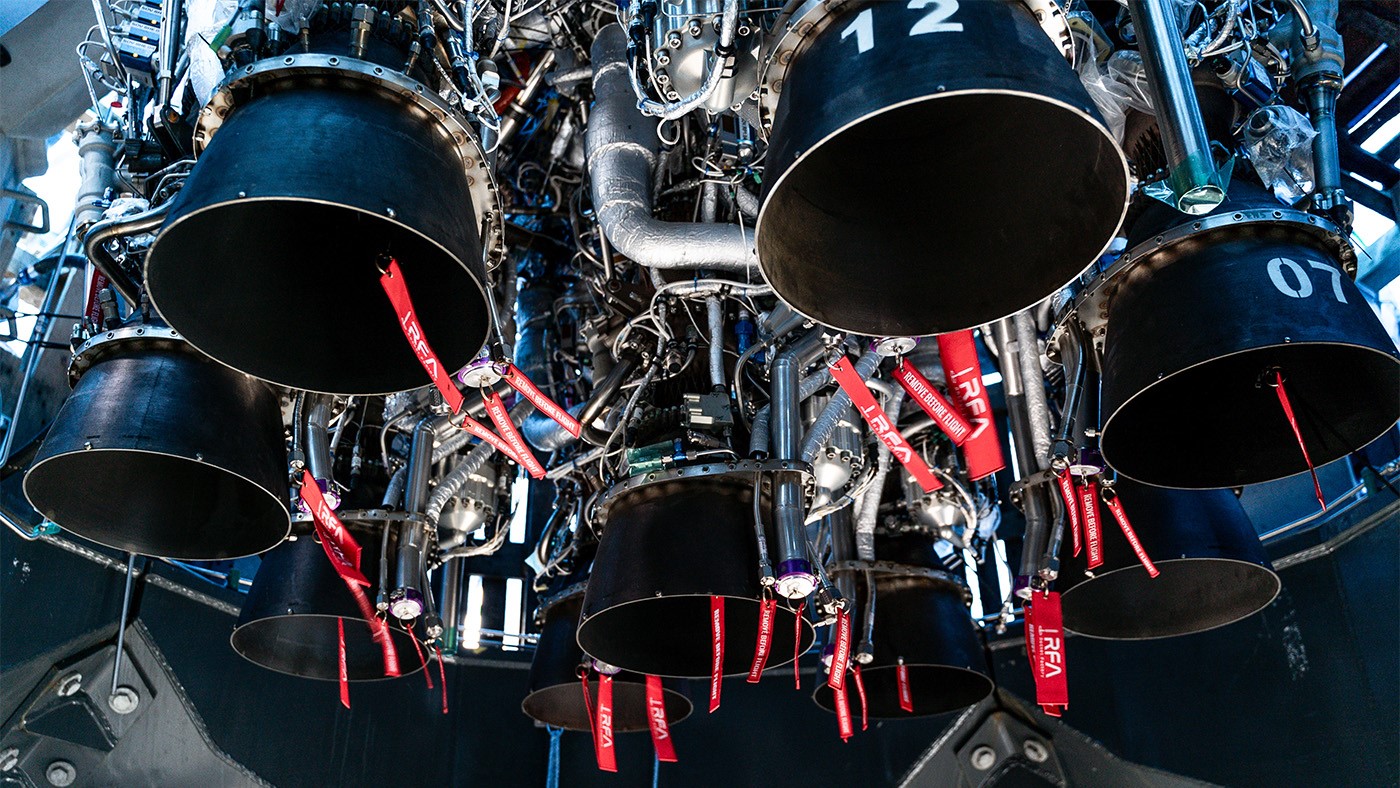
Sitting at the very bottom of stage one is a cluster of nine Helix engines that propel RFA ONE off the launch stool toward orbit.

We often get asked why we chose nine engines. This configuration was specifically chosen for several reasons.


The first is clustering increases redundancy – if one engine fails, the others can compensate. Second, using nine engines allows for greater control during ascent. We can individually throttle and gimbal each engine to steer the rocket accurately. Finally, smaller engines are way easier and quicker to produce and handle.

Our goal is to get to orbit successfully in the most efficient way – a nine-engine cluster allows us to do that.

RFA ONE Helix Engine Specifications

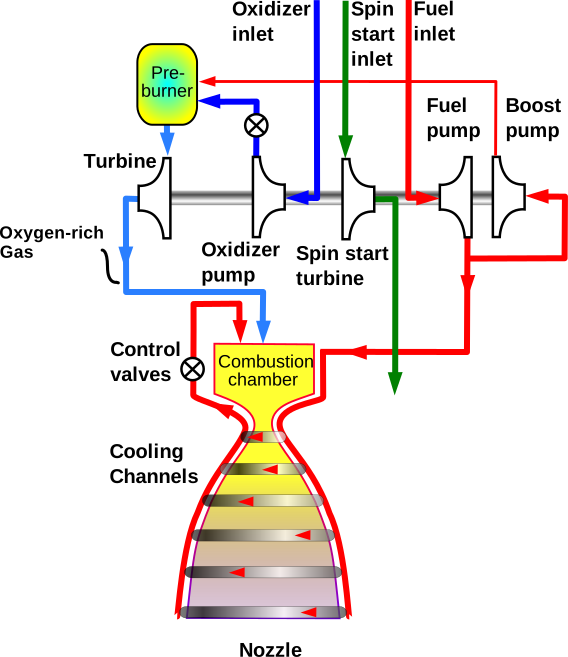
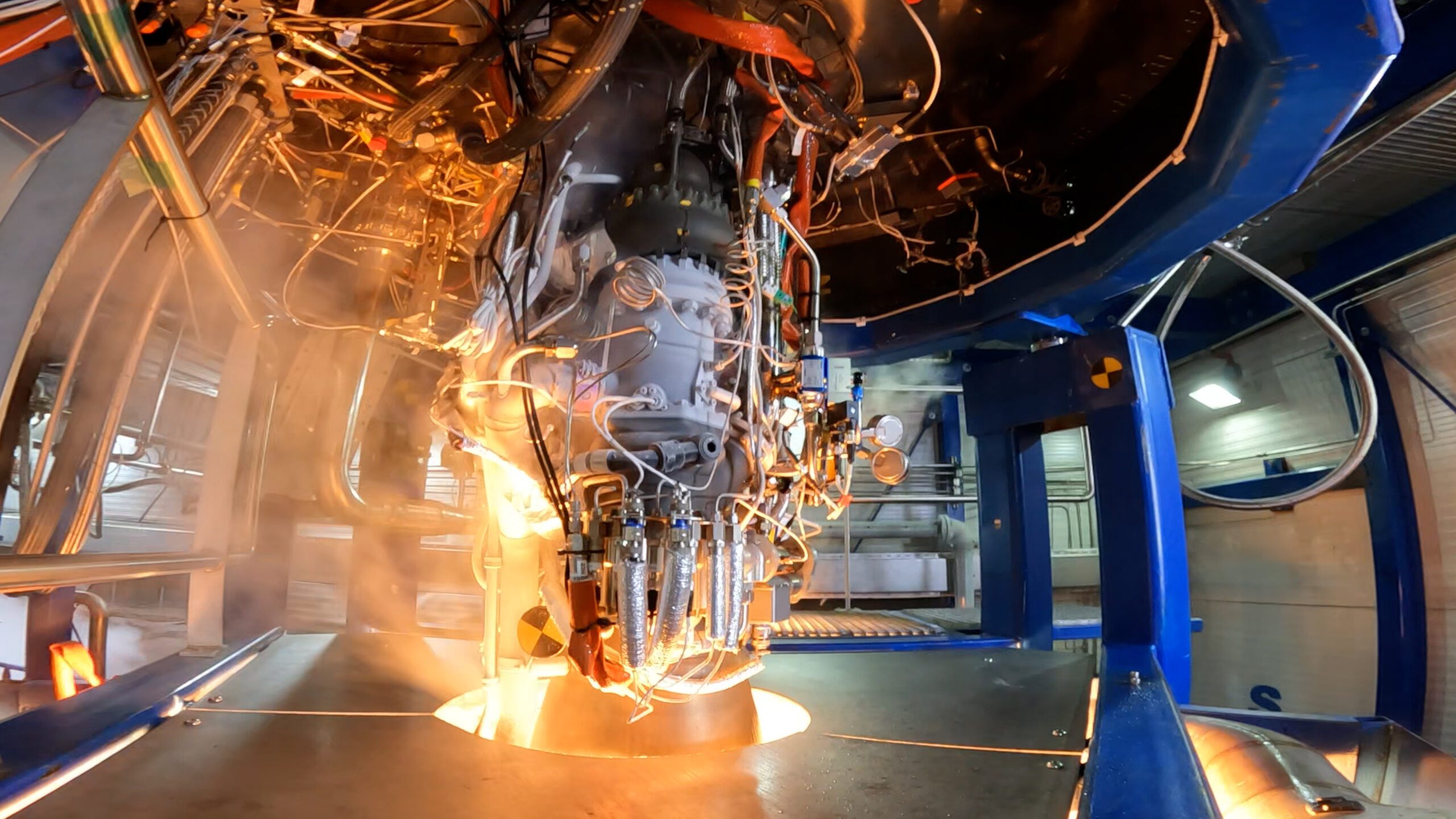
Our Helix engine is particularly unique. Developed in-house by our team of excellent engineers, it’s an Oxygen-Rich Staged Combustion (ORSC) engine that delivers 100kN (roughly 500,000 hp) per engine.


The staged combustion technology gives Helix up to 7% more efficiency which allows us 30% more payload and higher performance than traditional open-cycle rocket engines.


Staged combustion works by feeding the partially unburned exhaust gases from the turbopump into the main combustion chamber, burning the available fuel more completely, getting the most out of it. This also makes it more environmentally friendly.


We designed Helix and its turbopump entirely in-house for additive manufacturing, using standardized parts wherever possible, and quick and easy assembly by just a few mechanics.


In July 2022 we became the first company in the European Union to successfully develop and test a staged combustion engine in flight configuration. It also made us the third commercial company in the world to successfully test this type of engine on a large scale.

The Interstage – connecting stage 1 and stage 2

The interstage is a vital component of RFA ONE. Designed to connect stage 1 and stage 2, it is responsible for ensuring a smooth separation between the two stages. It also serves to protect the HelixVAC engine during ascent. Made from automotive-grade carbon fiber, the interstage is designed to minimize weight while maximizing structural integrity. In fact, RFA ONE is the only rocket in the world utilizing this unique stainless steel-carbon-fiber-hybrid design!


Fun fact: creating the interface between the rigid carbon fiber and stainless steel tanks was a challenge for our engineers. The tanks contract when filled with cryogenic liquid oxygen, adding complexity, but the result is a flexible interface that maintains the structure’s overall rigidity.

RFA ONE – Stage 2

Structurally, stage 2 shares the same robust design as Stage 1, but in a more compact form. Like Stage 1, it’s crafted from stainless steel tanks, applying the same cost-efficient and high-quality approach. As dictated by fundamental rocket physics, the higher you go in the rocket, the smaller the stage needs to be. That is why we have optimized Stage 2 in terms of weight, length, capacity and engine performance.

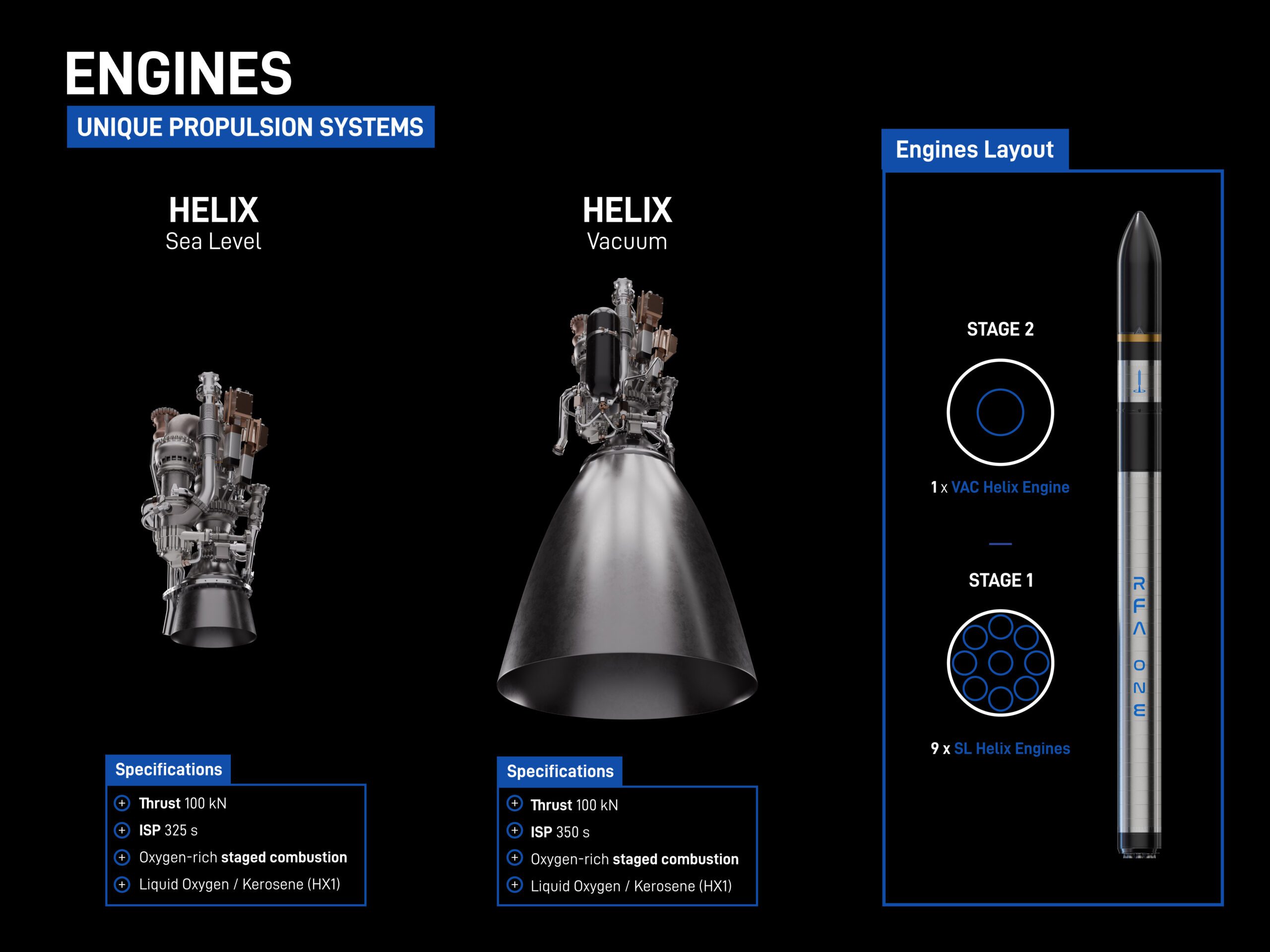
Graphic comparing Helix SL engine with HelixVAC engine

HelixVAC Engine

Alongside our standard Helix engines (Helix SL = sea level), we also developed the HelixVAC (Helix vacuum) engine for stage 2. The key differences between the Helix SL and HelixVAC engines lie in their start systems and engine nozzle.


At sea level, the Helix engine is designed to handle atmospheric pressure that pushes against the exhaust plume. To prevent flow separation and maintain exhaust jet stability, the nozzle is made smaller. However, in the vacuum of space, where there’s no atmospheric pressure, the HelixVAC engine has a much larger nozzle. This allows for targeted acceleration of exhaust gases over a longer duration, improving efficiency in space.


An interesting detail about the HelixVAC engine is that its nozzle glows in space because it isn’t actively cooled at the lower end. Despite reaching nearly the same temperature as the exhaust jet, it doesn’t melt. Woohoo, engineering!


Both engines use a spin start system that gives the turbopump an initial boost using helium before the preburner ignites. For the first stage, the launch pad’s helium system is used to save weight on stage 1. In contrast, stage two carries its own high-pressure helium bottle.

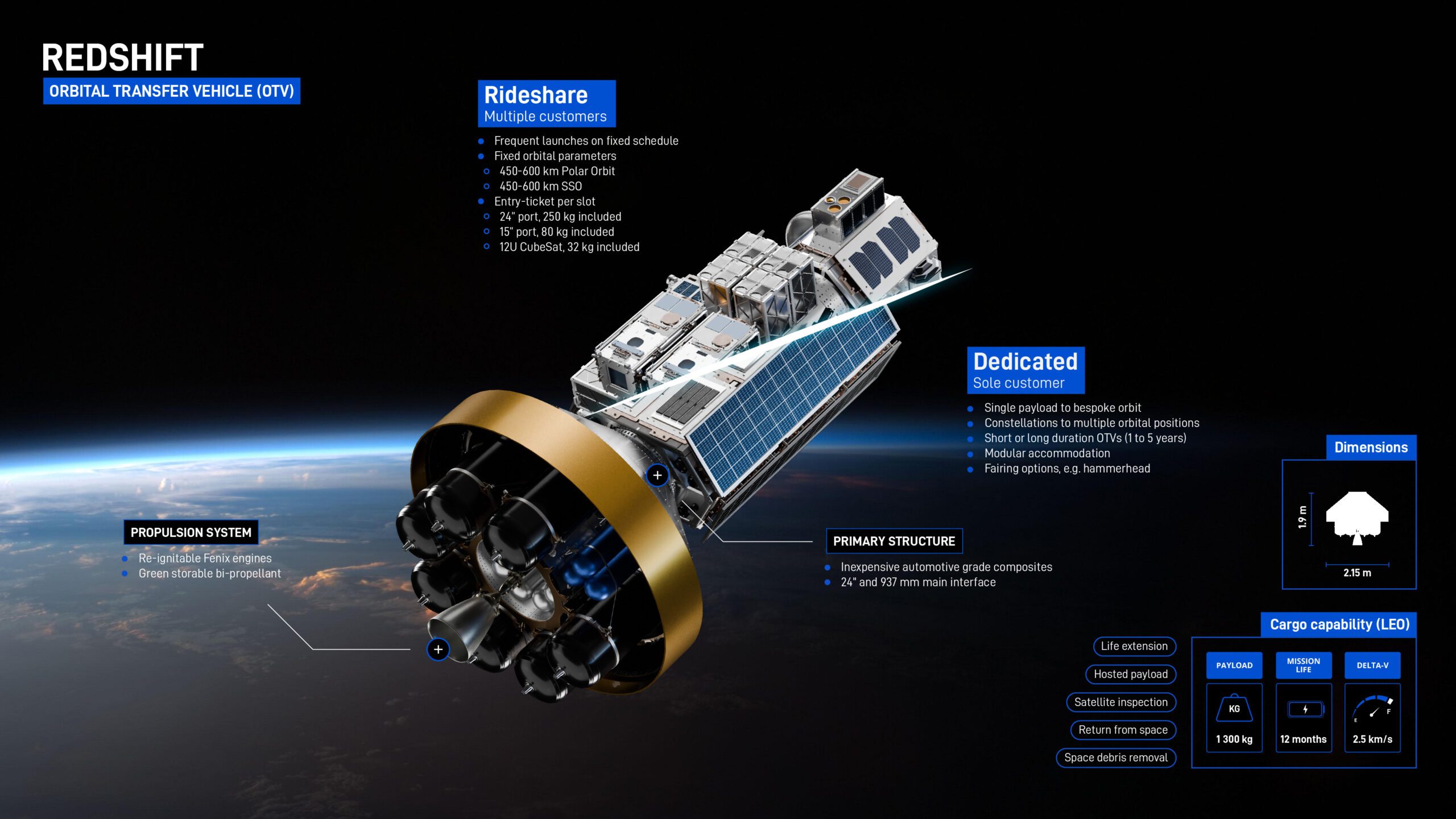
Graphic showing explanation of Redshift Orbital Transfer Vehicle on RFA ONE

RFA ONE – Stage 3 (Redshift Orbital Transfer Vehicle)

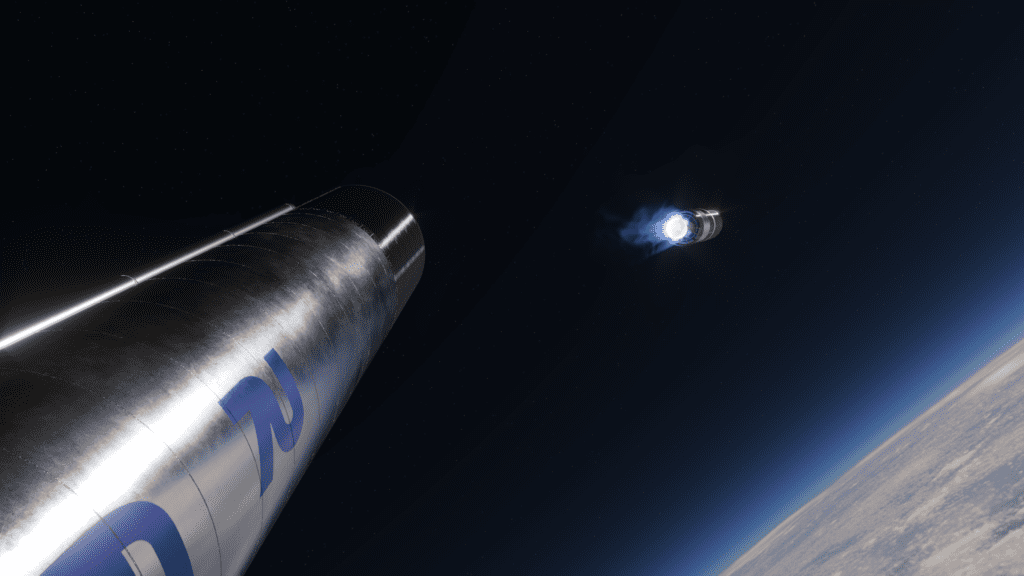
Stage 3, also known as Redshift, is our Orbital Transfer Vehicle (OTV). When RFA ONE reaches orbit, Redshift takes over and deploys the payloads.


The primary structure is made from inexpensive automotive grade composites and it is powered by our Fenix engine – a 1,5kN, re-ignitable engine run on green, storable bi-propellant.

Payload Capacity

Our Redshift Orbital Transfer Vehicle (OTV) can carry up to 1300 kg of payload into orbit.


It can serve multiple customers at a time with rideshare capabilities or serve a single customer with a dedicated payload to a bespoke orbit. There are further configurations and customizations available – Redshift can be tailored to the needs of every customer.


You can discover more about RFA ONE’s payload capabilities in our Payload User Guide.

In-Orbit Capabilities

Redshift’s in-orbit capabilities are what really sets it apart. Going beyond just delivering multiple payloads in different orbits (altitude-and inclination-wise), it can in a not-to-far future host payloads for extended missions, assist with life extension and perform space debris removal.

These versatile capabilities make it an invaluable asset for complex and multi-faceted space missions.

The Power of Standardized Components (COTS)

One of the key innovations behind RFA ONE is our use of standardized components, or Commercial Off-The-Shelf (COTS) parts. By integrating high-quality, low-cost components from industries like automotive and oil & energy, we are able to significantly reduce both development time and production costs. This approach also ensures that our rocket benefits from the proven reliability and mass-production efficiencies of these sectors.


For example, we use stainless steel sourced from the beverage industry for our tanks, a cost-effective material that meets our high-performance needs. Or connectors, which can be found in every car harness. Or valves that usually operate welding robots. This allows us to offer a highly competitive price for launch services without compromising on quality or safety.

RFA ONE – the most unique small launcher in Europe

RFA ONE has the potential to reshape the European space industry. Built to handle the growing demands of modern space missions, RFA ONE offers customer-oriented transport services at a much lower price point. By leveraging low-cost materials like stainless steel and employing standardized components from other industries, we´ve created a flexible and cost-effective solution for access to space that can benefit any industry that wants to connect, understand and protect our Earth with data from space.

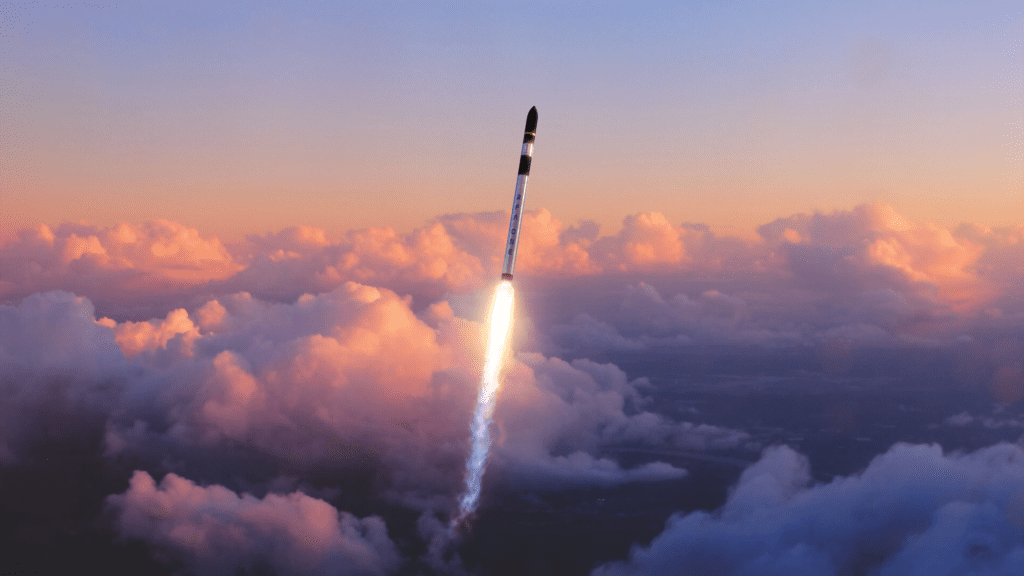
RFA ONE flies into space

Standing on the shoulders of a giant: An overview of our launch pad

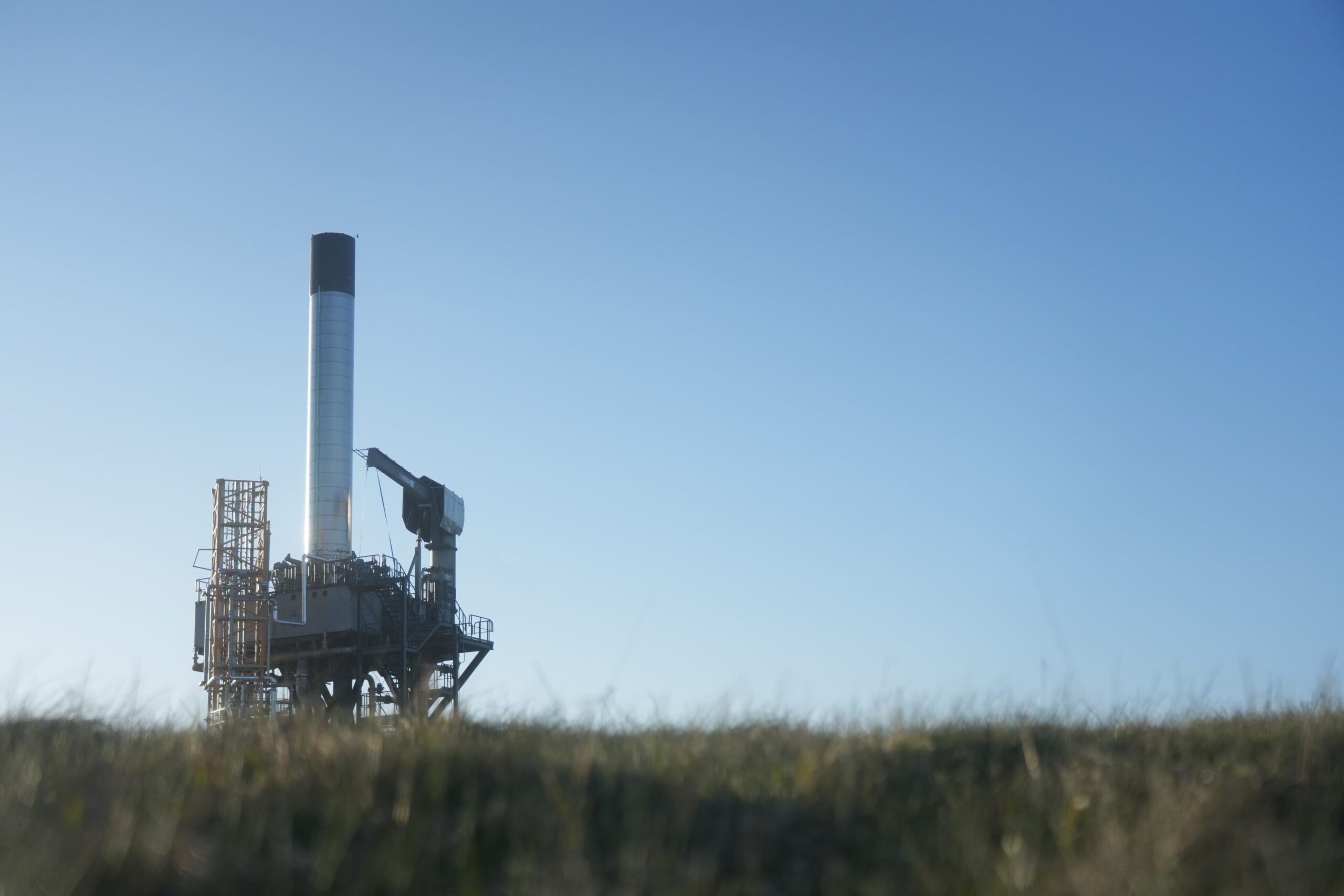
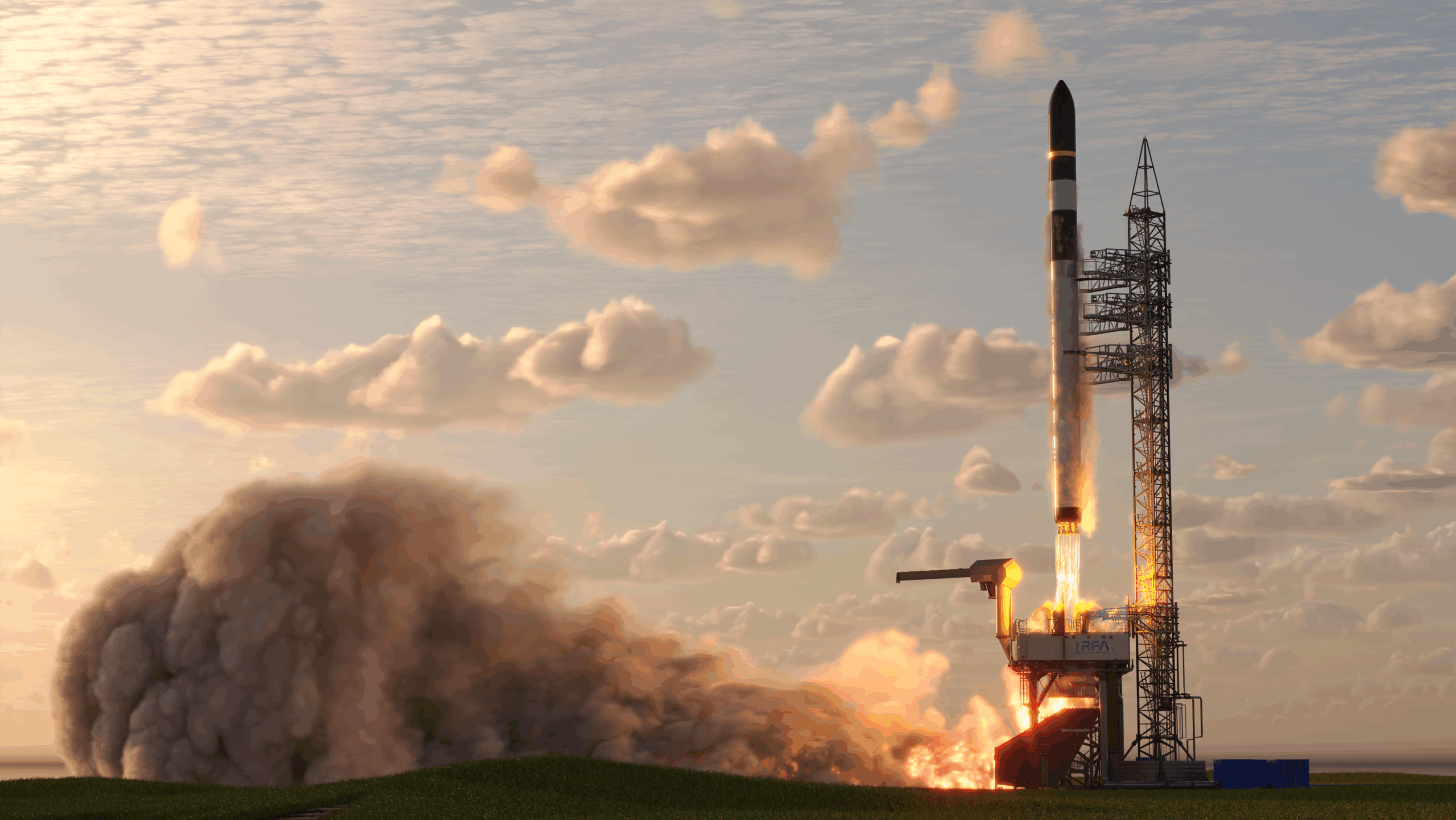
Photo of Stage 1 on the RFA launch site at SaxaVord Spaceport from the perspective of a nearby field.

Reaching the launch pad is a monumental milestone for any rocket company, but building the launch pad is an entirely different challenge. It is essential for launching a rocket, yet it often remains an unsung hero in the background. At Rocket Factory Augsburg (RFA), we’re dedicated to sharing the story of our “Stage Zero” and giving you a behind-the-scenes look at our process.

While most people focus on the rocket itself (which is completely fair), we delve deeper into the question: “But how do we make it actually happen?” The entire process is incredibly complex and requires meticulous planning. Our launch pad must store, amongst others, thousands of liters of fuel, LOx, Nitrogen, and Helium. It then has to fill our three rocket stages at precise temperatures, to a specific time, provide power to all systems and sensors, and protect itself from the immense power of our nine Helix engines roaring to life.

Why SaxaVord? The Strategic Location of Our Stage Zero

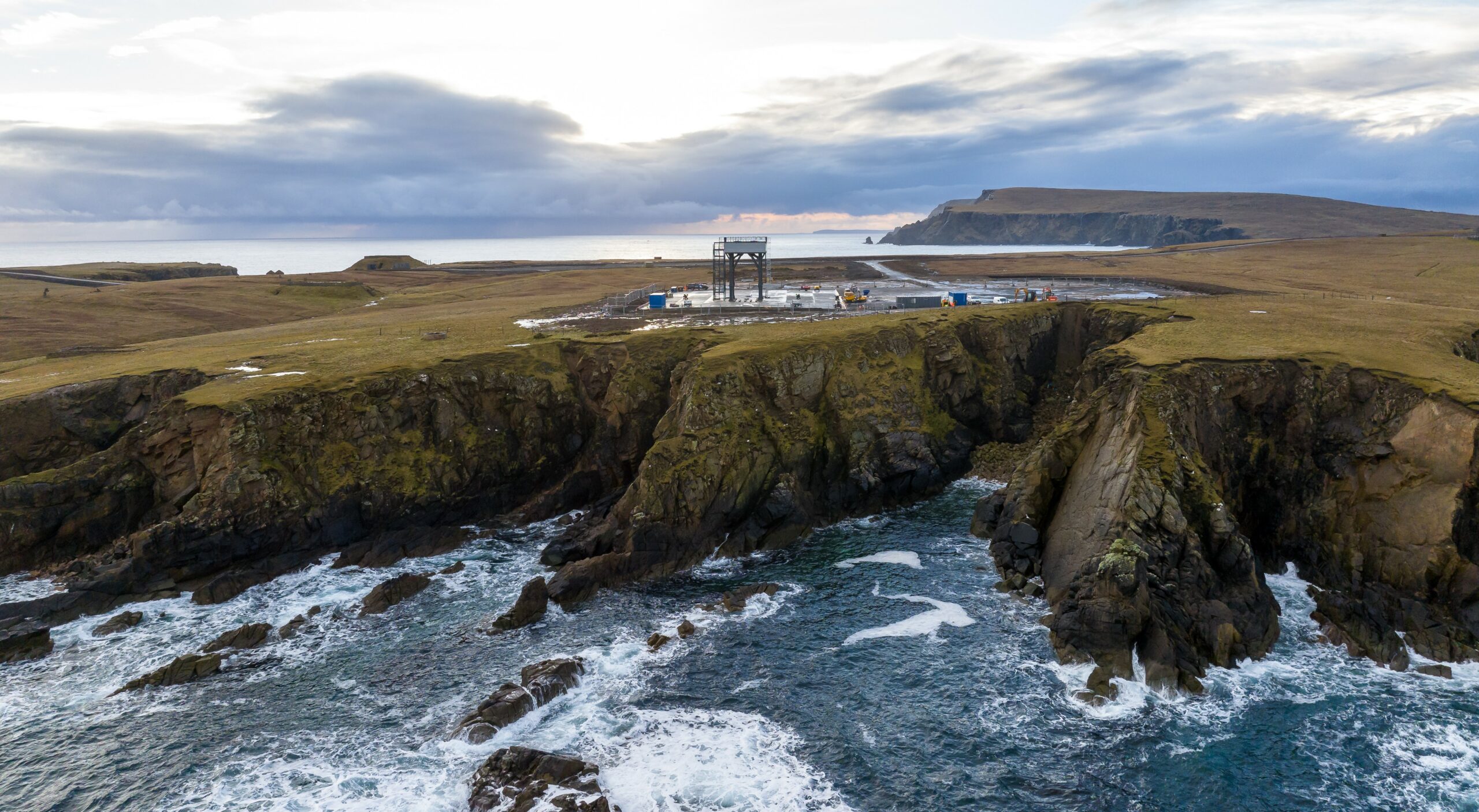
Photograph of the peninsula of the Isle of Unst in the Shetland Islands in Scotland. The photo shows the Rocket Factory Augsburg launch pad at SaxaVord Spaceport.

Believe it or not, we didn’t just close our eyes and point to a map.


Choosing SaxaVord Spaceport as the base for our flight operations was a decision made after careful consideration of various factors: Firstly, SaxaVord and RFA are both private companies who share the same approach of cost-efficiency, a fast pace and “go-get-it”-mentality. Secondly, Shetland has a rich oil and fishing industry with existing infrastructure (e.g. industrial harbors, tool stores, suppliers). Finally, it is perfectly located for launches into polar low earth orbits.


While launching from the equator provides additional speed from the Earth’s rotation, this advantage is primarily relevant for higher or further orbits (e.g., GEO, Lunar, or interplanetary). For our purposes, proximity to the equator is not a crucial factor since we will be launching in a direct north/south direction. We’re primarily targeting polar and sun-synchronous orbits as that is the optimal location for the more commercially interesting constellations and Earth Observation (EO) satellites.

The Technical Backbone of the Launch Pad

Now, as we set the scene in Scotland, building a rocket launch pad involves much more than just concrete and steel.


Our team of engineers has worked tirelessly to design and implement the technical infrastructure needed to support our rockets. From fueling systems to communication with, and erection of the RFA ONE, every detail has been carefully planned to make sure we have a safe, efficient, and successful launch. Let´s have a look at some of the main elements:

Key Components of Our Launch Site

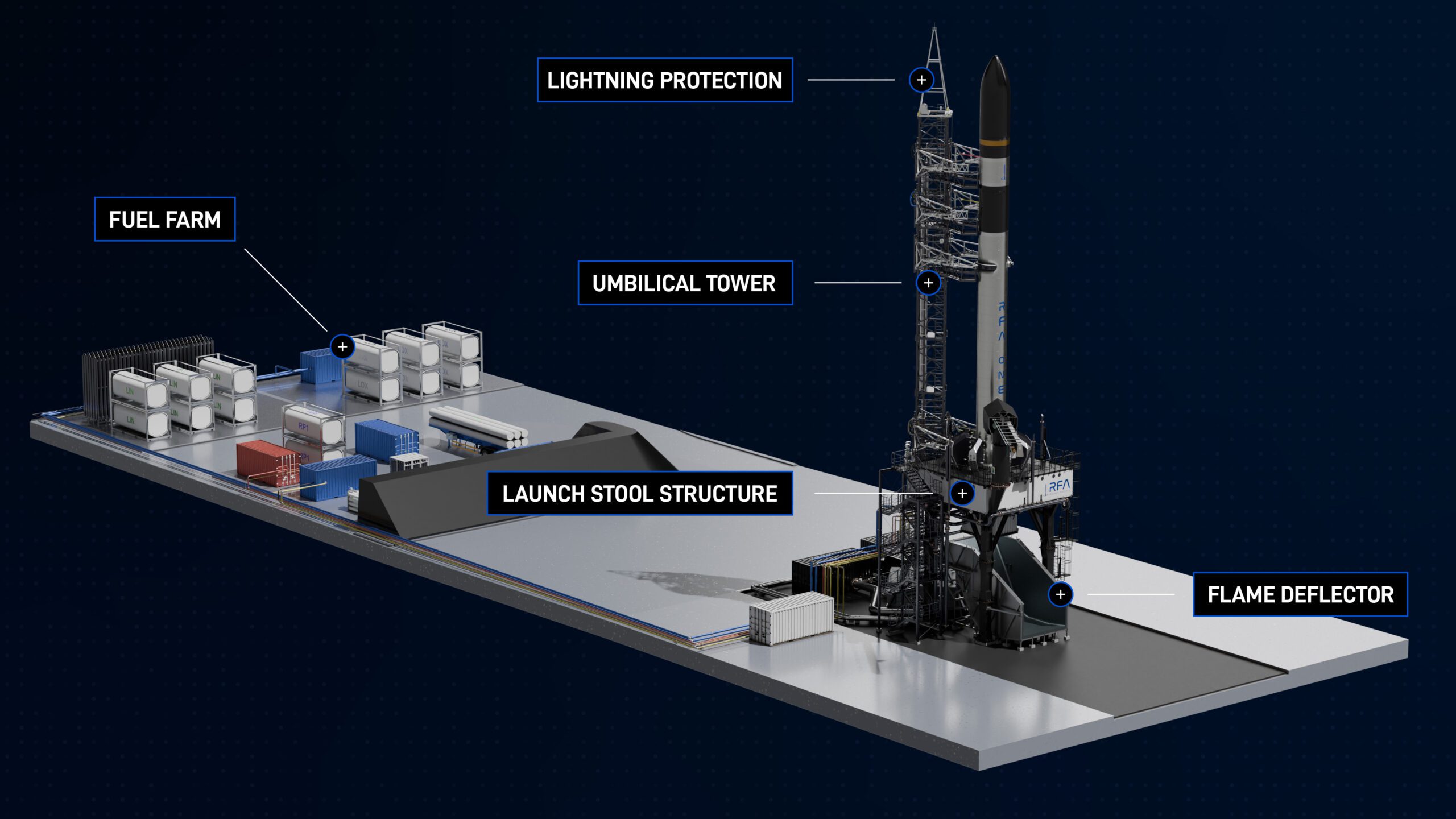
3D render of the RFA launch site with labeling. The render shows the Umbilical tower, fuel farm, launch stool structure, lightning protection and flame deflector.
  • Launch Stool Structure: You know what it looks like. A large, gray steel structure on four legs, to put it simply. But the launch stool does not just hold our RFA ONE in place before launch. It also allows us to work on things like the engines when the vehicle is fully integrated and vertical. The structure is made of stainless steel and has to withstand the strong winds and salty (corrosive) sea air. By the way: The company that built the launch stool for us comes from the maritime structural engineering sector. We want to go beyond highly specialized (and correspondingly paid) aerospace suppliers – not only for RFA ONE but everywhere.
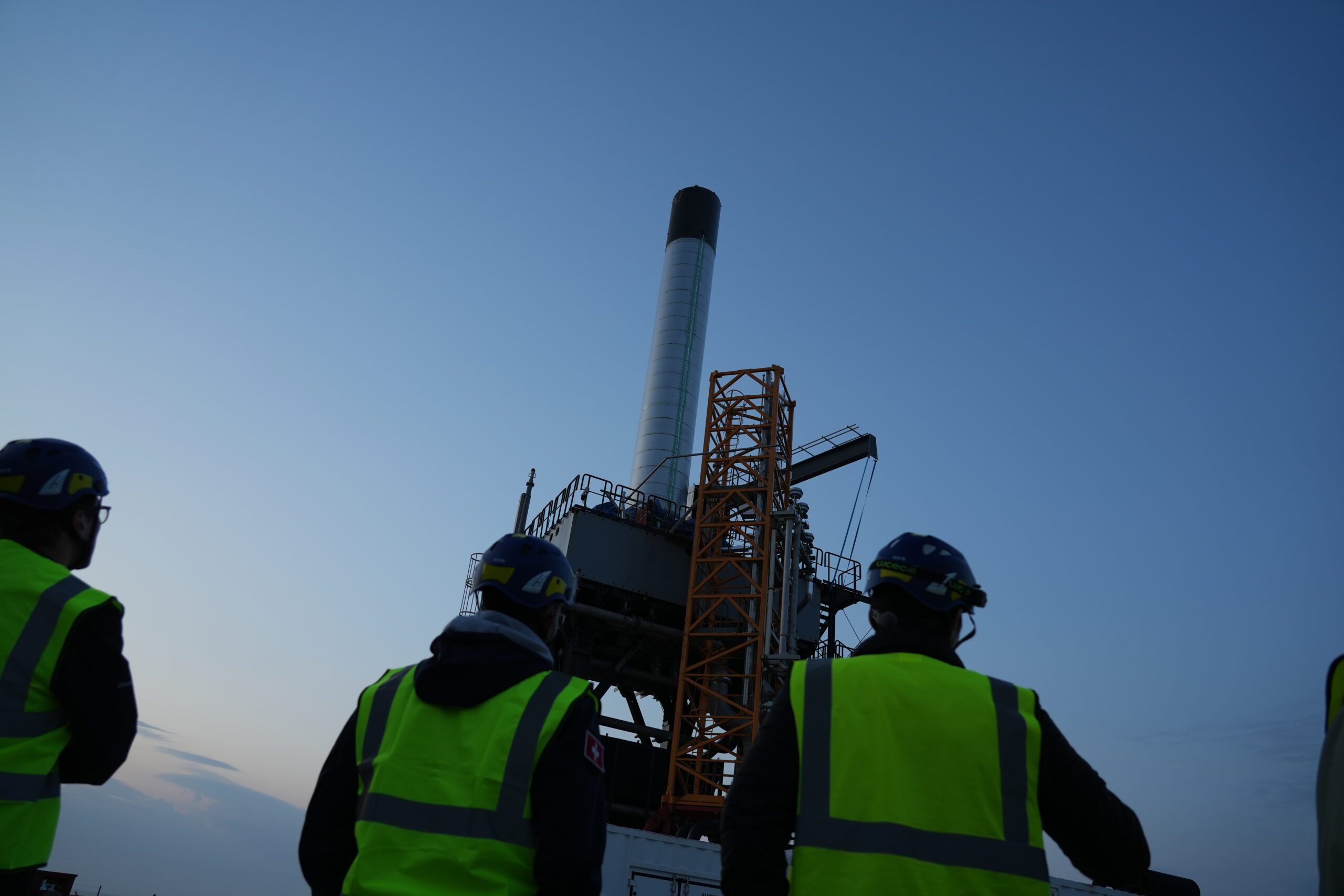
Photo of RFA employees looking up at Stage 1 standing on the launch pad at SaxaVord Spaceport.
  • Fuel Farm: Our so-called fuel farm is where we store everything we need to fuel our launch vehicle. Inert gases, propellants, oxidizers and other liquids are all kept here until it’s time to fill RFA ONE with them in a precisely timed and temperature-controlled manner. For example, LOX gases off at an ambient temperature so we have to continuously cool it and fill it into the rocket at precisely the right temperature so that it is perfectly fueled for launch. The fuel farm is protected by an earth wall and connected to the launch stool by several different sized pipelines. We have many sensors and valves on that ground support equipment (GSE) ensuring everything is perfectly coordinated – keeping track of everything is crucial and an art in itself!


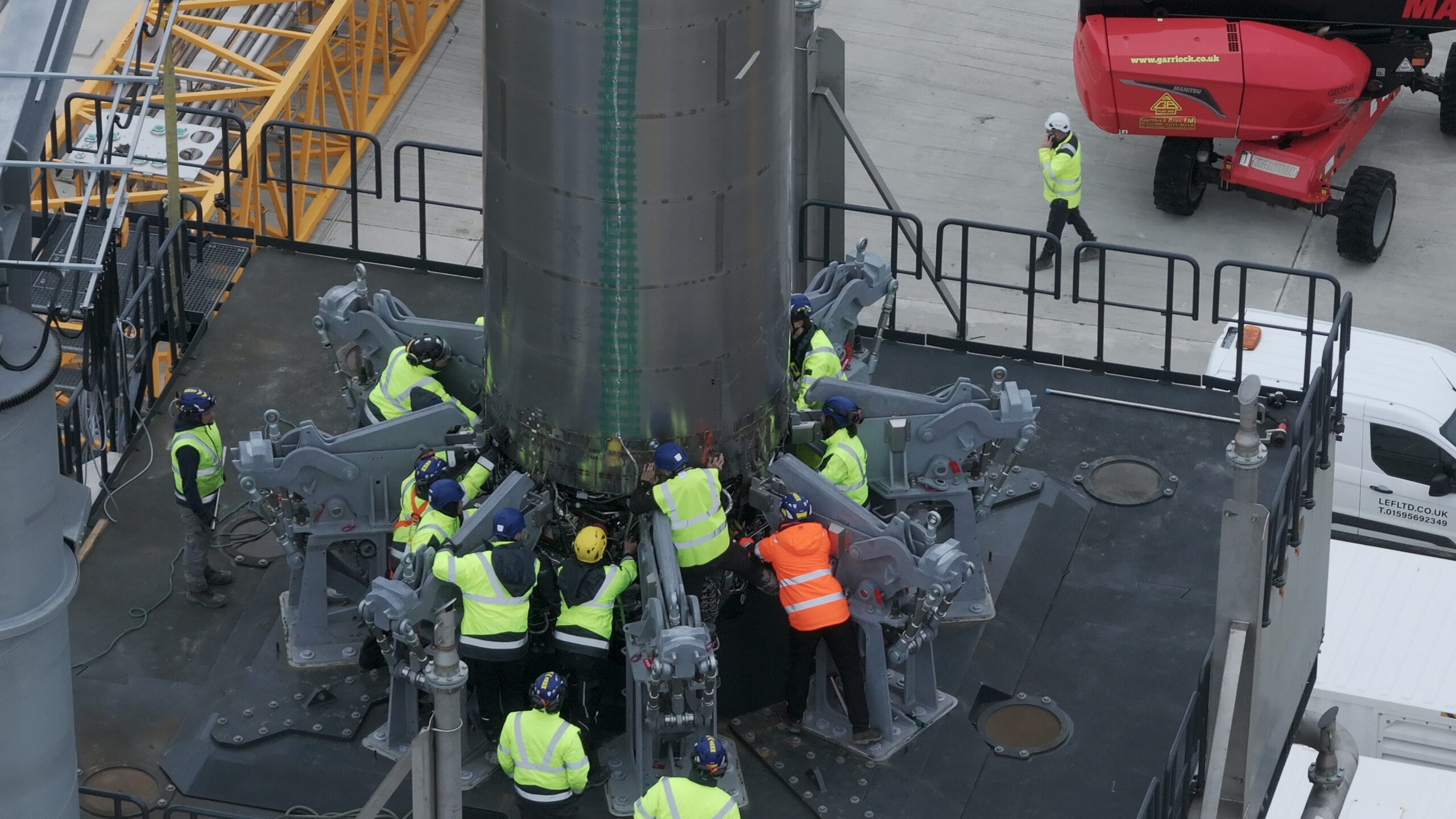
  • Umbilical Tower: The large yellow tower is our umbilical tower. All fuel pipelines, power and data cables run up the rocket to the respective stages via this tower using interfaces. These only get disconnected when we get to lift off. If one of them gets stuck unplanned, we’ll have a problem. Further up the umbilical tower, we have collar clamps to stabilize the rocket in windy conditions. There are also eight massive hold-down clamps at the lower end. These clamps only let go when the thrust is right and all systems are running as planned. By the way, we made our umbilical tower by repurposing a decommissioned and commercially available construction site crane. Classic, cost-effective, pragmatic RFA. 😉
  • AIT (Assembly, Integration, Testing) Hangar: Like the launch stool, our hangar is another seemingly simple structure: a steel building with a concrete floor. But behind the doors, it’s the place where all the magic happens! We will conduct our final tests in this hangar before integrating all three stages of RFA ONE into the final launch vehicle. The hangar serves as our technical workshop, complete with a clean room for integrating our customers’ satellites with our Redshift OTV.
  • Mission Control Center: This is the central hub of activities on launch day. From our MCC, the core launch team will monitor and control all systems before, during and after the test flight.

Safety Considerations

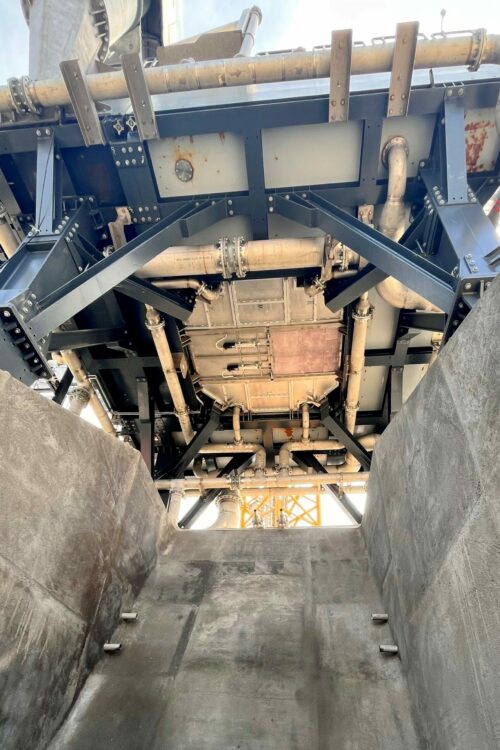
  • Flame Deflector Ramp: We have constructed our own ramp that sits directly below the rocket. This serves to deflect the powerful exhaust jet of RFA ONE so it exits horizontally. Without it, the exhaust jet would go straight into the ground, causing dust and stones to be thrown upwards against the rocket and into the engines. While the ramp is made of stainless steel (what else), we have applied a very special and fire-resistant concrete to it to make it reusable.
  • Water Deluge System: Just before those nine powerful Helix engines ignite, we inject the water into the sides of the exhausts. This reduces the heat from flames and dampens noise and shock waves, maintaining the structural integrity of the stool and protecting the vehicle. This is also what creates the large white cloud you usually see during rocket launches – it’s just water vapor.


  • Lightning Protection: The umbilical tower is also the highest point on the entire SaxaVord peninsula. So we have installed a lightning conductor, just in case – better to be safe than sorry!


  • Communication Systems: The most important safety consideration when on our launch site, especially so when the stages are on the launch pad and we are testing. It is essential to communicate with both the rocket and each other continuously. We have to ask questions like: Is the pressure right? How much fuel do we have in the tank? Are the engines cold enough? Are all the valves working? Does the flight computer have everything under control? To monitor this, we (currently) have many sensors on RFA ONE and the launch pad. They automatically check the health of all ground systems and the rocket and send the data to our team who communicate with each other via a radio system.

From Design to Assembly to Lift Off: It’s All About the Journey

The process of building Stage Zero was a journey marked by challenges and collaboration. In true RFA fashion, the design philosophy for the launch site was to aim for low-cost and standardization. We achieved this by building the site from the ground up and designing all our systems and modules to fit into standard shipping containers. It made it easy to transport everything from Augsburg to Shetland and beyond. Our launch site can be packed down and put up anywhere in the world, further adding to our flexible and low-cost approach.


Ultimately, designing and building Stage Zero has been a challenging but highly rewarding experience for everyone involved. Our recent first stage hot fire has shown that the systems are working well and that we can now push on with finalizing everything for our first test flight. Our hope with this blog post is to shine a little more attention on this marvel of engineering.


The rocket is one thing – what it takes to really get this thing off the ground is a story all of its own.

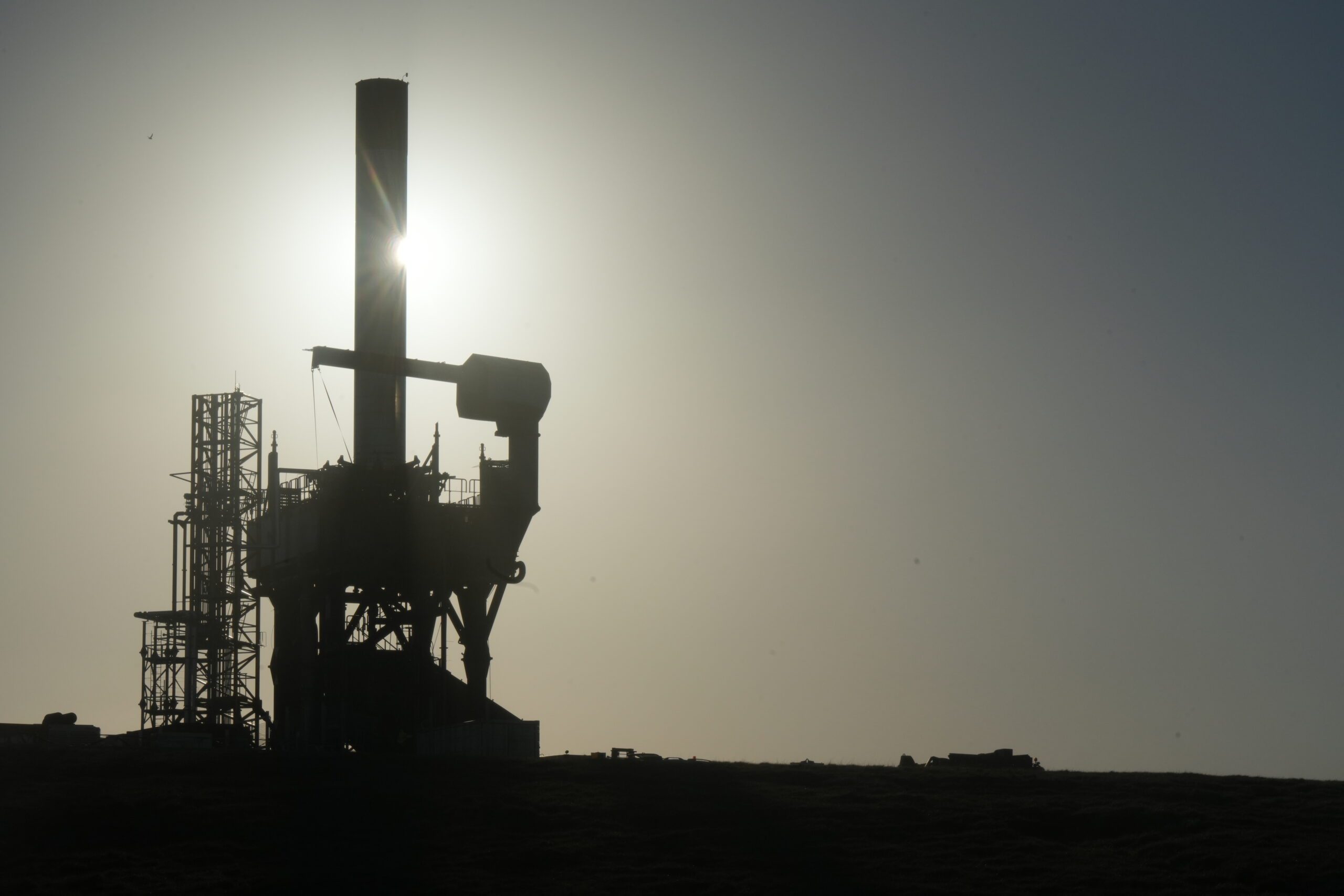
Photo of stage 1 of RFA ONE stood on the launch pad at SaxaVord Spaceport in a silhouette.

The Ultimate Guide to Argo: Our Cost-Effective Cargo Capsule

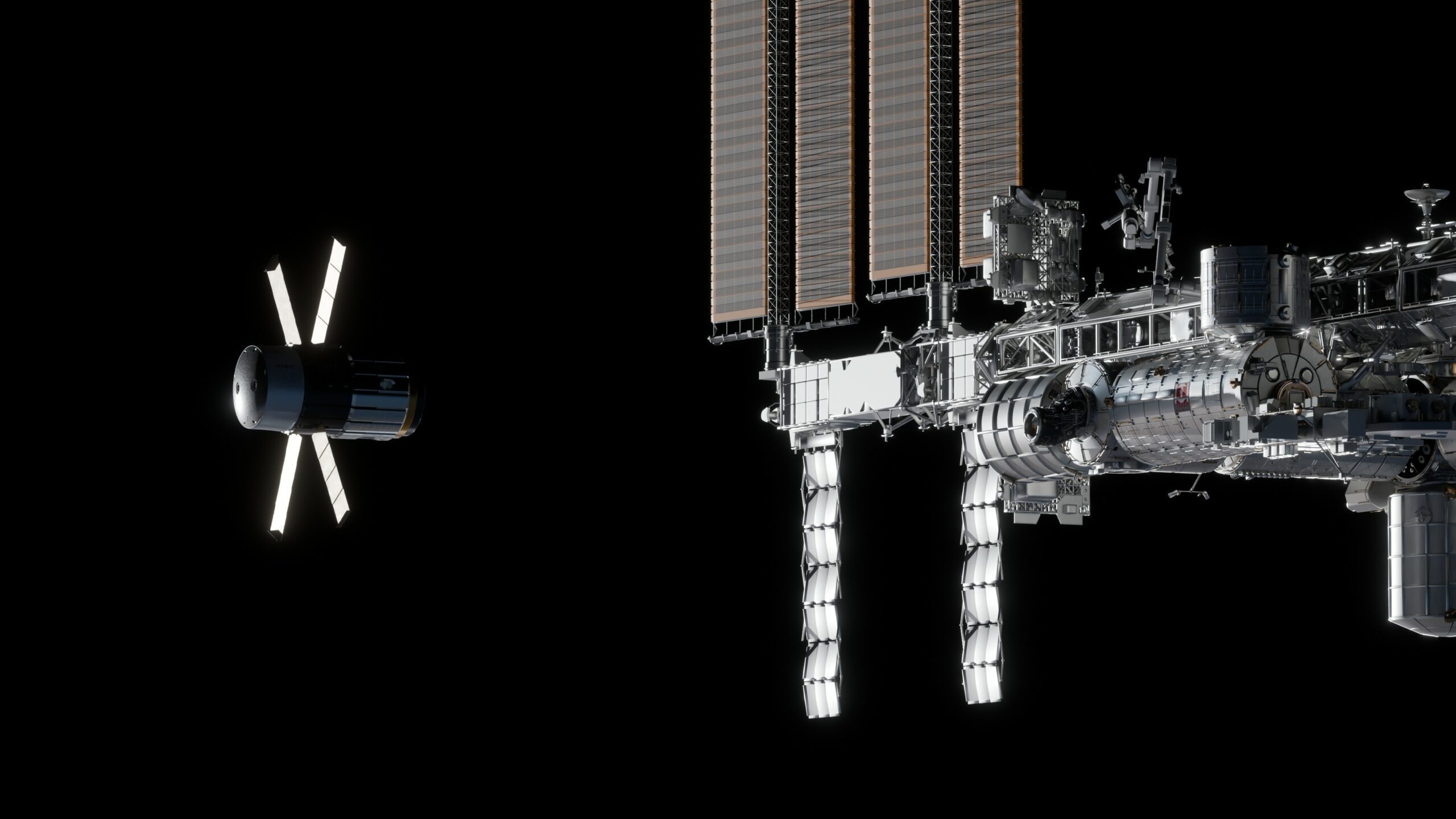
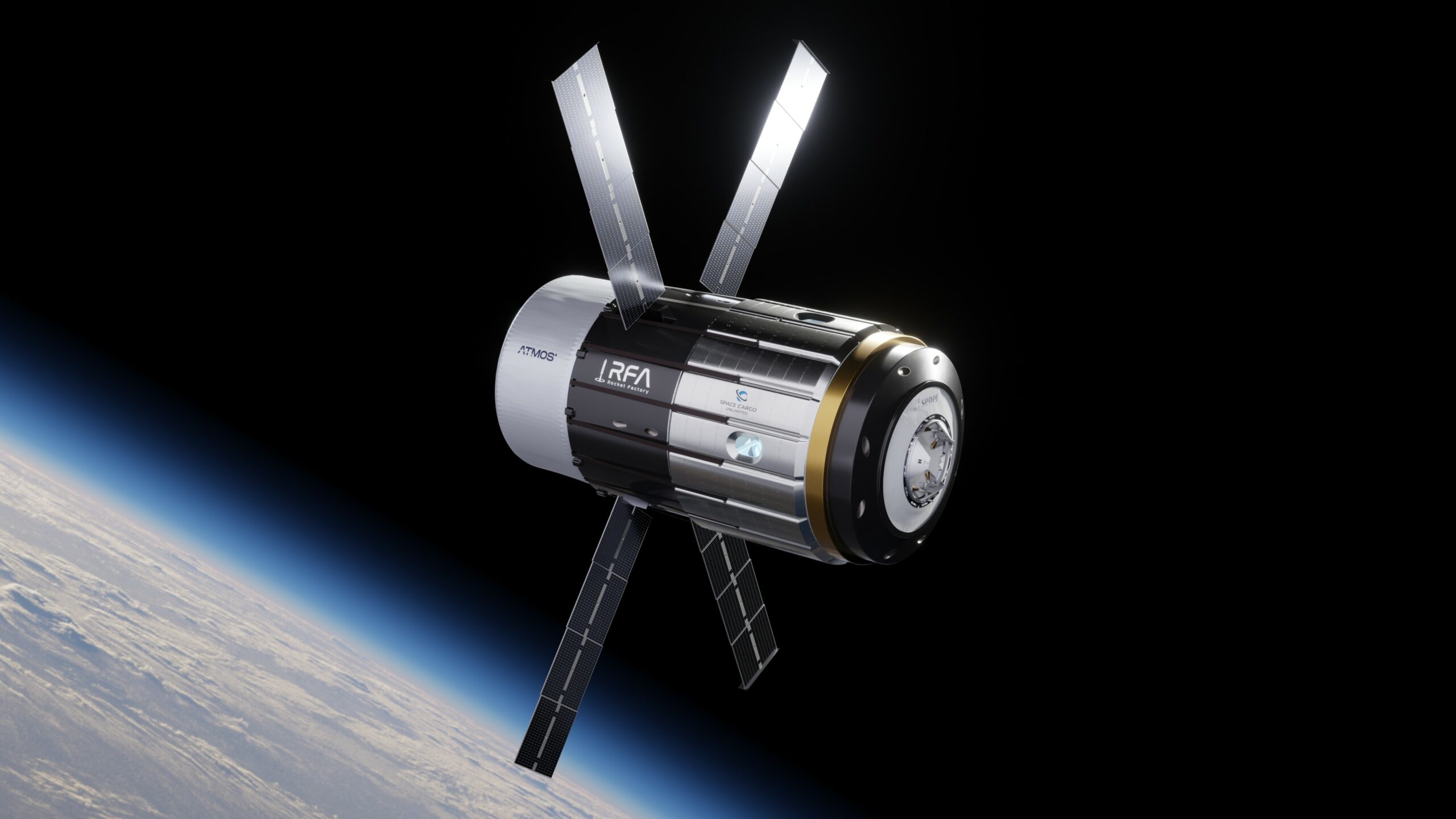
The image shows the ARGO capsule approaching the International Space Station

Meet Argo, our cost-effective space cargo capsule. Optimized for flexibility and reliability, Argo offers an end-to-end service at a low price point of just €150M. Led by RFA, the bidding consortium combines our expertise with that from Space Cargo Unlimited, along with partners like ATMOS Space Cargo to offer a fully reusable solution for the European Space Agency and commercial clients.

Instead of giving you a formal press release, we decided the best way to talk about Argo would be to talk directly with YOU. So, we asked you to submit any pressing questions you had about Argo and promised to answer some of them in a future post.

Rocket Factory Augsburg post on X (twitter) that reads: "Good morning Europe! Got questions about Argo? Ask us directly in the comments! We will answer some in a future post."

However, you came up with such great questions that we decided we couldn’t choose just some to answer. So we’re giving you answers to every single one! Before we dive into your questions, let’s first take a look at why Argo, as a concept, exists in the first place.

Table of Contents

Chapter 1: Why Europe Needs Space Cargo Capabilities

While Europe’s space capabilities are still world class, it is no longer the space power it once was due to the lack of autonomy.


But with a booming New Space industry and innovative initiatives, the doors are open to achieve the European Space Agency’s ambition to position Europe as a global space power once again by 2035. One such initiative is the competition opened by ESA in November 2023 for a European cargo service to and from space stations in Low Earth Orbit. Since the termination of ESA’s Automated Transfer Vehicle (ATV), we have had to rely on international sources for our space cargo needs. The recent call from ESA shows their commitment to developing Europe’s future as a global space leader once more.


Argo is our answer to this call. But it’s also more than that. Argo is not “just” a supply service for space stations. It stands as a symbol of Europe’s leadership and innovation in the New Space economy.

The Inspiration Behind Argo

Image of a reply received on X (Twitter) asking why RFA is sending a Fiat to space with an external link to the Wikipedia page about the Fiat Argo.

As much fun as it would be to send a Brazilian-built Fiat to space, that’s not quite what we had in mind when we came up with the name for our cost-effective cargo capsule.


The meaning behind the name Argo is two-fold. The main reason is simple: It’s Cargo, without the (C)osts. The second reason is that our pre-development team was inspired by the legendary Argo ship in Greek mythology.


Now that we’ve cleared that up, let’s get on with the rest of your questions. We’ve broken them down into categories, so please don’t stress if we don’t answer all questions shown in the screenshots in one go.

Chapter 2: Launch Details and Vehicle Compatibility

1) Which rocket will launch Argo into orbit?

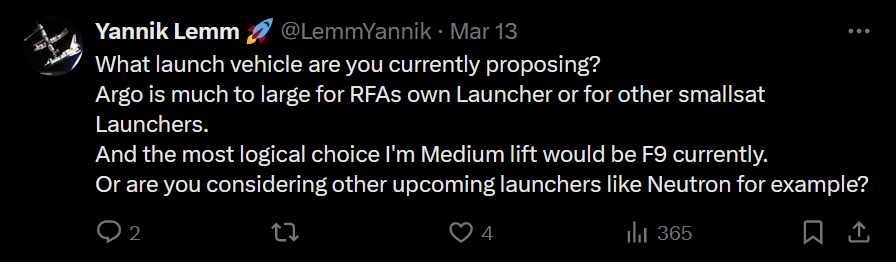
Unsurprisingly, but understandably, we got a LOT of questions about Argo’s launch vehicle.

According to the requirements of ESA, Argo is developed for use on any launcher. At a minimum, it is compatible with current and future European medium to heavy-lift launch vehicles, but can also fly with other medium or heavy-lift launch vehicles if needed.

This approach makes Argo launch agnostic and capable of offering a 100% flexible and customer-oriented service.

2) Will Argo launch on an RFA-built launch vehicle?

Although Argo is compatible with other existing and upcoming launchers, the most cost-effective solution would be to launch on our very own medium or heavy-lift launch system. This enables us to offer a full end-to-end cargo service for 4,000kg to and from orbit.


As one person pointed out, RFA ONE is indeed too small to carry Argo. But that was never our plan. ESA’s requirement is that we must launch Argo by 2028 – and by then the European Launcher Challenge will presumably provide the framework for the development of a larger RFA rocket. So we move step by step and start with our RFA ONE which, you’ll know, is due to launch in summer 2024 and is already fully booked for its two test flights.

3) When is the maiden flight planned?

the image shows a twitter comment asking for technical and financial aspects of Argo

Tying in nicely to the previous point, we can confirm that we plan to implement Argo’s first demo mission in 2028.

4) What is the expected annual cadence?

the image shows a twitter comment asking for technical data about Argo

During our market research, we found a substantial global demand for cargo transportation missions. After its first demo mission in 2028, we plan to make the service commercially available from 2029 onward, with the aim to increase cadence as needed to serve the market.

Chapter 3: Design and Specifications

1) What are the dimensions of Argo?

Argo will be 3.7 m in diameter and 7.7 m long (without its fairing). It will have a 1:1 ratio between its up and down cargo mass – one of its most unique features. How do we achieve the same up-and-down mass? With an Inflatable Atmospheric Decelerator (IAD), provided by our partner Atmos Space Cargo.


The main structural elements of Argo can easily be scaled in a fast and cheap way. Using our building block approach, it’s possible to add segments to the existing capsule. We can also scale the propulsion system and propellant storage with minimal changes elsewhere, making Argo more flexible for future space stations in LEO. Of course, service evolution depends entirely on market demands and trends. But what we’re saying is that we will be ready!

2) What is the internal volume and cargo capacity?

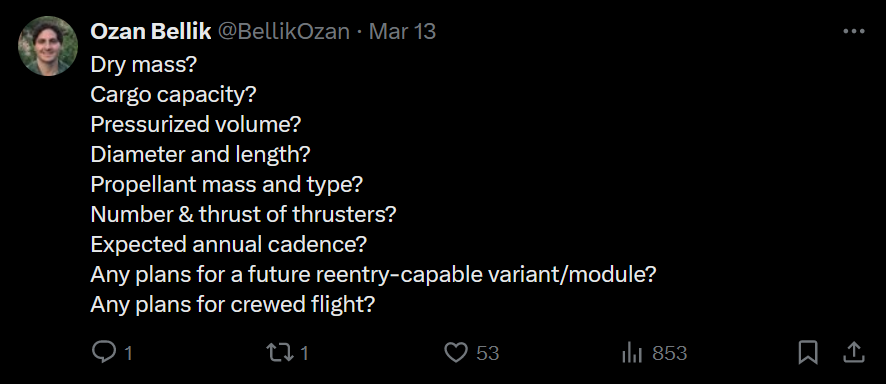
Argo has a dry mass of 5,200 kg without cargo, a total internal pressurized volume of 27.9 cubic meters and a pressurized cargo volume of 15.5 cubic meters. It can carry up to 4,000 kg of cargo to and from orbit.

3) What rocket engines will be used on Argo?

the image shows a twitter comment asking for technical data about Argo

Two RFA Fenix engines will power Argo in orbit, with an additional 24x 100 N Thrusters for the Reaction Control System (RCS). The Fenix engines use bi-propellant and will already have flight heritage from RFA ONE. Argo has an estimated propellant mass of 3,082 kg.

Chapter 4: Functionality and Operations

1) Can it carry cube sats or unpressurized cargo?

Cube Sats are a critical part of the LEO research environment. Our RFA ONE with Redshift OTV already offers satellite deployment capabilities, but we also see potential future opportunities for adding dispensers to Argo to complement the Redshift service.

2) Can it bring cargo back down to Earth?

Argo will utilize its Inflatable Atmospheric Decelerator to allow the entire vehicle to return to Earth and safely land with up to 4000 kg of cargo. The position of the Inflatable Atmospheric Decelerator (IAD) was moved from the front in Version 1 to the back in the current version, but this doesn’t change the functionality or effectiveness of the return module. We can confirm that Argo is capable of safe re-entry.

3) How long can Argo stay in space?

Our demo mission in 2028 will last a total of 25 days. Argo will spend three of those days getting to the ISS, 20 days docked, and 2 further days for undocking, re-entry and recovery. However, Argo is designed to service our customers and their needs. Therefore, it’s possible for Argo to remain in orbit for over one year, if required.

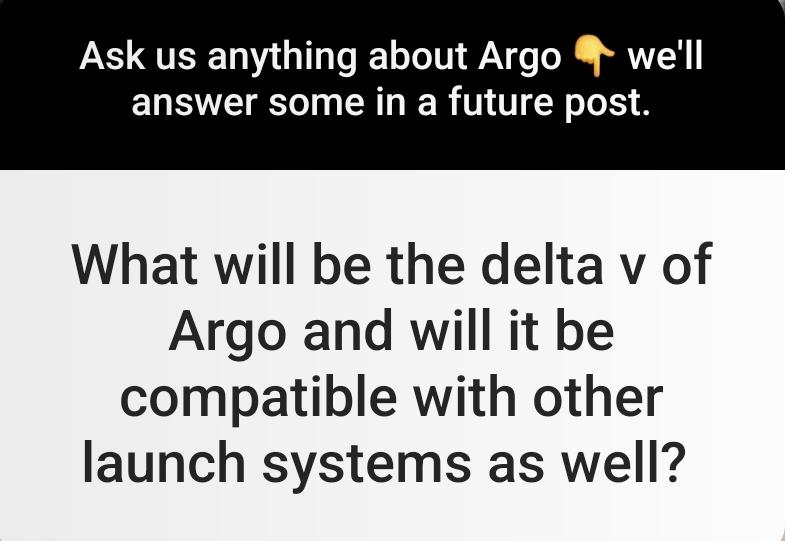
4) What will be the delta v?

the image shows a screenshot of an instagram story in which an user asked: "what will be the delta v of Argo and will it be compatible with other launch systems as well?"

For the demo mission in 2028, we have enough delta v to reach ISS and safely re-enter – around 1,000 m/s.

5) What about a reaction control system?

the image shows a screenshot of an instagram story in which an user asked: "are you going to develop a reaction control system for the Argo?"

Yes. As previously mentioned, the primary propulsion system uses the existing Fenix engine and 24 100 N thrusters make up the Reaction Control System.

6) Is the entire capsule pressurized?

the image shows a screenshot of an instagram story in which an user asked: "is the whole capsule under pressure? Is there a roadmap for publicity?"

The front of the vehicle is pressurized, with the middle section containing the service module and the rear end comprising the Inflatable Atmospheric Decelerator and Fenix engines.


For more information on the specifics of each module, you can watch our animation video.

Chapter 5: Mission and Usage

1) Will Argo service other space stations apart from the ISS?

The first question has a very simple answer: ESA requested docking. This makes Argo compatible with other planned commercial stations. So yes, Argo will be able to service other space stations in the future.


Currently, there are no plans for Argo to refuel a space station, but it can provide significant orbit-raising maneuvers.

2) Can it be used for in-orbit experiments?

the image shows a twitter comment asking if Argo could be used for in-orbit science experiments, without docking to the ISS

Absolutely! Argo can be used for in-orbit experiments with or without docking to the ISS or any other space station. Specifically, Argo can induce spin to generate up to Martian gravity along the cylindrical hull of the pressure vessel.

3) Is Argo only for LEO?

The image shows a screenshot of a twitter comment which says: "only for LEO or will it have a luna rated heatshield?"

With its current re-entry profile and decelerator (heatshield), Argo is specifically optimized for LEO. However, our preliminary analysis did not find any showstoppers for modifying the trajectory and/or decelerator for re-entry after departing from Gateway, so who knows what could happen in the future…👀

Chapter 6: Reusability

1) How is Argo fully reusable?

Argo will be fully reusable. This reusability starts from the first mission with immediate post-recovery actions like de-salting and unloading payload, followed by refurbishment. Argo returns to Earth enveloped and protected by the cutting-edge technologies of the large IAD, allowing a fast turnaround time on refurbishment and expedited reuse. This also helps keep costs low and offer short response times for emergency delivery.


Its design is based on existing technologies from our partners and also our RFA ONE and Redshift OTV. This allows us to provide modularity and be cost-competitive, but we also have the goal of full reusability. After our first demo mission with Argo, we will analyze and further refine the reusable aspects to meet our goals effectively.

Chapter 7: Market and Commercial Viability

1) Is Argo just a smaller ATV?

the image shows a twitter comment asking if argo is like a smaller version of the ESA's ATV

Sure, Argo is similar in appearance to ATV. But most importantly, Argo is unique because, until now, it has not been possible to return cylindrically shaped capsules to Earth. This will be possible with Argo thanks to the Inflatable Atmospheric Decelerator. By the same means, Argo is also capable of returning to Earth with the same amount of mass as it delivers to orbit. Overall, Argo benefits from several decades of development since ATV and the heritage from RFA ONE launch system.

2) What makes Argo different to other commercial vehicles?

the image shows a screenshot of an instagram story post, where the question appears, "what makes argo different to other commercial vehicles?"

It all comes down to the Inflatable Atmospheric Decelerator (IAD). This technology enables the uniqueness of using a stainless steel cylindrical capsule. It is this benefit that makes us different thanks to three key commercial factors:

  • Competitive service price point starting at 150 million EUR
  • Equal up and down cargo ratio of 4000 kg
  • Offering a fully integrated end-to-end service with an RFA launch system

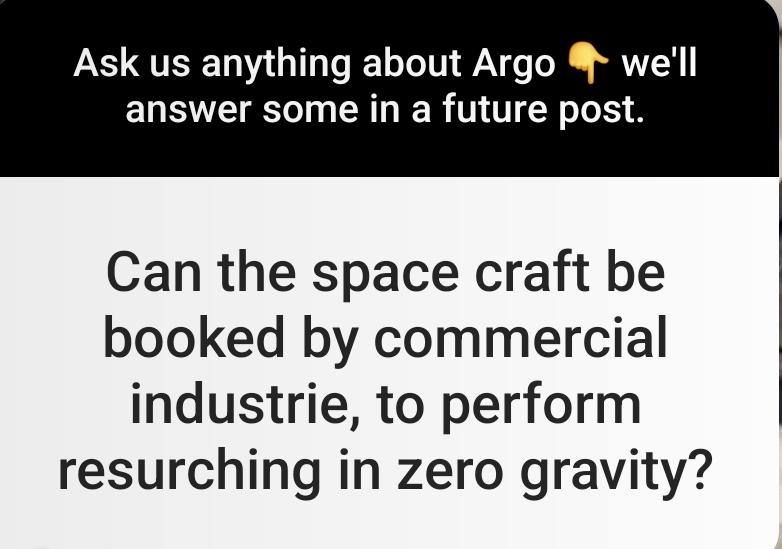
3) Can commercial industries book Argo?

the image shows a screenshot of an instagram story in which an user asked: "can the space craft be booked by commercial industry, to perform resurching in zero gravity?"

Yes! Argo is strategically oriented towards commercial viability. We warmly welcome collaboration and partnership from diverse commercial sectors and encourage companies to leverage Argo for innovative scientific research and exploration.

4) Is there a roadmap?

the image shows a screenshot of an instagram story in which an user asked: "is the whole capsule under pressure? Is there a roadmap for publicity?"

In short: Yes. From the start, we envisioned Argo as more than just a cargo delivery system to LEO. Together with our partners, we have created a detailed roadmap on how further capabilities can be achieved in a reasonable time frame. If you’re asking what exactly that roadmap is, well, you’ll just have to wait and see…

Chapter 8: Cost and Budget

1) How much does an Argo mission cost?

Argo’s services start at 150 million EUR per launch.

Our analysis was based on publicly available information and showed that Argo is highly competitive and significantly undercuts the prices offered by competitors. For reference, ATV claimed to be 300 million EUR per launch.

Chapter 9: Partnerships and Outreach

1) Will you reveal more at Space Creator Day 2024?

the image shows a twitter comment asking if community will see more at the next space creator day

You’ll just have to come along to find out. See you there to discuss Argo, RFA ONE, Redshift and other awesome space things!

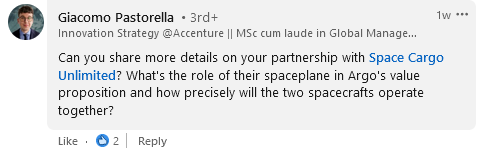
2) Can you share more on your partnership with Space Cargo Unlimited?

the image shows a LinkedIn comment asking for details on a partnership with Space Cargo Unlimited.

Space Cargo Unlimited is committed to developing, delivering and operating the outfitting capabilities of Argo to play the role of commercial services provider for microgravity research in space at a high-value benefit on Earth. Their REV1 vehicle is considered an alternative return solution that will be further investigated during the project in line with the technical feasibility and/or the market needs  The core of Argo would remain the same, and another scenario could see REV1 Max added to the front end of the capsule.

Chapter 10: Testing and Development

1) Is there an Argo prototype?

The picture shows a tweet asking "How far are you in building a prototype?" dated March 13th

Lucky for us, Argo is based on a combination of existing technology through European partnerships. Therefore, we can use a building blocks approach to build the capsule. The Fenix engines will see their first flight on RFA ONE this year. A subscale IAD has already been tested and is planned to gain its flight heritage on the SpaceX Transporter mission in 2025. And the stainless steel tanks and CFRP structures will also be flight-qualified on RFA ONE. We are confident that all critical systems of Argo will reach TRL 6 in 2026 for its first demo mission in 2028.

2) Have you started parachute testing?

the image shows a twitter comment asking if RFA stared parachute testing

The beauty of Argo is that parachutes are not needed. The Inflatable Atmospheric Decelerator (IAD) fully covers re-entry and deceleration prior to splash down in the ocean.

Chapter 11: Future Development

1) Any plans for a crewed version of Argo?

Along with questions about the launch vehicle, this question popped up most often. We understand why – you’re curious!


And we want to be transparent. Argo’s journey does not end with cargo delivery to LEO. It is deliberately designed to evolve into a comprehensive exploration and transportation system to push the boundaries of human presence in space.

the image shows a screenshot of an instagram story in which an user asked: "can I be shipped in argo too?"

To answer this, we’ll just say: Have patience.


And we’ll leave this here…

the image shows the ARGO capsule flying threw the orbit

Discover More About Argo

We hope you enjoyed this deep dive into Argo. We certainly enjoyed answering all your questions! If you want to check out more details about Argo, you can see some of our recent social media posts.


Alternatively, you can visit our dedicated Argo webpage at https://rfa.space/argo

SUBSCRIBE

Stay up to date with The Preburner blog and all of our latest posts by signing up.

Interested in featuring us?

“This is the day the European launcher sector will totally change.”

An interview with former Director General of ESA, Jean-Jacques Dordain.

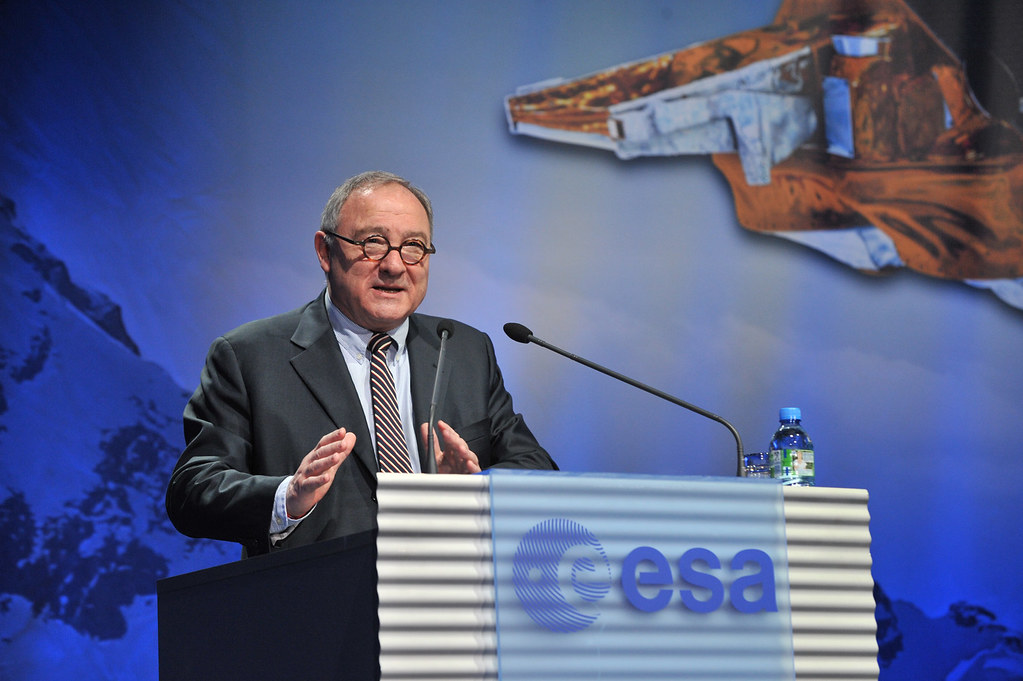
Jean-Jacques Dordain speaking at the CryoSat-2 launch event in 2010. Image credit: ESA

Jean-Jacques Dordain is Chairman of the Supervisory Board at Rocket Factory Augsburg AG. Having been professionally involved in space travel since the 1970s, he brings a wealth of experience to the table and is a highly valued member of our RFA family. From his dreams of being an astronaut to becoming Director General at ESA and eventually joining RFA, Jean-Jacques has a unique story to share!


We sat down with him to talk about his professional journey, the challenges he faced, his view on the current developments and why he is so passionate about what we are doing at Rocket Factory.

You were Director General at ESA for 12 years from 2003 to 2015. How did you get that role?

I was already working at ESA and became the first Director General to be promoted from within ESA itself, so that was easier for me than my predecessors because I already knew the people at ESA.  I was the Director of launchers when I was invited to apply for the Director General role by the Nordic ESA member states. The selection process is very complex. But after a few months, I was appointed Director General.


It was a very special position to be in because on the one hand, you have this fantastic team of 2,000 people supporting you. But on the other hand, when it comes to making crucial decisions, you are alone.

That can’t have been easy.

You get great advice! But in the end, making decisions is always the most difficult part. Because there is a difference between making a decision and making a choice. When you make a choice, you should have all the elements to choose from. When you make a decision, there are always some uncertainties and thus some risks.

Jean-Jacques Dordain speaking at the CryoSat-2 launch event in 2010. Image credit: ESA
Jean-Jaques Dordain speaking at the CryoSat-2 launch event.
Image Credit: ESA / www.juergenmai.com

What was your job as a Director General like?

There was a lot of politics and diplomacy. I had to propose new projects and ideas to the member states of ESA. And therefore convince 22 countries to make joint decisions at the same time. This is where politics and diplomacy are very important because you have to explain to 22 countries that they should combine their specific interests into one mutual interest. And after that, you have to implement the decisions within the ESA rules together with the industry and all the ESA partners. It’s a lot of work, but all of it materializes into fantastic projects.

What are you doing now?

Now, I support young enterprises to make their dreams come true. I still have the pleasure of working in space but I don’t have the responsibility or do any of the administrative tasks anymore. It’s much better. Just the fun parts.

Is it true that you originally wanted to become an astronaut?

I tried to become an astronaut back in 1977. I did not make it, but I was among the final five candidates selected by France. Sometimes I joke that my dream was always to become an astronaut, being Director General of ESA was just the backup!

Space is a passion for me, not a job. Not many people are able to live their passion as I did and still do. I would still fly into space if I was offered the opportunity. That dream remains alive.

While you were at ESA, what was the most exciting thing happening in spaceflight?

There were so many events. Landing on Titan with the Huygens probe is one because it was the first marking event of my first mandate. Landing on this faraway moon of Saturn with its thick atmosphere was fantastic. ESA was the first to ever achieve this. But I was just the lucky Director General at the end of a chain of successive Director Generals doing the proposal, studies, development and the launch of that project.


Another one was the landing of Rosetta on a comet because it was the last marking event of my last mandate. I was just lucky to be there when it landed. I don’t take credit for this amazing mission. It was a multi-generational team effort.

So it´s all about the team.

Absolutely! It´s the same here at RFA. The biggest asset of RFA is its dedicated team and the pleasure of feeling part of the team.

Let’s talk a little bit about JUICE and JWST, which also happened during your time. How was your experience there?

James Webb was just a continuation of the NASA-ESA cooperation for the Hubble Space Telescope. When NASA decided to create the next generation of space telescope, they naturally discussed the idea with ESA, because of the success of Hubble.

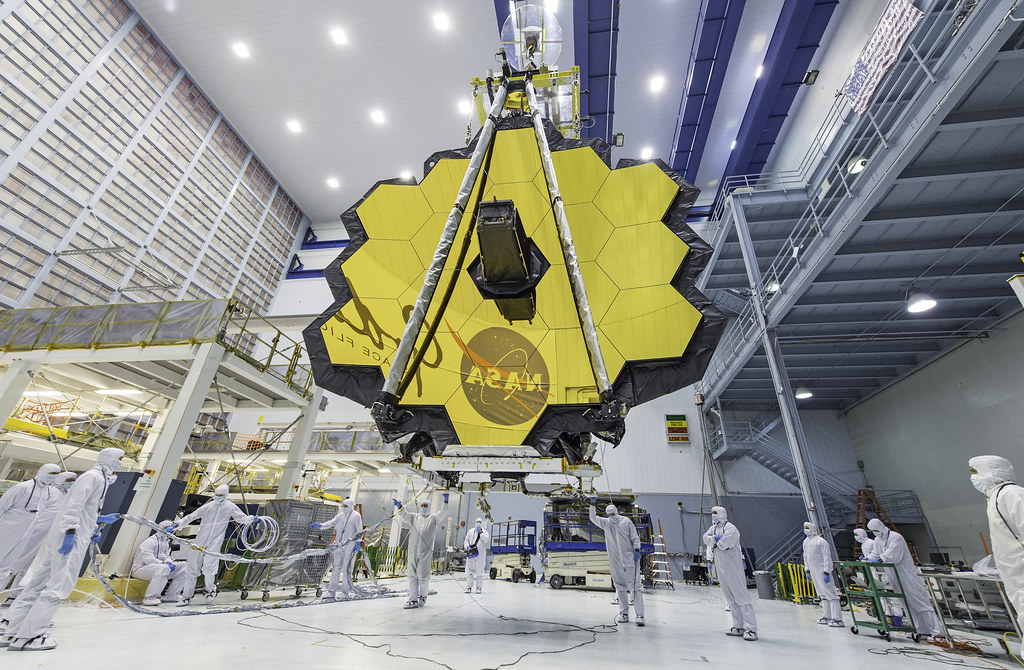
James Webb Space Telescope that Jean-Jeacques discusses during the interview with RFA.
James Webb Space Telescope. Image Credit: NASA/Desiree Stover

One of the ideas that emerged was the use of a European launcher to launch JWST. That was significant because it is unusual for NASA to put such a big project on top of a European rocket. This shows the confidence they had in our capabilities. Making the deal between NASA and ESA was the easy part. The hard part was for NASA to explain to the US launch operators that it preferred to launch with Europeans and for ESA to explain to the European scientists that we were using money for science to purchase a launcher.

Why is that so important?

The launch is always a very critical part of a space project. You work decades for a mission and then the launch is 10 minutes of bottlenecks and stresses. It’s all or nothing. This is the reason why it’s the launch of any mission that is always very, very emotional. No launch is easy. When I was the DG, I used to quote Winston Churchill before any launch: “You can never guarantee your success, but you must always deserve it”. And after a successful launch, I would say “my only regret is that it looks easy.”

What was your first touch point with private spaceflight?

It was – of course – SpaceX in 2002. Traditionally, we had always taken a government-driven top-down approach. But New Space works from a privately-driven bottom-up approach. It’s a totally different approach, but the two are not antagonists. They are both necessary. What traditional space agencies can do is promote and help new private enterprises.

I remember my first meeting with Elon Musk. He said that he thought space agencies were representative of the traditional space industry. But he also quickly realized that he could not do without the agencies. There is always interaction between the two worlds.

This year Europe lost its independent access to space. Ariane 6 is late, Vega-C had critical failures and is grounded. What are your thoughts?

My thoughts are first going to all those who are giving their best to get both Ariane 6 and Vega-C into orbit. It confirms that launching into space is not easy.


But it also demonstrates that the model European space access relied on for decades must be adapted to a world where commercial offers are available at much lower prices. Ariane has been the most reliable launcher in the world for decades, but being reliable is not enough anymore.


The guarantee of access to space will be more robust if it relies upon several competitive sources, as is currently the case for satellites in Europe and launchers in the US. Competition is good for both companies and customers. It provides customers with the best prices and companies with the motivation to continuously improve to keep making competitive offers. This is where RFA is so important!

You saw this potential of a new business model decades before the likes of RFA, Latitude, Isar Aerospace, OrbEx and all these companies came along.

Yes, I was convinced we could develop a launcher totally differently and with much lower costs.  As a young research engineer on rocket engines, I met Lutz Kayser. He was a German entrepreneur who founded the private company OTRAG, which developed orbital launchers in the 1970s. He was the first guy that I knew of to try and use this private model and make launchers at a low cost using tubes, pipes and other parts he could buy in the shop next door. Fascinating!


Unfortunately, his project was ultimately unsuccessful. Among other reasons, it was too early. But it was the first time I heard that it could be possible to make a launcher privately.

image of a SpaceX rocket launch
Falcon Heavy Demo Mission. Image Credit: Official SpaceX Photos on Flickr

Do you think the only way Europe can maintain access to space now is to commit to commercializing the industry, where institutions buy privately developed products and services instead of developing them themselves?

Yes.  because it’s exactly what NASA is doing successfully. They are just purchasing services through competition bidding among several US commercial operators.  In addition, they support new technologies available as open sources.


Interestingly, when I went to the German Parliament last year on behalf of RFA, I was told the European market is not big enough to sustain several sources.

And I said “I never said that we shall stay within the European market. What we wish is to be competitive in the world market.”


Our competitors are not just Isar Aerospace or the Ariane Group. Our competitors are also SpaceX, Blue Origin and ULA. We want to be successful in the world market, not just the European market. At least this is the end goal. Of course, we are not yet there and first we have to launch!

What brought you to RFA in the end? What was something that drew you in?

I’m here for two reasons. First, I had made a commitment to Manfred Fuchs back in 2006. I was Director General at ESA and we were in a meeting with OHB when the topic of Elon Musk was raised. With Lutz Kayser still in my memory, I told Manfred “If you put 100 million on the table today, I will leave ESA tomorrow and come with you to make the best launcher in the world.”


Of course, he did not do that. But years later, his son Marco Fuchs came to me after I had left ESA and said “Do you remember what you promised my father?” He confirmed that he was financing the start of a new enterprise. I told him I was ready to do for him what I had promised his father. And that new enterprise became RFA.


But I have a second motivation.


Even before the Ariane6 project started in 2014, I had already tried to change the European launcher sector several times within the framework of ESA but I did not succeed. It showed me that changing from the inside without being challenged from the outside was very difficult. So, my wish is to make RFA the outside challenger helping to change the European launcher sector I could not change when I was at ESA.


Thus, the success of RFA will be much more than the success of RFA. It will prove that we can make a launcher totally differently. The day RFA demonstrates this with two or three launches is the day the European launcher sector will totally change.

What do you think defines the New Space industry? What are the key points that make a successful modern launcher and how do you apply those to RFA?

Costs, costs and costs. It’s all about significant cost reduction. That’s the key to the future. And that´s the main driver of RFA.


Obviously, it has to work and be reliable and, as I said already, we are not yet there. But the key driver is cost. I have met costs at RFA that I never believed were possible when at ESA. And what’s interesting is that RFA is using parts from different industries to build their launcher.


It’s a totally different approach which is 100% cost-driven. What RFA has been able to do so far with just 50 million is incredible: A functioning Helix staged-combustion engine, a qualified first stage, and an upper stage that was hot-fired for its full flight duration of 280 seconds multiple times. We are on a good track to fulfill our commitment to complete the full development and two first launches within six years and within 100 million Euros.


But we have to demonstrate and prove we can successfully fly into space. Until we have demonstrated that it works, it’s just hope. It’s not a reality yet.

What are the things that make you confident in our ability to build a working launcher?

The people. Definitely the people. The biggest asset at RFA is the dedicated team. When I come to Augsburg, I try to spend one or two hours with four or five people on the team and I really enjoy that.


Each time, I measure the expertise, I feel the passion and I appreciate the ownership. I also value the diversity of culture. There are more nationalities in the 200+ people at RFA than in the 2000 people at ESA! I learn every day I meet the people of RFA.

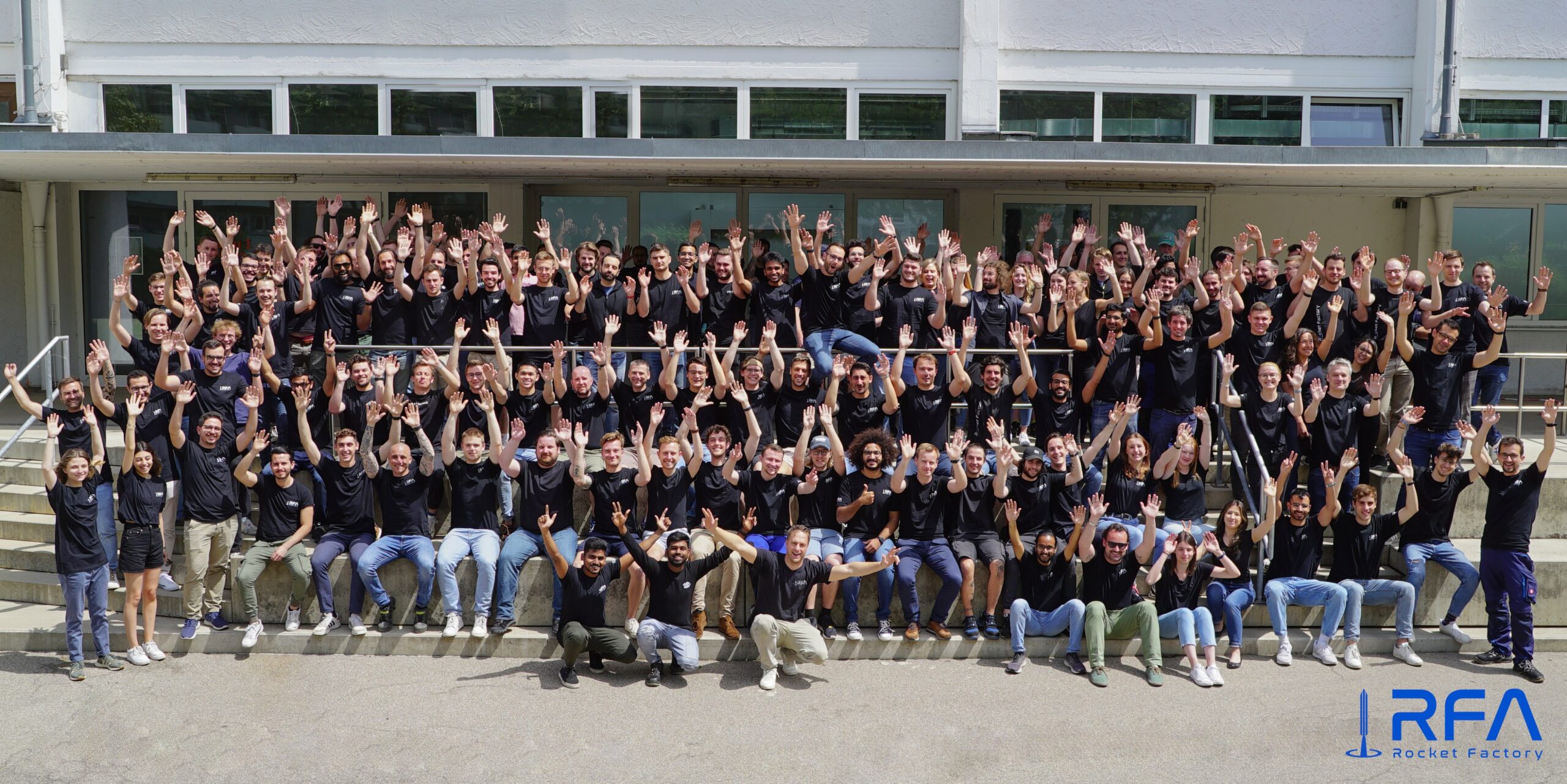
Rocket Factory Augsburg Team Photograph 2022

What was your greatest moment so far at RFA?

The whole journey has been exciting, but of course, the biggest moment so far was our successful upper-stage hot fire in May 2023, where we integrated the Helix engine into an upper-stage tank system and hot fired for a full duration of 280 seconds. It is an incredible achievement. RFA was the first private space company in Europe to achieve this success with a staged combustion engine. This hot fire test was the first big step for RFA in proving their technology and business case to the world.


But the most exciting moments are the ones still to come, and among them are the firing test of the first stage on the launch pad and ultimately the first launch. As a rocket engineer, of course, I especially love things that involve fire. Controlling fire and bundling it into engines of this power is an incredible achievement of mankind.


Controlling fire. That’s a great line to end on. Thank you very much for your time, Jean-Jacques Dordain!

Rocket Factory Augsburg upper stage IST

SUBSCRIBE

Stay up to date with The Preburner blog and all of our latest posts by signing up.

Interested in featuring us?

Iteration – the unique RFA way to success

Smart iteration cycles and straight forward development

thumbnail of blogpost: circle of build test improve and repeat

Iteration is one of the most important aspects to make technical development fast, efficient and successful. RFA has a very original and unique way of keeping its iteration cycles short and moving quickly to further development steps. 

Technical progress thrives on an apparent contradiction: on the one hand, development is thought of in terms of the end product, but on the other hand, the focus is always on the next iteration. Think of it like software: A base product is released early to get customer feedback and gain traction in the market. Constant updates and frequent patches are the core of development. So in terms of RFA, we have a final product in mind, but will start with a less capable “minimum viable product” (MVP) at the initial launch. We will then iterate performance and capabilities from launch to launchSo let’s get right to the heart of this blog post: one of the unique elements to RFA’s success is our iteration cycles. Here’s why and how. 

Always on the move 

At RFA, engineers are given responsibility for a system. From concept to test to qualification. While there is already a frozen version for the first flight, iterations of the systems for the second launch are already underway. Each engineer has to improve his system a little bit for each subsequent flight, improving performance while at the same time, reducing mass and cost. However, reliability and function always come first. To accomplish all of this, it is important that everyone involved looks at the ideas and steps with a fresh eye every day and is also willing to question and adjust their own decisions. We can tell you that: It’s not always easy. But necessary and already successfully applied by us several times. 

We iterate in a different way 

RFA ONE helix engine atteched to testing stand
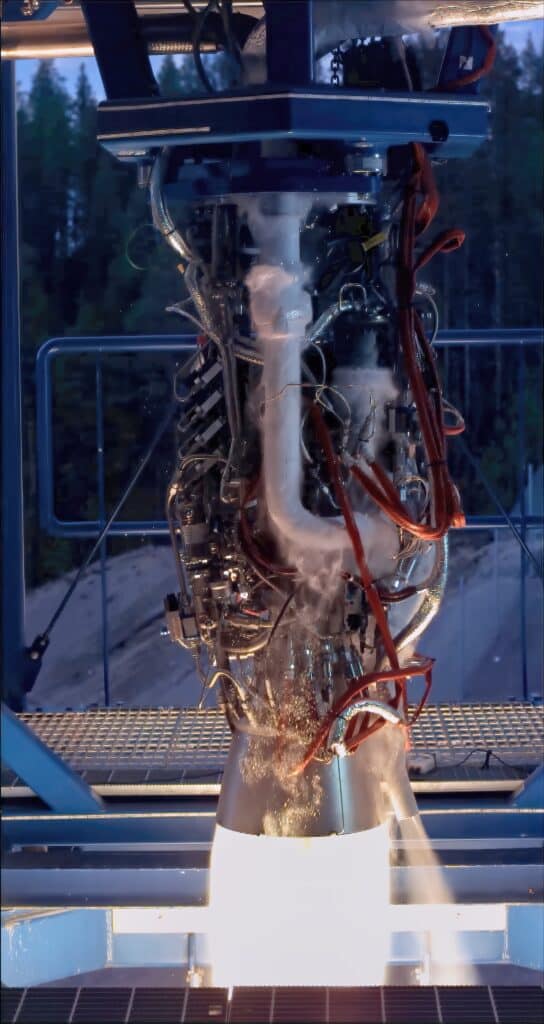
The best example of successful iteration: our Helix engine. Picture: RFA 

No simulation can give you the data and insight that a test in a real physical environment can. We stay practical and pragmatic and test as much as possible, once the analysis results have answered 50% of the questions at hand. In doing so, we think from big to small. That means we always take the most direct route to configurations when possible, testing entire parts and complete systems. A small team then takes care of the problem of a sub-component, while high-level testing can continue. This way, we are able to do large iterations and find quick and workable solutions. We never dwell too long on individual stumbling blocks, but simply flick away a pebble. In this way, we shorten development time and arrive at reliable iterations based on real world testing.  

Another crucial point is how we test. Protect test stands with sand-filled shipping containers. Qualify turbopumps with helicopter engines. Test IMUs on tiltable workbenches. Buy used vacuum chambers. It doesn’t all have to be shiny, new and expensive it has to work and fulfill its purpose which is to validate our concepts and components. Full stop. Our motto is always “testing over simulatingas no simulation can deliver results as quickly, comprehensively and effectively as a real test. Especially if it fails. 

So far, we can state that this path is leading us very successfully towards the first flight. In the course of development, we have overturned major future-oriented decisions and taken a completely new approach. But we have never stood still. New designs and parts are always being worked on while a team deals with challenges that have arisen. 

Do not reinvent the wheel 

We use as many industrial components as possible from, among others, the automotive, oil and energy industries. For those industrial components we can rely on years of experience and quality from existing industries. In concrete terms, this means that our rockets could have the same valves as your car. Or the screws that attach your TV to the wall. Or your favorite beer might have been brewed in one of the beer barrels from our suppliers for the rocket stages. No joke: when we were thinking about the best way to manufacture our stainless-steel tanks for our rocket stages, we found a supplier for breweries who builds the large brewing tanks for them. Well, this supplier now also builds rocket stages. In one sentence: We no longer develop equipment for space, but demonstrate that standard components function reliably in space. Of course, once we have found a suitable component in the existing industry, we iterate with the component manufacturer to ensure that the off-the-shelf parts are made specific for RFA, fulfilling the highest standards for reliability. This way, we integrate existing supply chains for other industries into our product, while establishing a price point that is unknown in the current space industry. A disruptive approach for the space industry.

As an integrator, we bring together our knowledge of the entire launch system with the external knowledge of our suppliers. At the same time, we have the choice between many industrial component suppliers. This way we are independent and can always choose the best supplier according to price and performance, avoid sources of error that would occur in in-house development and have partners and suppliers that have been with us for a long time, know us and have grown with us. 

Made in Germany and Europe 

parts of RFA ONE engine laying on desk
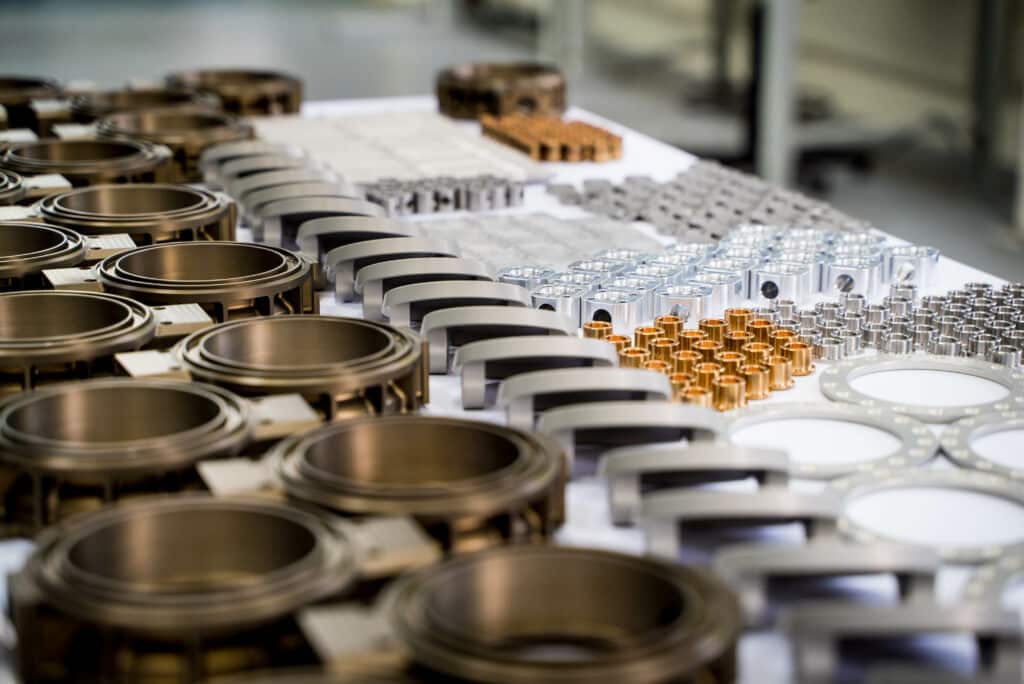
Parts of the Main Cryogenic Valve (MCV). These are continuously improved in performance and weight. Picture: RFA 

We are often asked why we chose Augsburg, of all places, as our headquarters. One elementary factor is that 80% of our suppliers are located within a radius of less than 200 km. They are important because we try to build a rocket from proven and reliable parts used in other industries. We believe in the engineering power of the German and European supplier industry, which is why we do not have the arrogance to say, for example, that we can build a better valve than someone whose component is used millions of times in cars. That is why we do not reinvent the wheel and use these components. Just because a part or technology wasn’t designed for space doesn’t mean it won’t work perfectly there. Of course, we still carry out test campaigns to ensure that these components are suitable for our use. So we iterate not only our own designs, but also purchased components. 

Made in Germany and Europe 

We are often asked why we chose Augsburg, of all places, as our headquarters. One elementary factor is that 80% of our suppliers are located within a radius of less than 200 km. They are important because we try to build a rocket from proven and reliable parts used in other industries. We believe in the engineering power of the German and European supplier industry, which is why we do not have the arrogance to say, for example, that we can build a better valve than someone whose component is used millions of times in cars. That is why we do not reinvent the wheel and use these components. Just because a part or technology wasn’t designed for space doesn’t mean it won’t work perfectly there. Of course, we still carry out test campaigns to ensure that these components are suitable for our use. So we iterate not only our own designs, but also purchased components. 

parts of RFA ONE engine laying on desk
Parts of the Main Cryogenic Valve (MCV). These are continuously improved in performance and weight. Picture: RFA 

The right mix: experienced non-space suppliers, in-house development, and a brilliant team 

We are working on our prototype, whose initial launch is drawing ever closer. However, we have already mastered the first steps towards industrialization and are making rapid progress. 

1 We iterate quickly and relentlessly. With all the capabilities in-house to produce, test and modify critical components ourselves, our test campaigns are designed for short iteration cycles and do not come to a stop due to failures. We basically rely on failures to learn as quickly as possible. With modern technology that we can update or realign at any time without much effort, we are flexible in production and, most importantly, immediately scalable.  

2 In addition, our suppliers build industrial components and do not normally supply aerospace. They supply components that meet established industry standards in reliability, quality and functionality, e.g. from the automotive industry. This means that we use components that have been proven and optimized. We then qualify them only for our application as space technology. Not everything that works in space has to be designed for space. 

3Our brilliant team thinks day and night about how to further iterate designs, hardware and processes for the next flight. To improve the product just like software. This mindset creates an inspiring environment and everyone contributes their part to building the rocket. Through openness to new approaches and an unpretentious attitude to the process, the way is the goal.  

Our team now consists of over 200 space enthusiasts from around 40 nations. We have experienced space professionals on board and people who come straight from university. A good mixture, that always questions well-trodden paths. 

In summary, strong industrial suppliers, in-house testing capabilities and an iterative mindset are creating a paradigm shift: We no longer develop a product that is optimized from the start and then sold unchanged for years. Instead, we pragmatically and practically improve product and its performance on an ongoing basis to achieve even higher reliability, quality and performance. We build with industrial components, permanently test at system rather than component level, and iterate from flight to flight to improve the performance of our RFA ONE rocket. Having built this process reliably, effectively and efficiently is one of the key success factors of RFA. 

SUBSCRIBE

Stay up to date with The Preburner blog and all of our latest posts by signing up.

Interested in featuring us?

We asked ChatGPT if spaceflight is necessary!

And then we commented it.

3d render of RFA ONE launch coming out a laptop screen

The hype around ChatGPT has been going around for some time now. So we decided to ask artificial intelligence if space travel is necessary. The generated article is surprisingly good, but (luckily?) it is not perfect – so we disagree or add in comments. You can see our comments when hovering with the mouse over the blue marks. Let’s look at where that is the case. ChatGPT, write a 2000-word essay about: “Is spaceflight necessary?”

The hype around ChatGPT has been going around for some time now. So we decided to ask artificial intelligence if space travel is necessary. The generated article is surprisingly good, but (luckily?) it is not perfect – so we disagree or add in comments. You can see our comments in blue. Let’s look at where that is the case. ChatGPT, write a 2000-word essay about: “Is spaceflight necessary?”

“Spaceflight has been a topic of discussion and debate for decades, with some arguing that it is a necessary endeavor for humanity, while others question its value and the resources that are being invested in it. In this essay, I will explore the arguments for and against spaceflight, and ultimately argue that it is indeed a necessary endeavor for humanity.

One of the most compelling arguments for spaceflight is its impact on technology and innovation. The development of new technologies and the drive to overcome the challenges of space exploration has led to countless innovations that have improved our daily live in countless ways. From satellite communication systems and weather forecasting to medical imaging and GPS navigation, space technology has had a profound impact on our world. This has not only made our lives easier and more convenient, but has also created new economic opportunities and has helped to spur technological advancements in other fields.

Another argument in favour of spaceflight is its scientific and educational value. Through space-based missions and observations, we have gained a deeper understanding of our planet and the universe. This has allowed us to better understand the natural processes that shape our planet, and to develop more effective ways of mitigating the impact of environmental degradation and climate change.

Moreover, spaceflight has inspired a new generation of scientists, engineers, and explorers, and has helped to foster a greater appreciation for science and technology.

In addition, spaceflight has also had a positive impact on international relations and diplomacy. Space has served as a platform for international cooperation, bringing together countries from around the world to work together on common goals and objectives. In addition, spaceflight has also had a positive impact on international relations and diplomacy. Space has served as a platform for national pride providing countries with an opportunity to demonstrate their technological capabilities and to showcase their scientific and engineering talent.

Another argument in favour of spaceflight is its potential economic benefits. The commercialization of space has created new markets and opportunities for entrepreneurs and businesses, from satellite-based telecommunications and remote sensing to space tourism and resource exploitation. This has opened up new avenues for growth and innovation, and has helped to spur economic development in many countries around the world.

Despite these compelling arguments, there are also those who question the value and necessity of spaceflight. One of the main criticisms is the high cost and the resources that are being invested in it. Given the many challenges and issues facing our world today, some argue that it is not a priority to invest in space exploration, when there are more pressing needs on the ground.

Another criticism is that spaceflight is inherently dangerous and carries significant risks significant risks. Space missions are subject to numerous technical and operational challenges, and there is always the risk of equipment failure, human error, and other factors that can lead to accidents and loss of life. Furthermore, the long-term effects of space travel on the human body and the environment are still unknown, and there is concern that it may have unintended consequences that we are not yet aware of.

Despite these criticisms, I believe that spaceflight is a necessary endeavour for humanity. The benefits and opportunities that it provides far outweigh the risks and costs, and its impact on technology, science, diplomacy, and economics cannot be overstated. Furthermore, space exploration has a unique ability to inspire people and to bring us together, reminding us of our shared humanity and our place in the universe. It has the power to spark curiosity, creativity, and a sense of wonder, and to motivate people to reach for the stars.

In conclusion, spaceflight is a necessary endeavour for humanity, and its benefits far outweigh its risks and costs. Through space exploration, we have advanced our knowledge and understanding of the universe, created new technologies and innovations, improved our lives, and fostered international cooperation and diplomacy. In a rapidly changing world, spaceflight provides a sense of stability, a common goal that brings people together, and a source of inspiration and hope for future generations. The pursuit of space exploration will continue to play a vital role in shaping our world and our future, and it is important that we continue to support and invest in this critical endeavour.

“Spaceflight has been a topic of discussion and debate for decades, with some arguing that it is a necessary endeavor for humanity, while others question its value and the resources that are being invested in it. In this essay, I will explore the arguments for and against spaceflight, and ultimately argue that it is indeed a necessary endeavour  for humanity. [Spoiler-Alert, but we really like where this is going.] 

One of the most compelling arguments for spaceflight is its impact on technology and innovation. The development of new technologies and the drive to overcome the challenges of space exploration has led to countless innovations that have improved our daily lives  [Did you know that 90% of baby food contains a discovery from space travel? NASA researchers discovered a natural omega-3 fatty acid while researching life support systems for a Mars mission. A second example is foam: it is hard to imagine our cars, pillows and houses without this material. Originally, the material was developed for the comfort and protection of astronauts. These are just two examples of the many applications of space technologies.] in countless ways. From satellite communication systems and weather forecasting to medical imaging and GPS navigation, space technology has had a profound impact on our world. This has not only made our lives easier and more convenient, but has also created new

economic opportunities   [Well, ok. Told you already above 😉]  and has helped to spur technological advancements in other  fields. [Let us pause for a moment at this point: The really sad thing is that at some point between The Beatles and Beyoncé, humanity lost interest in space travel. We’ve managed to put people on the moon and bring them back six times, but we haven’t gone beyond LEO with crewed missions for decades now. Who knows where we would be today had we built on that. We are working day and night to get Europe back into space and make up for the lost time.]

Another argument in favour of spaceflight is its scientific and educational value. Through space-based missions and observations, we have gained a deeper understanding of our planet and the universe  [Exactly that is what we are about! The paradox of our planet is that we have to get far away from it to understand it better. We want to use data and networks from space to protect and preserve our home planet. The added value of space travel is immense. Technological progress, but also tangible knowledge that we can use for better decision. And that is more important today than ever.] This has allowed us to better understand the natural processes that shape our planet, and to develop more effective ways of mitigating the impact of environmental degradation and climate change  [And to be very clear here: It won’t work without space travel! No ground-based station can provide the comprehensive data that satellites generate in orbit.

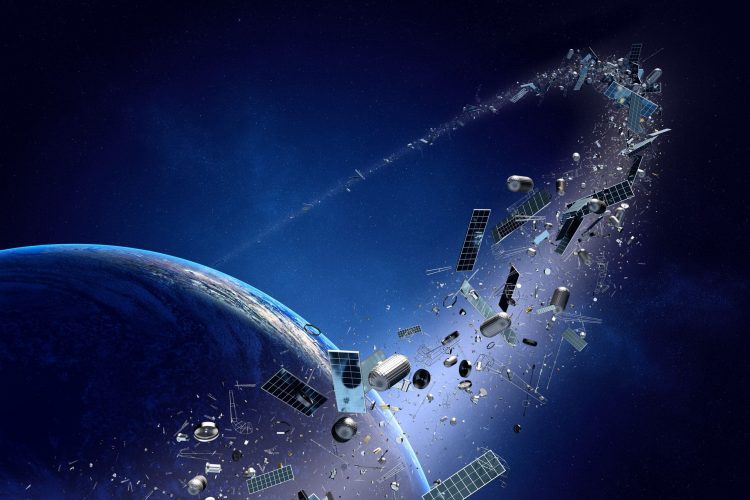
BUT: ChatGPT forgets one issue here: Orbits must also be protected from pollution. Our planet doesn’t end at the altitude of our plane taking us on a well-deserved vacation. You’d be surprised how much man-made space debris is floating around us. It is a threat beyond the horizon. If you want to learn more about it, read our blog post on space debris here.]

Moreover, spaceflight has inspired a new generation of scientists, engineers, and explorers, and has helped to foster a greater appreciation for science and technology. [This is true, but still far too few in relative terms! Awareness of space travel must continue to be created and the support of the general population must be won. That’s why we communicate as openly and transparently as possible to share our passion and fascination.]

In addition, spaceflight has also had a positive impact on international relations and diplomacy. Space has served as a platform for international cooperation, bringing together countries from around the world to work together on common goals and objectives  [The best and most well-known example: the ISS. But also numerous joint research projects on Earth or missions to other planets.]  This has helped to build bridges between nations and to foster a greater sense of global community and interdependence. Space exploration has also been a source of national pride  [That’s right. With not only a positive outcome. Space travel holds great potential, but it must be handled responsibly. Clear rules and agreements are necessary, as are bans on, for example, deliberate pollution of orbits through anti-satellite testing or militarization.] providing countries with an opportunity to demonstrate their technological capabilities and to showcase their scientific and engineering talent. 


Another argument in favour of spaceflight is its potential economic benefits. The commercialization of space has created new markets and opportunities  [Well said. But that doesn’t go far enough ioho: It can’t be done without commercialization! Space travel, like any other market, must obey the “laws” of price and performance. Even states should no longer build their own rockets, but finance private companies on a milestone basis – and then simply purchase the services. This promotes competition, lowers costs and increases the quality of products and services.] for entrepreneurs and businesses, from satellite-based telecommunications and remote sensing to space tourism and resource exploitation. This has opened up new avenues for growth and innovation   [That will only happen if access to space becomes cheaper and easier. We are working hard to achieve this. and has helped to spur economic development in many countries around the world.

Despite these compelling arguments, there are also those who question the value and necessity of spaceflight. One of the main criticisms is the high cost and the resources that are being invested in it  [Many people don’t even know what advantages we have through space travel. Benefits that pay directly into sustainability, environmental protection, resource conservation and much more. The benefits of space travel far outweigh the costs.] Given the many challenges and issues facing our world today, some argue that it is not a priority to invest in space exploration, when there are more pressing needs  on the ground [The data we get from satellites helps us solve these very problems here on Earth, for example, combating climate change, assessing disasters and crises, optimizing shipping routes, or planning a new road around nature reserves. The information we receive from space helps us make faster and better decisions to improve life on and with Earth.]

Another criticism is that spaceflight is inherently dangerous and carries significant risks [In other words: ”Immensely complex & high risk”?] Space missions are subject to numerous technical and operational challenges, and there is always the risk of equipment failure, human error, and other factors that can lead to accidents and loss of life  on the ground [Even if we don’t fly crewed, the challenge is still huge. But is that a reason not to try? What great discovery and achievement of mankind has fallen into our laps?] Furthermore, the long-term effects of space travel on the human body and the environment are still unknown, and there is concern that it may have unintended consequences that we are not yet aware of  [Regular and inexpensive flights into Earth orbit will do much to further explore precisely these developments and find solutions.]

Despite these criticisms, I believe that spaceflight is a necessary endeavour for humanity. The benefits and opportunities that it provides far outweigh the risks and costs, and its impact on technology, science, diplomacy, and economics cannot be overstated.  [This sentence sums it up well. We are already facing major challenges today. The technologies, data and information that space travel provides us with will be a core factor in solving the problems on our planet! The investments are worth it and must even increase!] Furthermore, space exploration has a unique ability to inspire people and to bring us together, reminding us of our shared humanity and our place in the universe. It has the power to spark curiosity, creativity, and a sense of wonder, and to motivate people to reach for the stars.  [We believe we are at the very beginning of something big. Humankind is striving for space and we can tell our grandchildren that we were eyewitnesses of the early space age.]

In conclusion, spaceflight is a necessary endeavour for humanity, and its benefits far outweigh its risks and costs. Through space exploration, we have advanced our knowledge and understanding of the universe, created new technologies and innovations, improved our lives, and fostered international cooperation and diplomacy. In a rapidly changing world, spaceflight provides a sense of stability, a common goal that brings people together, and a source of inspiration and hope for future generations. The pursuit of space exploration will continue to play a vital role in shaping our world and our future, and it is important that we continue to support and invest [A crucial keyword. Space and its commercialization must continue to receive financial support. Europe is currently without access to space, institutional systems are severely delayed and very expensive. Commercial solutions, which are supported with milestone-based funding programs, can offer low-cost and service-oriented flights.]  in this critical endeavour.

That was interesting! You can see from our comments that the topic is only answered on the surface and often in generalities by ChatGPT. What do you think about its point? Post a comment and let us know where you agree or disagree and why.

SUBSCRIBE

Stay up to date with The Preburner blog and all of our latest posts by signing up.

Interested in featuring us?

Europe: Step up to commercialization!

Europe stands – once again – at a crossroad. The Russian-Ukrainian crisis painfully demonstrated how quickly access to orbit can be lost. Now, only two options remain: either Europe renews its dependencies on the US and other foreign launchers, or  finally decides to compete on its own, building up European capabilities that can compete in the international market. Let’s do the latter!

Step up to commercialization!
Source: Jenny Mottar / NASA

The time to talk about the issue has never been better: most European space-eyeballs are directed toward the European Space Agency´s (ESA) Ministerial Council Meeting this week, which is expected to reveal how dedicated European space efforts truly are. Europe decides not only on its autonomy by allocating budgets to specific programs like IRIS², but more importantly, on the efficient use of funds. Europe needs competition in the market for space transportation services to reduce launch costs and thus gain the ability to be competitive in the global market. At present, we are not.

Nevertheless, ESA has taken an important step in the last two years with its newly established ESA Directorate for Commercialization. This is a decisive step towards the potential of commercializing not only space transportation, but also other directorates like earth observation or telecommunications in the immediate future. We firmly believe that this is the right way forward!

The current status

Global market analysis estimate that the space industry will grow by over 1 trillion US-dollars by 2040 [1]. 

The global space economy. Source: Morgan Stanley [1]
Europe has both the skills and the new ideas required to meet what’s on the horizon for the space sector, but it needs the right mechanisms for rapid and cost-effective implementation. This is where commercialization will come into play. As demonstrated in the U.S. and China, a commercialized space sector increases private investment and consequentially the speed of innovation. With that in mind, the Director General of ESA, Josef Aschbacher, included a big commercialization effort in his Agenda 2025. To fulfil the agenda, ESA established its new Commercialization Gateway. And then there’s “Boost!” – ESA’s Commercial Space Transportation and Support program. 

With this, ESA aims to co-fund commercially viable business models in the area of space transportation. Multiple European launch service providers have been supported to proceed through their development programs. At the same time, the launch of Boost! three years ago has led to national investments in the space industry in Italy, France and the United Kingdom in the hundreds of millions. This is the best example of how commercialization could intervene to take government interests out of the equation: Stopp institutional launch vehicle development and instead release institutional satellites for commercial space transportation programs and define satellite launch demand. This would work similarly to the Space Act agreement active in the United States, which ensures commercial cargo deliveries to the ISS, for example. Similarly, ESA should be willing to buy the services and help companies develop them based on predefined success criteria. We need accelerated and streamlined commercialization efforts to keep up with the speed at which international competitors are developing services. And most importantly, we need the readiness from ESA to support this approach.


Germany, leading the way

At the end of the last decade, Germany, ESA’s largest budget partner, initiated the microlauncher competition. The German Aerospace Center (DLR), ESA and the German government launched a competition for small launch vehicles, from which RFA, among others, emerged as the winner, winning not only 11 million euros in prize money, but also the German government as a customer [4]. This commercial model is a prime example of idea, concept and implementation.   

INFOBOX: The commercial space market in the U.S. began in much the same way. In 2006, when it became clear that the Space Shuttle would retire in a few years, NASA and the U.S. government launched the Commercial Orbital Transportations Service (COTS) program to ensure availability of commercial, U.S.-based transportation options after Shuttle retirement in 2013. A clear step away from institutionally developed launch systems by NASA, towards the procurement of commercial transportation services. Over the next several years, the program itself evolved into a competition of sorts. In several steps and milestones, different companies received funding (which increased with each step), and the program was divided into several subprograms, such as for ISS resupply, crew transportation, and even lunar missions. The programs have also been extended several times.

Privately financed launch providers on the rise

RFA is not the only launch service provider in Europe (luckily). Many privately funded companies have emerged in recent years in the United Kingdom, Spain, France and, of course, Germany. Launches of privately developed launch vehicles are coming up in 2023. The timing is very favorable for these launches, as they could fill the gap left the unavailability of Soyuz launches. Additionally, these small launchers could massively contribute to a tailored secure connectivity constellation, where they could be part of the deployment and maintenance of the constellation. With future growth potential of the launch systems and their subsequent evolutions, European Commission programs, such as Copernicus and Galileo, could be served as well.

Are current commercialization efforts in this regard already sufficient? We believe (not surprisingly) that more could be done. Here is what we have in mind. 

Falcon 9 rocket lifts off
A Falcon 9 rocket lifts off. Source: REUTERS/ Steve Nesius [8]

Establish sustainable commercial competition

First, current commercialization efforts should be significantly strengthened. Instead of fully funded institutional developments, ESA should encourage commercial development by booking and buying launch opportunities, and co-funding the development. This could pave the way for ESA to focus on exploration, science and technology – without completely excluding launch development – and instead rely on commercially available launch capabilities for institutional payloads. We have seen in the U.S. and other countries that this approach has worked very well and benefited national and international commercial competition.

We would advise to target efforts on the procurement of launch services in a test flight program. This can be achieved by firstly selecting multiple small launch companies. The German microlauncher competition and subsequent announcement of flight opportunities has demonstrated that satellite manufacturers and space data providers benefit from this. On the one hand, scientific payloads for DLR or universities will be delivered precisely and flexibly with flight opportunities. On the other hand, commercial satellite operators are provided with options for heritage flights and demonstration missions. However, to achieve this, funds comparable to those in Italy (€300 million) or even France with its €1.5 billion space industry fund are needed on a European level to support the New Space industry.

The second aspect is a national challenge for Germany. In July 2022, the Federation of German Industries presented ten proposals for an ambitious New Space Agenda in Germany [6]. One of the proposals, which we strongly support, is the establishment of a Space Task Force in the Chancellor’s Office to strategically steer space activities in Germany. Its scope would cover the national space strategy, space policy, national space law, and more focused space industry politics. This is needed in order to strengthen our national space industry and keep up with the international space competition.

Our third and final wish is that this week, during the Ministerial Council Meeting, a strong signal of political and institutional willingness is given to strengthen European space efforts. Especially in commercialization. However, this “strong signal” would also have to be followed by action. It should manifest itself, for example, in procurement of commercial launch services, removal of the outdated payload allocation policy and a fair support with funds for the already existing New Space industry. We believe that Europe must move away from purely institutional launch vehicle development if we are to remain competitive. This would boost the commercial market of launch service providers, satellite manufacturers and related industries.

Conclusion

The road to sustainable commercialization is bumpy, but the goal is clear. The ESA Ministerial Council Meeting this week could be a turning point for European spaceflight and its understanding. With current efforts, a good start has been made, but Europe needs to step up its space game. Commercialization and purchasing of private launch services brings competition, price reduction, innovation and eventually global competitiveness. Commercial spaceflight is the future, and, together with the rest of Europe, RFA is eager to shape it.

About Rocket Factory Augsburg:

Rocket Factory Augsburg was founded in 2018 with the vision to enable data generating business models in space to better monitor, protect and connect our planet Earth. Against this background, the company’s goal is to offer launch services of up to 1.300kg into low Earth orbits and beyond on a weekly basis at unmatched prices. With this, RFA wants to democratize access to space and reduce the launch costs in the space industry. The RFA ONE launch service combines three key competitive advantages: A customer focused service with precise in-orbit delivery and a high degree of mission flexibility through its orbital stage; at a highly competitive price; made possible by superior staged combustion technology, low-cost structures and usage of industrial components.

Sources:

SUBSCRIBE

Stay up to date with The Preburner blog and all of our latest posts by signing up.

Space Debris: A threat just beyond the horizon

With the advent of mega-satellite constellations like SpaceX´s Starlink, who plan to launch more than 12,000 satellites, space debris is increasingly becoming an issue.1 Satellites break, lose control capability, or have to be turned off. In addition, anti-satellite tests generated large clouds of debris in space, even endangering the lives of astronauts on the ISS. We urgently need clear and internationally valid rules and regulations regarding space debris. And furthermore, innovative ideas on how we can actively remove space debris. RFA proposes three approaches to solving this pressing problem.


3d render of satellite trash orbiting earth

The consequences of space debris

A satellite, once in low-Earth orbit, can continue to orbit the Earth for a long time. Up to a certain height, individual air molecules do slow it down, so the satellite eventually burns up in the atmosphere. But this process can take decades or even centuries. And so, it’s getting more and more crowded: while the number of objects in Earth orbit has nearly doubled from about 15,000 objects larger than 10 cm in 2011 to more than 30,000 objects in 2021, the number of objects re-entering Earth has remained relatively stable at about 550 per year over the same period.2 There are estimated to be more than 130 million objects smaller than one centimeter that cannot be tracked but travel at five times the speed of a bullet.2 These can be pieces of old satellites, but also e.g. small fragments of paint that come from rocket launches. Take Starlink, for example: Given the large number of objects located in Starlink’s 550 km orbit, the journal “Nature” estimates that there is about a 50% chance of one or more collisions per year.3 In addition, each collision increases the number of objects in orbit, which in turn increases the probability of another collision. This vicious cycle is called “The Kessler Syndrome.” A study conducted by NASA in 2005 concluded that even a complete halt to satellite launches at that time would not have been enough to completely prevent a possible Kessler Syndrome.4 In the most extreme case, space debris could reach the point where rocket launches from Earth become virtually impossible because of the high likelihood of collisions in which the rocket is hit by debris before it even reaches orbit.

statistic about count evolution by object type
Number of objects in orbit by type. Source: ESA (2)

The emergence of mega-satellite constellations

While such a scenario is currently not foreseeable, the number of satellites launched into orbit has increased rapidly due to the emergence of mega-constellations. In the last five years alone, the number of active satellites has nearly quadrupled – from 1.466 in 2017 to 4.877 in 2021.5 It is easy to see the dangers of this trend. However, concluding that satellites and mega constellations are dangerous and therefore should not be launched leaves out the potential positive impact that satellites and large constellations can and do have on our daily lives. They provide internet connectivity in remote areas. They help detect forest fires in large countries like Australia. They enable the optimization of logistics routes. They make a vital contribution to environmental protection. And only with satellites are we able to fully understand and predict the tipping points in the fight against climate change. In short, satellites and constellations are critical to gathering data about our Earth. So, what is a possible solution? One thing is obvious: we need clarification when it comes to rules and regulations in space.

Tackling the problem

Examples of what these regulations must include and what solutions might look like already exist today and in abundance: For one thing, most government agencies such as NASA or ESA already track space debris themselves and make this information available to third parties. This information can and is already being used to avoid collisions. For another, research is underway to develop tools and devices that can actively or passively remove dead satellites from orbit. A NASA study also concluded that the LEO environment could be stabilized if up to 5 high-risk objects were actively removed from orbit each year.4 Companies like Astroscale are already working on active space debris removal, while companies like SENER Areoespacial are working on solutions for passive space debris removal.6 ESA has planned the first mission for active disposal of an old satellite in collaboration with ClearSpace for 2025.7 While the solutions are not yet commercially viable, they are available and will become more common as launch costs fall and access to space is democratized.

3d render of Vespa satellite
ClearSpace-1 prepares to reenter with Vespa. Source: ESA (7)

And now? Let's get to it.

First and most importantly, we need tighter rules and regulations for space debris. These rules must be enforced internationally by an organization that has the ability and authority to monitor the international space environment and impose sanctions or fines in the event of violations. In the interest of equal rights for all space-faring nations, the problem of space debris must be tackled together at its root and solved in a sustainable manner over the long term. National go-it-alone efforts, however well-intentioned, make little sense. Everyone needs to work together and clearly regulate how much space debris an individual organization can produce, how long an object can stay where in orbit, and how and when it must be removed. Internationally recognized institutions must be established or expanded in their competencies to take on this responsibility. In addition, they must oversee the efforts of all spacefaring nations to remove their retired satellites from orbit. We propose a maximum time frame of five years for this instead of the 25 years that the FCC currently adheres to.8


Secondly, we need financial and political support for the companies developing the tools and devices with which to de-orbit satellites. However, this support should not take form of subsidies. Instead, ESA, for example, should award fixed-price contracts that companies can bid on. Whoever offers the most compelling and effective solution should then be awarded the contract. Objects such as those identified by Darren McKnight in his paper “Identifying the 50 statistically-most-concerning derelict objects in LEO” could be an initial target of such contracts.9 The industry will then develop a market for such services. Since space debris is considered a common problem, without initial financial incentives, a market cannot develop, which would lead to fewer space debris removal solutions. In short, we need to build an industry that produces tow trucks for space, whose services can then be purchased by states or institutions. After a successful primary mission, orbital stages can also be equipped for this purpose, which is how we plan to do it, for example.


Last but not least, there should be an international, standardized and public database for debris. Debris tracking solutions should be contributed by all and based on an international standard. This public database should be fed with both ground-based and space-based data, thus contributing significantly to reliable Space Situational Awareness. Based on this database, not only is safe travel to space possible in the decades to come, but also sustainable Space Traffic Management (STM) – to everyone’s benefit.


Conclusion

Yes, the challenge is a big one. And yes, economic interests have to take a back seat to a certain extent. But as with climate change, the same is true here: If we don’t act today, it will be even more difficult, if not impossible, to solve this problem 20 years from now. So we should act together, decisively and, above all, now.

About Rocket Factory Augsburg:

Rocket Factory Augsburg was founded in 2018 with the vision to enable data generating business models in space to better monitor, protect and connect our planet Earth. Against this background, the company’s goal is to offer launch services of up to 1.300kg into low Earth orbits and beyond on a weekly basis at unmatched prices. With this, RFA wants to democratize access to space and reduce the launch costs in the space industry. The RFA ONE launch service combines three key competitive advantages: A customer focused service with precise in-orbit delivery and a high degree of mission flexibility through its orbital stage; at a highly competitive price; made possible by superior staged combustion technology, low-cost structures and usage of industrial components.

Sources:

SUBSCRIBE

Stay up to date with The Preburner blog and all of our latest posts by signing up.

Sustainable Space Flight: More than loud noises and flashy lights

In November 2022, the next UN World Climate Conference will take place in Egypt. It will reconfirm what we have known for years: We have to be more sustainable. And we can be more sustainable – from space. Data from satellites in low-earth orbit allow us to conduct comprehensive real-time research on the climate, make informed decisions and take action. Small launch vehicles from Europe make it possible to transport these satellites and thus form the foundation of a sustainable space travel, called Green New Space.

Earth Green Energy Infographics Half Orb Night White Icons Place

Spaceflight plays an important, if not crucial, role in creating a global climate data model. Satellite constellations for Earth observation can create a huge data model, a digital twin, of the Earth. Researchers can use this data to observe, research, understand, and act. Transporting the satellites needed to do this into space must also be sustainable and ecological. This must be done in two dimensions in particular: The strategic dimension as well as the technical dimension.

With foresight into orbit

In the case of space travel, it is important to keep reminding ourselves of the enormous benefits it brings: satellites provide data that can not only optimize logistics routes by emission or prevent forest fires, but also actively contribute to climate research and environmental protection. Atmospheric and ecosystem research, e-mobility, determination of fertilizer concentrations, sustainable water management – all these are just a few of the numerous application examples where it is best to work with an overview, from above, from space. In conclusion, rockets, the means to an end, are extremely sustainable on a completely different level: they enable us to better understand and protect our Earth with data from space.

In the long term and from a strategic point of view, one might object that it is getting more and more crowded up there and that space debris has already reached worrying proportions. That’s true. Russia shot down an old Russian satellite in November 2021, causing vast amounts of small, yet highly energetic debris due to its enormous velocity, and thus dangerous to existing and future satellites. Therefore, it is imperative to deal with the prevention and disposal of the same. Orbital stages are being developed that can automatically burn up after some time and even selectively collect space debris beforehand. Services offered by these orbital stages in orbit include refueling, battery replacement or repair work. They work to make satellite constellations decisively more durable and thus more sustainable. Because what can be operated longer does not have to be newly produced and replaced.

Sustainable space flight

heat map of earth
Data on average CO2 Levels provided by NASA’s Orbiting Carbon Observatory-2 satellite. Credit: NASA/JPL

Rockets and sustainability are not mutually exclusive. On the contrary: Economy and ecology are not contradictory here, but go hand in hand and have been part of the business idea from the very beginning: climate and environmental protection is one of the main customers of space travel. We are convinced that in the medium term, every industry can and will benefit from data from space. Consciously sustainably designed rockets, with their simultaneously inexpensive, flexible and precise transport into orbit, are a key element of space-based climate and environmental protection. And thus far more than just (very loud) noises and flashy lights. Let´s get into details.

Sustainable space flight

heat map of earth
Data on average CO2 Levels provided by NASA’s Orbiting Carbon Observatory-2 satellite. Credit: NASA/JPL

Rockets and sustainability are not mutually exclusive. On the contrary: Economy and ecology are not contradictory here, but go hand in hand and have been part of the business idea from the very beginning: climate and environmental protection is one of the main customers of space travel. We are convinced that in the medium term, every industry can and will benefit from data from space. Consciously sustainably designed rockets, with their simultaneously inexpensive, flexible and precise transport into orbit, are a key element of space-based climate and environmental protection. And thus far more than just (very loud) noises and flashy lights. Let´s get into details.

Sustainable rocket technology

On the technical side, much has happened in recent years, and a sustainable Green New Space has developed. Reusing stages, for example, not only saves a large part of the total production cost of a rocket, it also saves resources and labor time and reduces the CO2 emissions of production – those who reuse do not have to produce anew. And it works: SpaceX and Blue Origin have been landing and reusing their first stages fully automatically for years.

Tank structures are made of stainless steel. This is available at lower cost, can be processed quickly and with low energy consumption, and also allows corrections to be made: Where composite structures become very expensive and only storable, non-recyclable waste in the event of even the smallest production defects or test damage, stainless steel with its properties is ideally suited for series production. Tank structures made of stainless steel can be simply rolled and welded, and isolated production errors or test losses are of little consequence either ecologically or in terms of time and cost because they can be reused.

graphic of staged combustion rocket cycle
Oxidzer Rich Staged Combustion Cycle Visualisation. Credit: RFA

At the same time, modern engines with staged combustion are being developed. In these, the exhaust gases from the turbopump are fed into the main combustion chamber. The fuel is burned more completely and thus not only more efficiently but also in a more environmentally friendly way: Thanks to this so-called “closed cycle,” the engine does not eject highly sooty exhaust gases from the turbopump into the atmosphere, as is the case with engines with an open combustion cycle, for example. Additionally, research is being done on other sustainable options like hybrid-rocket propulsion using e.g. wax as a fuel. These are just a few examples of technologies that show that the industry is aware of its responsibilities and is working to incorporate the ecological dimension into its development and business ideas.


Sustainable rocket technology

On the technical side, much has happened in recent years, and a sustainable Green New Space has developed. Reusing stages, for example, not only saves a large part of the total production cost of a rocket, it also saves resources and labor time and reduces the CO2 emissions of production – those who reuse do not have to produce anew. And it works: SpaceX and Blue Origin have been landing and reusing their first stages fully automatically for years.

Tank structures are made of stainless steel. This is available at lower cost, can be processed quickly and with low energy consumption, and also allows corrections to be made:

Oxidizer Rich Staged Combustion Cycle Visualisation. Credit: RFA

Where composite structures become very expensive and only storable, non-recyclable waste in the event of even the smallest production defects or test damage, stainless steel with its properties is ideally suited for series production. Tank structures made of stainless steel can be simply rolled and welded, and isolated production errors or test losses are of little consequence either ecologically or in terms of time and cost because they can be reused.

At the same time, modern engines with staged combustion are being developed. In these, the exhaust gases from the turbopump are fed into the main combustion chamber. The fuel is burned more completely and thus not only more efficiently but also in a more environmentally friendly way: Thanks to this so-called “closed cycle,” the engine does not eject highly sooty exhaust gases from the turbopump into the atmosphere, as is the case with engines with an open combustion cycle, for example. Additionally, research is being done on other sustainable options like hybrid-rocket propulsion using e.g. wax as a fuel. These are just a few examples of technologies that show that the industry is aware of its responsibilities and is working to incorporate the ecological dimension into its development and business ideas.

Quo vadis? Ad astra!

The coalition agreement of the German Government signed in the end of 2021 in Germany describes space travel and especially the field of  NewSpace as a central technology of the future  and wants, among other things, to strengthen the national space programme. It demonstrates the importance the coalition and especially the green party, which is part of the coalition, puts on New Space to help achieve a CO2 neutral Germany. Climate protection efforts need solid and continuously updated data as a basis for decision-making, which can only be gathered by satellites.

With its three rocket-building start-ups, Germany has already taken a leading role in European New Space. Building on this, New Space is a crucial piece in the institutional fight against climate change. With its setup of new launchers, Germany has the option to lead in the production of green launch vehicles, which enable the gathering of data that can in turn be used to coordinate climate protection efforts all over the world and allow sustainable services in orbit. What is needed, however, is practical political initiative in the form of institutional launch agreements, economic and structural support for commercial competition and clear regulations. We have everything to lose, so let’s address the problem head-on – based on and with the help of sustainable space travel.

SUBSCRIBE

Stay up to date with The Preburner blog and all of our latest posts by signing up.

Payload User's Guide

If you’re interested in receiving access to our Payload Users Guide for our RFA ONE, please enter your details below.

REQUEST PRESS KIT

If you’re interested in receiving our press kit, please enter your details below. We’ll review your request and get back to you ASAP.

BOOK YOUR LAUNCH

Interested in launching with us? Enter your details and specifications to explore tailored solutions.

Payload User's Guide

If you’re interested in receiving access to our Payload Users Guide for our Redshift OTV, please enter your details below.